You opened the phenomenon of Ukrainian avant-garde,
particularly Malevich, for the world and for many years
methodically explored the artistic legacy of the artist.
Could you please tell why you got so interested in him?
“I saw that Malevich is one of the most
important artists of all times not only in
Ukraine and Russia,
but also of the entire world. This is a unique
phenomenon when, after centuries of
academism there appeared a mythological
form of the Black Quadrilateral (this was
the name used at the exhibition ‘Zero-Ten’
in Petrograd). Not so muchthe painting itself,
but the form. The conceptual energy
that emerged from this form, raised
the art to zero. It all started again. Art
became more rapid and, according
to Chernyshevsky, it became a textbook of
life. “Still, there is a very popular belief
among common people that Malevich had
very little paintings, they often
say that their kids can draw just as well.
This is rather the issue of bringing up. Today,
the art returned to things against which
Malevich and all the left art
revolted. Avant-garde is the name the
movement received later on. After the
revolution, ‘the left’ and ‘the right’ became
political notions, but before they
meant innovators and those in rear guard.
“Once, at some international congress
one of the art critics said that Claude Monet,
for example, has more artistic material than
Kazimir Malevich. I then said to that man:
‘In Chinese art a stroke on white paper
can mean a whole world.’ Malevich did not
just do such things when he worked on
cubo-futurism and primitivism – he showed
that he was a master of complex spatial solutions.
And during re-Ukrainization of Malevich,
as Dmitro Gorbachev used to say, he again
proved his artistic strength.” Given these facts,
you can’t but notice that Ukrainian art is
often defined as a part of “Great Russian” art.
In your opinion, why does it happen?
“This question should be addressed to the
supporters of the Great Russia. Historically
the empire before the Soviet Union was ruled
by tsar. Then in the history of art there were
chapters on Ukrainian Baroque and its impact
on Moscow art. Art historians still wrote
about it at the time of the early Soviet Union.
But by now it all disappeared – there was a
regress to certain extent. This is a political
problem, of course, and there was no Ukrainian
state in the empire, even though there were
the beginnings of some, such as
Galicia in the Middle Ages.”
In fact, I would argue with that.
“Well, you know, Ukraine to the Western people
is as if in some Great Russian mirage. There were
phenomena, but in reality there was nothing
like we have right now, thank God. Sich was a
rudiment of a state. Of course, not of a scale as it
was in the days of Danylo or Yaroslav.
But a state with its own internal problems, which
would play its role in the international arena –
this notion is still new for Ukraine, while for
Russia it’s not. Ever since the days of Peter I,
and later German Ekaterina, Ukraine was on the
outskirts. Despite the recognition of the country,
for example, after its description was published
as a part of Guillaume Le Vasseur de Beauplan
recount of his travels. Or, for example, Bohdan
Khmelnytsky thought that he had been deceived
by Muscovites and thought that an alliance
with Poland against Muslims was possible, but
in reality, the Muscovites did not treat his actions
with respect and, therefore, the disaster struck.
“Things are still not easy. You have to fight.
Of course, the supporters of the Great Russia
still don’t give in their ground. They consider
everything to be Russian. I saw the scandalous,
as to my mind, exhibition at the Louvre –
‘Holy Rus’.’ Even though the topic was Rus’,
French people, given the translation,
viewed it as ‘Holy Russia.’ The exhibition was
wonderful and was a great success
and that’s why it was even worse, because
there were very nice exhibits, which are rarely
put on display. It was a Year of Russia in France.
And even though everyone used the word ‘Rus’
rather than ‘Russia’ but the adjective was still
‘Russian.’”
Our newspaper published books every year.
We already presented an entire series
The Day’s Library. One of these books is
called The Power of the Soft Sign. The
authors of this book, professional
historians, explain the appropriation
of the Ukrainian past, which is taking
place even now… Please, tell us whether
there are “white spots” in Malevich’s legacy
in perception of mass consciousness? For
example, Ivonna Malevich, great-niece of
the artist, in 2010 at the ceremony of
awarding Malevich Prize in Kyiv said that
Kazimir Malevich responded to the
Holodomor not only with a series of
paintings, but he also wrote civil lyrics.
Do you know anything about these facts?
“I must admit I knew nothing about this
award and the lyrics too. The archives have
many unpublished materials. But, of course,
in his works he conveyed his attitude to the
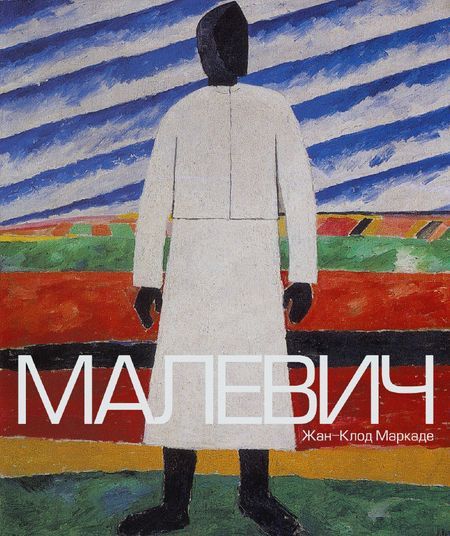
Ukrainian tragedy. He saw it. The
black face of a peasant woman in his painting
is a coffin. He embodied the Ukrainian tragedy
in such image of the tragedy of the entire
mankind. That’s what makes Malevich so
different from others – he cried through
his silent art.”
Could you tell us what is the attitude of French
people to Ukrainian art these days?
“I’d have to disappoint you, they have no
distinct attitude, unfortunately. There is,
of course, a small group of people who are
interested in it. But in general,
even the same exhibition at the Louvre was
covered by journalists as the ‘Holy Russia.’
Even though it was rather a historical exhibition
than artistic – it featured all the stages of the
Kyivan Rus’ development until the time of
Peter I. It’s goal was to show the formation of
Russia. And it all was presented
in such a way that all the nice and interesting
exhibits were viewed as Russian. I, of course,
wrote a big article regarding this. But if we
would take, for example, the reaction to the
exhibition of Pinzel’s art in Paris – it didn’t
cause much interest among the audience.
The exposition was done not on a large scale,
but as if imitating the scale of the
Holy Rus’ exhibition. Ukrainians were delighted,
in particular the Minister of Culture. I love
Ukrainian art a lot and that’s why I think that the
exhibition was held not on an adequate level –
the exhibits were displayed in the space where
they did not ‘breathe.’ It would be better if it had
been presented in the Louvre, in the chapel with
access through the maze and the stairs. Exhibitions
are important events, but they end at some point.
It’s good that a catalogue was published after
this one. So far, unfortunately, the Ukrainian art
has not been recognized separately.
Even though I wrote a large book about the
Russian avant-garde, I singled out the Ukrainian
school there as a separate formation.”
What distinguishing features does it have?
“It’s an entire complex. In short, first, it’s the
color. Solar illumination. And this is a striking
feature of those who lived in Ukraine. It
manifests itself in a range of colors in nature,
in people’s clothing. For example, Sonia
Delaunay, who left Ukraine
at the age of seven, had very warm memories
of her homeland due to the fact that at that
time it was more beneficial to be called
Russian. The color of wheat, sunflowers,
watermelons, tomatoes, which she
remembered as a child, embodied in her
work and in this way she affected her
husband. Another example is
Mykhailo Larionov, who lived in Bessarabia
and his mother was Ukrainian. His yellow
is sunny and cheerful. And his life-long friend
(they got married in their latter days, but
everyone considered them to be a husband
and wife anyway) Natalia Honcharova used
a somewhat different color –reddish yellow,
rather iconic, but not natural – she is Russian
by origin. Another artist who used
amazing colors was Oleksandr Archipenko.
“Second, it’s the space. This element of art is
especially important. The feeling of space gives
the feeling freedom. The fact that in the
consciousness of the Ukrainian people there
were Cossacks, free people, who never knew
the Tatar yoke, like the Northern people.
The Great Russians lived in forest areas. If we
would compare the Suprematism of Kazimir
Malevich and Liubov Popova, his forms
are floating in infinite space, while hers are
attached to other objects.
“Another distinguishing feature of the Ukrainian
school of art is the Baroque. This element played
its role also in avant-garde. For example, baroque
trend is noticeable in art work of Oleksandra
Ekster, Volodymyr Baranov-Rossine, and even
Oleksandr
Bohomazov.
“And, finally, it’s humor. Larionov painted
Katsapska Venera (Russian Venus). He had a
series of such Venuses with, let’s say, easy morals.
The name itself suggests humorous attitude,
even though he was not an ethnic Ukrainian,
but the Ukrainian part in his work, just like in
Vladimir Tatlin’s work, was extremely important.
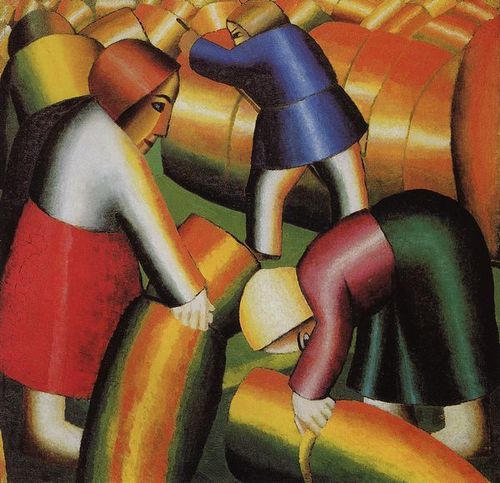
That’s why even Malevich has some humor
in his brilliant white background with red
and black squares, called
Pictoral Realism. A Boy with His Schoolbag,
exhibited in New York. It’s a great sample of art,
it is the quintessence of the iconographic range!
But he gave it such name. And in this I see the
serious Ukrainian humor. Pictorial Realism of a
Peasant Woman in Two Dimensions and
Pictorial Realism. A Boy with His Schoolbag
contain the energy of colors and in general
the whole Slavic mainland.”