Catégorie : Malévitch

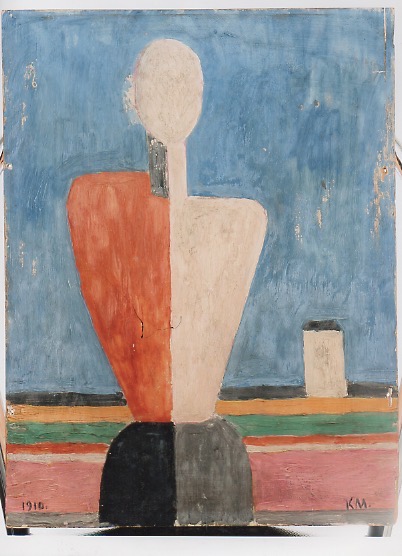
  • « Torse féminin N° 1 » de Malévitch :

  • « FEMALE TORSO No. 1 » BY MALEVICH IS THE IMAGE OF THE NEW SUPREMATIVE ICONICITY


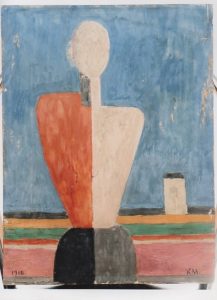
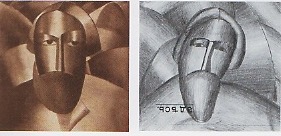
    TORSO 1


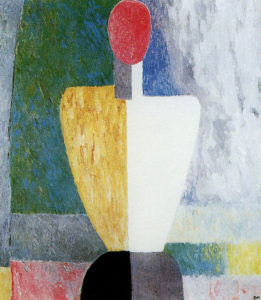
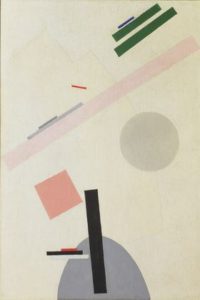
    TORSO 2


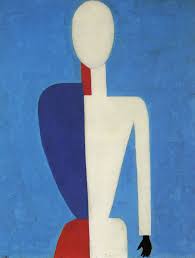
    TORSO 3


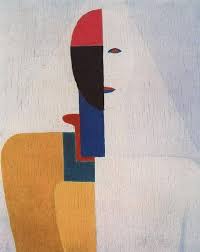
    TORSO 4


    Jean-Claude Marcadé


    « FEMALE TORSO No. 1 » BY MALEVICH IS THE IMAGE OF THE NEW SUPREMATIVE ICONICITY


    The painting “Female Torso No. 1” (oil on wood, 41 x 31 cm), which appeared in a private collection in Kyiv, brings new light to one rather mysterious series of the late 1920s, which was shown in a retrospective exhibition of Malevich in Tretyakov Gallery (Moscow) in 1929 and in the Art Gallery (Kyiv) in 1930. It is still difficult to classify the artist’s paintings after 1927. « Female Torso No. 1 » allows us to bring in some order to this important part of the paintings of the Ukrainian artist.


    BACKGROUND


    Between 1928 and 1934, the founder of Suprematism intensively returns to painting and creates more than two hundred works, the exact chronology of which cannot be established today. We only know that for a retrospective exhibition at the Tretyakov Gallery in 1929 and at the Art Gallery in 1930 in Kyiv, Malevich draws a series of impressionist paintings which he dates by the beginning of the 20th century and depicts the peasant themes of 1912-1913 in a new way, which he also antidates.

    The artist then reinterprets his early cubofuturism, leaving the old dating. He dates works made in the late 1920s by the pictorial culture that they represent, and not by the date of their drawing. Thus, “Female Torso No. 1” is dated as of 1910, and we will return again to this problem. The entire series of the works (“The Mower” at the Tretyakov Gallery, “At the Cottage”, “Van’ka Boy” at the State Russian Museum, etc.) employs again the early cubofuturistic elements in order to bring them into a structure that takes into account the achievement of Suprematism.

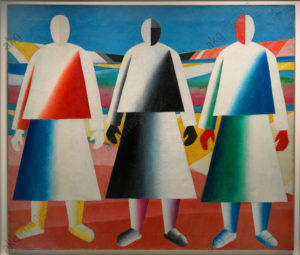
    So, this structure is built of colorful stripes for the background and simplified planes for the body of the characters (see “Girls in the field » at the State Russian Museum[1]). The invariant verticality of those characters who, like in the church icon, occupy the central space of the picture is noted. In post-suprematism, a person stands in front of a universe whose color rhythms pass through him/her. The horizon line is low. There is no real color simulation.


    THE MEANING OF ICON PAINTING


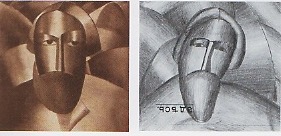
    Malevich’s return to the image after 1927 is actually a synthesis in which objectivity pierces people depicted in the position of eternity. Between 1909 and 1913, the face of the painter Ivan Klyun served as the plot of various stylistic metamorphoses, symbolist, primitivist, geometric, cubofuturistic, realistically abstruse. After 1927, it became the paradigmatic face of the peasant, adopting the basic structure of the prototypes of icon painting, in particular the Pantocrator or the Miraculous Savior[2].

    This borrowing of the basic system of some icons is not, as in Boychukism, a “juggling of centuries” [“tricherie avec les siècles”] as Apollinaire[3] puts it, but a modern application of icon painting as a “form of the highest culture of peasant art”[4]:

    « Through icon painting, I understood the emotional art of the peasants, which I loved before, but did not understand the whole meaning that was discovered after studying the icons. »[5]


    POSITION IN THIS CONTEXT OF THE PICTURE « WOMEN’S TORSO No. 1 »


    The four main elements are of great interest in this work: its iconicity, its popular primitivism, its alogism, and its energy of color.


    SUPREMATIC ICONICITY


    The painting « Female Torso No. 1 » is painted on a linden board. Its background consists of oil paint, to which animal glue and chalk are mixed. Linden wood is one of the noble materials used by icon painters in Russia and in the Balkans; glue and chalk are an integral part of gesso, with which artists cover the board before they integrate the drawing into the plot. This drawing is called the sketch, it draws the outline of the plot before applying paints.

    In the painting « Female Torso No. 1 », it is clear that Malevich returns to the principle of the icon-picture, which he initiated in the early 1910s, but here he applies a new structure. Of course, Malevich is not an icon painter, he is a painter who wanted to give the easel picture the same structural and metaphysical setting as the church icon in order to develop a new image of the universe. In this, we repeat, it differs from the Byzantine Boychukist school, which strove to garment modern reality in the forms of traditional icon painting.

    On the formal side, you can consider « Female Torso No. 1 » as a suprematization of the icon. He is the prototype of a series of paintings and drawings between 1928 and 1932.

    The works that immediately followed this prototype are known: the canvas “Torso. The First Formation of a New Image 1928-1929” in the Tretyakov Gallery, on the back of which is written by Malevich’s hand: “No. 3 The First Formation of a New Image. The Problem is Color and Form and Content,”[6]

    TORSO 3

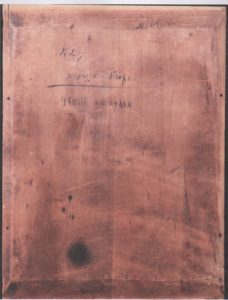
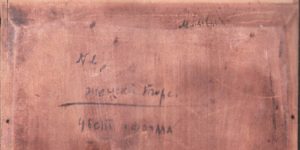
     and on the back of our painting « Female Torso No. 1 », Malevich wrote: « No. 1 Female Torso color and shape« 

    ; another « Female Torso 1928-1929 » is also known, which is also in the State Russian Museum, oil on plywood, on the back of which the artist writes with his own hand: « No. 4 female torso – Development of the 1918 motive.”

    TORSO 4

    My hypothesis is that another canvas of the same late 1920s, located in the State Russian Museum, which has an identical structure as our « Female Torso No. 1 », namely, « Torso (figure with a pink face) 1928-1929 »[8]

    TORSO 2

    is actually number 2 which immediately follows number 1 (our « Female Torso ») and precedes number 3.

    That is, Malevich used « Female Torso No. 1 » as a prototype from which he created variations in the likeness of a composite of paints and shapes. This hypothesis seems to me confirmed by the presence of two holes on both sides of the board, indicating that it was nailed to serve as a model for further work.

    Let us go back to the “Female Torso No. 4”

    TORSO 4

    , since here we are talking about a new step in developing the “new image”: the female face has an eye and a mouth, but also without the slightest realism (for example, there is no direct image of the nose); the suprematic iconic timeless character of the image is fully marked.


    DATING


    We find, as in our painting « Female Torso No. 1 », dating of 1910 in the works which, most likely, follow from this prototype. To understand what the Ukrainian artist is implying, one should recall his letter to L. M. Lisitzky dated February 11, 1925, at the time when he was attacked by the adherents of Marxism-Leninism and he was accused of idealism and mysticism. He not only does not give up his thoughts, but also reinforces them with his highly metaphorical-metonymic style, Gogol’s biting humor. Speaking about his heads of the « Orthodox peasants » of the early 1910s, he announces:

    “It turned out, I painted the ordinary head of a peasant that it is unusual, and really if you look from the point of view of the East, then it’s everything that is ordinary for Westerners, then for people of the East it becomes unusual, everything ordinary turns to the Icon, for the East is iconic and it is, and the West is a machine, an object, a toilet, utilitarianism, technology, and here is a plant and factories, this is a new hell from which People will be freed through a new image, that is, through a new Savior. I painted this Savior in 1909-1910, he became a savior through the Revolution, the Revolution is only a banner, the thesis through which he became a synthesis, that is, the « New Savior » […]

    I did not go « past the Revolution » – on the contrary, I foresaw its synthesis back in 1909-1910 in the New Savior. And this is now becoming the main thing. The Tatlin Tower is a fiction of Western technology, he will now send it to the Paris exhibition, and of course he can also build a reinforced concrete urinal so that everyone can find a corner. It’s so clear to me that without a lamp I can write (paint) about the West and the East. « [9]

    So it is natural that Malevich, when he returns to easel painting and seeks to convey “in color and form”, as it is written in our “Female Torso No. 1”, a new image-icon of a man and the world, continues his poetics of the beginning of 1910 when the image of the peasant (not in the sociological sense of the word, but in the sense of a man in the lap of nature) is revealed in the prism of the image of the Orthodox.

    THE ORTHODOX, 1912


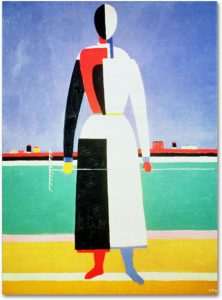
    In this section, we find the same iconic features in the late 1920s in the painting « Suprematism in the contour of a peasant woman » [« Woman with a rake« ] from the Tretyakov Gallery

    or in « Girls in the field

    Kazimir Malevic, Ragazze in un campo, 1929, Museo di Stato Russo, San Pietroburgo

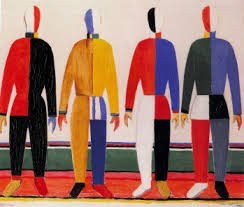
     and “Suprematism in the contour of athletes » from the State Russian Museum[10],

    which are in the spirit of our « Female Torso No. 1 », which affirms the purely pictorial framework of the artist.

    Malevich could say that he does not portray the faces of many of his characters because he does not see the person of the future, or most likely because the future is an unknown mystery.

    Christological references are present in many images of post-Suprematist creativity, often they are camouflaged.

    Among the impulses that could lead the artist to these “faceless faces”, there is the Roman Catholic practice of worship (adoratio) before the wafer (guest) in a monstranza (ostensorium).


    Despite the fact that Kazimir Severinovich, being baptized according to the Roman Catholic rite, was not a churchman, he in all probability visited churches in childhood and in his youth. In addition, we know from correspondence with M.O. Gershenzon in 1920 from Vitebsk that he « returned or entered the religious world »:

    “I don’t know why this happened, I go to churches, look at the saints and the whole spiritual world”[11]

    Could the artist, among the impulses from the “Religious World”, receive an impulse from worship in front of a guest who is in the hole of the Catholic Ostensarium. And there is « presence-absence. »

    The ostensarium well is round or sickle-shaped. Just « faceless faces » have a lunar contour. The monstrance’s hole was traditionally surrounded by bronze, silver or gold artwork, often depicting the sun. But she could have been without this ornament. Namely Malevich wants to leave the Solar World, leaving only a contemplation of the Pure action.

    It should be noted that Malevich refers to the adoration of the Blessed Sacrament in the Catholic Church in his astonishing text on Lenin « Extract from the book on the Objectlessness » (1924):

    « Lenin was buried in a glass coffin for no other reason except that he should be seen as a Blessed Sacrament.This forecast that I wrote has really come true. When I wrote it I did not know about the idea of the glass slit. I had considered the idea of the glass coffin supposing that a man who has been sanctified is a Blessed Sacrament, and the degree of his holiness corresponds to the holy sacrament in the Catholic world in which the Sacrament is put under glass.”( Malevich III, The world as Non-Objectivity. Unpublished writings, 1922-25. (ed. Troels Andersen),Borgen, 1976, p. 315-36)


    PRIMITIVISM


    Malevich calls in this era for exposure, not for wild accumulation. This return to primary rhythms, to the minimalism of figurative expression, also deals with the poetics of folk art, which seeks visual efficiency with the help of sketchy drawings. Dmytro Gorbachov showed how these Malevich’s « faceless faces » resemble rag dolls created in the peasant Ukrainian world. It is interesting to note that since July 1930, two paintings of the peasant cycle were among the exhibits of the exhibition « Sowjetmalerei » (Soviet painting) in Berlin. They were dated 1913 and 1915! The critic Adolf Donat describes them as figurative paintings depicting characters resembling tight and faceless dolls in front of flat landscapes. He adds:

    « That ‘colossus’ is visible, in which a person is displaced simultaneously in the arts and around them. »[12]


    In the same way, the colored stripes that have the figure of the “Female Torso No. 1” next to them, are a kind of picturesque echo of those polychrome stripes on the aprons of the Ukrainian peasant women, like many handmade towels and carpets, especially in Polesie, where the Malevich’s family comes from. The artist even used these stripes in a lot of post-suprematic paintings and even they make up objectless (pointless) canvas painting of 1932 from the State Russian Museum[13]. These polychrome abstract stripes refer to aerial vision of the fields. This is the last statement of outer space, which protrudes through the contours of man and nature. Suprematism blew up any visible realistic outline, while post-Suprematism restores the visible outline of things, while preserving the demands of « peace as pointlessness. »

    The theme of the windowless house also appears before Malevich’s prison and interrogations at the GPU from late September to early December 1930. Here, it seems, the matter is about a simplified minimalist primitivistic arrangement, almost graffiti, of the painter’s architectural thought, his “architectons” with its so complex form; like the character of « Female Torso No. 1 », with whom he adjoins, this house is another mystery of what will be the dwelling of a human being in the future. All houses depicted or painted in 1928-1930 have the same white color of Ukrainian huts. After 1930, this primitive house will become the emblem of a prison symbolized by the Red House from the State Russian Museum[14], in which a man of a totalitarian society is already imprisoned and where red expresses the suffering to which the prisoner is subjected.

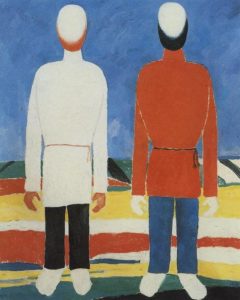
    In the same way, after being subjected to the interrogations by the KGB and spending time in prison, Malevich’s faceless characters become more and more representatives of suffering humanity; they seem to be connected, ugly. Nevertheless, the artist continues to adhere in parallel to the task that he expressed in « Women’s Torso No. 1, » namely, the further development of the purely pictorial problem of « color and form. » In this regard, he wrote on the back of the canvas of the 1930s « Two male figures » from the State Russian Museum:

    « An engineer uses one or another material to express his purpose, the artist painter takes one form or another of nature to express color sensations. K. Malevich 1913 Kuntsevo. »[15]


    It’s funny that Malevich tried to write his text using pre-revolutionary spelling, supplying the endings in the consonants with a solid sign! Of course, he gives, as usual in these cases, not the date the drawing was painted, but the initial date when this purely formal task was conceptually conceived.

    ALOGISM


    The character of the “new image” in the form in which it is found in “Female Torso No. 1” is very peculiar: in it, at the same time, the woman is represented facing us and facing the universe. It seems that the right white part (face and torso) appears to us full-face, while the left red-black side, which is raised, gives the impression that the character turned to us backwards and looks at the world.

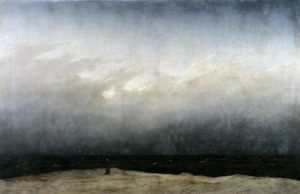
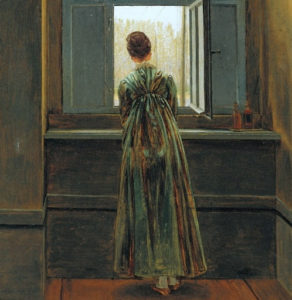
    Another element, whether conscious or not for the artist, which may attract our curiosity, is an echo of the famous painting by Caspar David Friedrich, “The Monk by the Sea”, (1808-1810) from the Berlin National Gallery

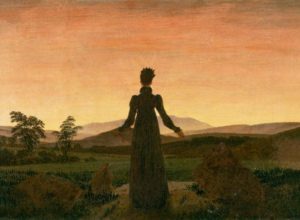
    This would mean that here the iconicity of Malevich’s work is coupled with the reference to the world art. Others paintings by Friedrich are even closer to « Female Torso No. 1 » : « A Woman Before the Sunset » from the Folkwang Museum in Essen

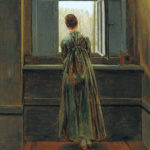
    or “Woman at a Window”

    Une jeune femme se penche a la fenetre de l’atelier de Friedrich. C’est Caroline, l’epouse du peintre. Tournant le dos au spectateur, elle regarde couler l’Elbe. Les seuls signes de vie sont la femme, le vert delicat des peupliers, et le ciel de printemps. Dans ce travail, Friedrich a adopte un theme de predilection du romantisme, le cadre evoque un desir de l’inconnu. Le regard vers l’exterieur, contemplation de la nature, retour vers l’interieur de soi centre spirituel de l’individu.

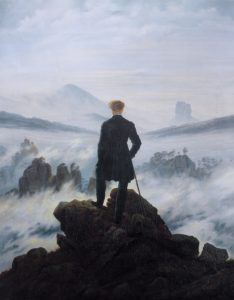
    See also “Traveler in Front of a Sea of Fog” from Kunsthalle in Hamburg.

    The artist saw without a doubt the art of Friedrich when he was in Berlin in April-May 1927[16].

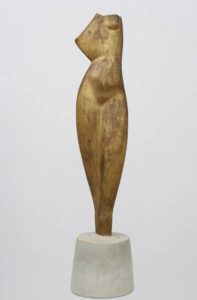
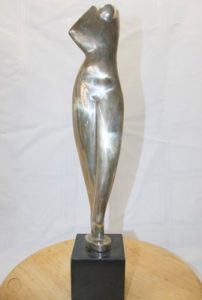
    The alogism of the character’s representation in “Female Torso No. 1” can be found too in all three other paintings of this cycle: “Torso (Figure with a pink face) <No. 2>”, “Torso (Primary formation of a new image) No. 3” and “Female torso No. 4  » We observe in all these paintings  the same raised left shoulder, which turns its  back on us. There is no depiction of hands that could be interpreted as a kind of disfigurement, as it  will happen in the paintinge  after 1930. In fact, one can imagine that the arms are crossed with a cross or tucked in the back or in the front. Moreover « Torso N° 3,(Primary formation of a new image), has one arm turned towards us and we can assume that on the left side which turned its back on us, the arm is folded down. And, moreover, it seems that Malevich wanted to dialogue, creating a new form, with the torsos of his compatriot Archipenko who, from 1914, created a whole series of truncated, armless female forms.


    In No. 4 we note an even stronger alogism: on the left side we see the overlapping on the “shoulder” of elements that can indicate suprematist clothing with a collar. The contrast with the right-hand side turned towards us is very strong due to the bright presence of a white square on it on the shoulder, which is marked by a slight bend, while the beginning of the arm is represented.

    The white veil surrounding the woman gives her the character of a Bride. Recall an article-poem in the Moscow newspaper Anarchy on June 12, 1918, “Engaged in a Horizon Ring,” which describes artists of all arts as lovers of the earth who seek its “hidden beauty”:[17]

    « Beauty seekers walked across the face of the earth, among the rings of the horizon. »[18]

    The earth appears as a « rich bride, »[19] to which « lovers engaged in a horizon ring aspire”[20].

    COLOUR


    Another significant element identified in the prototype of « Female Torso No. 1 » is a matter of color. Striking in post-suprematist paintings is its generally bright polychrome. The « imaginary geometry » of suprematic forms corresponds to what might be called the « imaginary colors », to the extent that the artist refutes the use in his painting of all scientific optical studies of the color prism. Already in 1913, the idea that the sun illuminates only the illusory world was approved in the cubic futuristic opera by M. Matyushina based on A.E. libretto Kruchenykh “Victory over the Sun”, in which the “black square” appears for the first time in Malevich’s sketch for “The Grave Digger”. From the 1919-1920s in Vitebsk, the artist reinforces the idea that color does not come from a light prism and that he determines the place of color in his letter to M.O. Gershenzon of April 11, 1920:

    « For many years I was busy with my movement in colors, leaving aside the religion of the spirit. »[21]

    He further, in the texts of the 1920s devoted to the question of “light and color,” invariably confirms that the pictorial color has nothing to do with prisms that optical science disassembles and analyzes.[22]

    Note what Malevich declares about this during his teaching at the Kyiv Art Institute in 1928-1929, i.e. at the time when « Female Torso No. 1 » was written; refuting the idea that a painter must resort to scientific research on color, such as, for example, Ostwald (you can add Chevreul and Helmholtz there), he writes:

    “We still think that the architectural forms follow from one “-ism”, and the color and texture follow from the discussion of the general meeting of all representatives of different institutions, who collectively select the color for this building on the walls of the built house. In another case if the builders want to bring the scientific base to color, turn to Ostwald or the nearest optical physical study room for studying color.

    It’s all the same if Picasso, Braque, having drawn the forms of the painting, would have turned to Ostwald to have them painted according to all the rules of science, or if a society of artists, engineers, bakers, representatives from all unions would gather together to discuss the coloring of the painted form of a picture. »[23]

    The painter affirms Suprematism even after 1930 in his work, already marked by the tragedy of the Holodomor (Great Hunger in Ukraine). He then wrote about “the development of color and its extinction from the dependence of dynamic stresses”[24]. He then intends to write a treatise on the “Sociology of Color,” which he cannot realize until death. It can be assumed that the word « sociology » did not have for the painter the meaning that Marx and his Marxist-Leninist followers gave to it …

    Multicolor stripes depicting a Suprematist landscape are painted in our painting “Female Torso No. 1” in a rough, rigid manner, which is typical of many other Malevich’s last paintings.

    The whole background of « Female Torso No. 1 » is also colored with a primitive brutal opaque way like the Matisse palette, for example, in the famous « Dance », or in M.F. Larionov around 1910… One could say about the “Female Torso No. 1” what was written about the “rude” application of paint by Matisse as a “wild pulsation ascending to the archaic, to primitive stains.”[25]

    The same brush stroke power is found in the image of the head, where a white rough brushstroke is full of energy flutter. We find the same texture in a white hut. White paint is of particular importance in the poetics of Malevich, based on his attitude towards the world. In his above-mentioned letter to M.O.  Gershenzon, he writes:

    « I also see the New Temple, I divide black, white, and other colors into three actions – in the white I see the Pure action of the World, the colors are something pointless, but the conclusion of the Solar world and its religions. »[26]

    Just in the “Female Torso No. 1” we see that three colors – gray, black, red – are opposed to the white figures and the house on its right side.

    In the same way, as in many post-Suprematist portraits, from the face of the “Female Torso No. 1” comes an element that gives an additional metaphysical dimension, metaphysical in the etymological sense of the term, that is, behind the physical world. The Ukrainian artist several times surrounded with a kind of « halo » the faces of the depicted characters; then it’s a fiery red radiance, then the hair of some characters seems to be moved by the breeze, then it’s a white cover in “Female Torso No. 4… What we see on the left side of the face of “Female Torso No. 1 could be considered as  » leaking « or damage to the picture, « a scratch ». It seems to me, in fact, that the matter is about the outline of the radiation emanating from this new image.

     CONCLUSION

    The painting « Female Torso No. 1 », which we consider in this article, is obviously the prototype of a whole group of works from 1928-1929, when the Ukrainian painter continues to research, through a sense of a objectless (pointless) world, the possibility of introducing a new image of a person in the bosom of the « Earth Bride ». It is a question of a new embodiment of Suprematism in icon contours.

    « Female Torso No. 1 » allows us to reorganize suprematist creativity, which is still described in a chaotic approximate order, often just on a thematic basis.

    First of all, it is necessary to distinguish works created before 1930, the category of which includes « Female Torso No. 1 ».

    All those things that have this icon structure, either with or without a face, form a coherent unity. In this period, between 1928 and 1930, when Malevich was immersed in the Ukrainian world, his work was marked by a vision reflecting the coming world to be rather optimistic, although mysterious, in any case, as a promise of possible happiness. « Female Torso No. 1 » just opens a series of this type.

    Although such a picture as “The Carpenter”, shown at the Kyiv exhibition in 1930, contains camouflaged disturbing elements (the Christ Artist holds a Passion’s tool in his hands)[27].

    It is obvious, however, that the famous « Peasant Woman » with a black face[28], in which a black coffin is in place of the face, cannot be attributed to the period before 1930. It marks the beginning of the tragic vision of the suffering people and society. The painting « Peasants »[29] from the State Russian Museum is also, apparently, painted after 1930. After spending time in the prison and experiencing interrogations, Malevich starts drawing faceless and mutilated people. The themes of the crucifix, coffin, and cross become insistent. The white hut becomes the menacing red emblem of the prison. Red is no longer the color of the « Beautiful » as in « Red Square. The Peasant Woman » of 1915, but the color of blood.

    So, “Female Torso No. 1” makes it possible to reinterpret Malevich post-Suprematist creativity; it also allows us to understand at its source the synthesis that the Ukrainian painter wanted to realize between Suprematism, primitivism, icon, alogism, and colorful energy. This synthesis is unique and completely original among the European art of the late 1920s-early 1930s.

    June-July 2018

    [traduit du russe par Andriy Khraban]

    [1] Казимир Малевич в Русском музее, Санкт-Петербург, Palace Editions, 2000 (под ред. Е.Н. Петровой et alii), № 42, с. 337 / Kazimir Malevich in the Russian Museum, St. Petersburg, Palace Editions, 2000 (edited by E.N. Petrova et al), No. 42, p. 337

    [2] См. Валентина Маркаде, “Селянська тематика в творчості Казимира Севериновича Малевича” (“Сучасність”, лют. 1979, с. 65-76) / See Valentine Marcadé, “Te Peasant Themes in the Work of Kazimir Severinovich Malevich” ( Malewitsch, Cologne, Galerie Gmurzynska, 1978, p. 94-119° )

    [3] Guillaume Apollinaire, « Les Russes » [Русские], L’intransigeant, 22 avril 1911

    [4] К. Малевич, Главы из автобиографии художника [1933], в кн. « Малевич о себе. Современники о Малевиче. Письма. Документы. Воспоминания. Критик  (сост. И.А. Вакар, Т.Н. Михиенко), Москва, РА, 2004, т. 1, с. 28 / K. Malevich, Chapters from the autobiography of the artist [1933] in the book. « Malevich about himself. Contemporaries about Malevich. Letters. Documents. Memoirs. Critic (compiled by I.A. Vakar, T.N. Mikhienko), Moscow, RA, 2004, v. 1, p. 28

    [5] Ibidem

    [6] Казимир Малевич в Русском музее, цит. произв., № 36, с. 334. / Kazimir Malevich in the Russian Museum, cit. production., No. 36, p. 334.

    [7] Там же, № 38, с. 335. Начальная дата была « 1910 », она была изменена на « 1918 », что требовало бы комментария, не входящего в рамки нашегонастоящего эссе. / The first date was “1910”, it later was changed to “1918”, which would require a comment that is not part of our present essay.

    [8] Там же / Ibidem, № 37, с. 335

    [9] К.С. Малевич, Письмо к Л.М. Лисицкому от 11 февраля 1925, в кн. Малевич о себе. Современники о Малевиче. Письма. Документы. Воспоминания. Критика, цит. произв., т. 1, с. 171 / K.S. Malevich, Letter to L.M. Lissitzky February 11, 1925, in the book. Malevich about himself. Contemporaries about Malevich. Letters. Documents. Memories. Criticism, cit. production., t. 1, p. 171

    [10] [10] Казимир Малевич в Русском музее, цит. произв., № 42, с. 337 и № 68, с. 352 / Kazimir Malevich in the Russian Museum, cit. production., No. 42, p. 337 and No. 68, p. 352

    [11] К.С. Малевич, Письмо к М.О. Гершензону от 11 апреля 1920 года, в кн. Малевич о себе. Современники о Малевиче. Письма. Документы. Воспоминания. Критика, цит. произв., т. 1, с. 127 / K.S. Malevich, Letter to M.O. Gershenzon of April 11, 1920, in the book. Malevich about himself. Contemporaries about Malevich. Letters. Documents. Memories. Criticism, cit. production., t. 1, p. 127.

    [12] Цитирую по Joop M. Joosten’у в каталоге Malevich . 1875 [sic]-1935, Los Angeles, The Armand Hammer Museum of Art, 1990, c. 19 / I quote from Joop M. Joosten in the Malevich catalog. 1875 [sic] -1935, Los Angeles, The Armand Hammer Museum of Art, 1990, p. 19.

    [13] Казимир Малевич в Русском музее, цит. произв., № 70, с. 353 / Kazimir Malevich in the Russian Museum, cit. production., No. 70, p. 353

    [14] Там же / Ibidem, № 85, с. 358

    [15] Там же / Ibidem, № 74, с. 354

    [16] Thank the Berlin sociologists Anabella Weismann and Gerd Otto, who led me to such an interpretation of « Female Torso No. 1 ».

    [17] Казимир Малевич, Собрание сочинений в пяти томах, Москва, « Гилея », т. 1, 1995, с. 115 / Kazimir Malevich, Collected Works in Five Volumes, Moscow, Gilea, vol. 1, 1995, p. 115

    [18] Там же / Ibidem.

    [19] Там же / Ibidem, с. 116

    [20] Там же / Ibidem, с. 115

    [21] К.С. Малевич, Письмо к М.О. Гершензону от 11 апреля 1920 года, цит. произв., с. 127 /    K.S. Malevich, Letter to M.O. Gershenzon of April 11, 1920, cit. production., p. 127

    [22] К.С. Малевич, Письмо к М.О. Гершензону от 11 апреля 1920 года, цит. произв., с. 127 / K.S. Malevich, Letter to M.O. Gershenzon of April 11, 1920, cit. production., p. 127

    [23] К.С.  Малевич, « Архитектура, станковая живопись, скульптура » [1929], в кн. Казимир Малевич. Київський період 1928-1930 (сост. Тетьяна Филевська), Київ, Родовід, 2016, с. 127 / K.S. Malevich, « Architecture, easel painting, sculpture » [1929], in the book. Kazimir Malevich. Kiev period 1928-1930 (comp. Tetyana Filevska), Kyiv, Rodovid, 2016, p. 127

    [24] К.С. Малевич, Письмо к Л.М. Антокольскому от 15 июня 1931 года, в кн., Малевич о себе. Современники о Малевиче. Письма. Документы. Воспоминания. Критика, цит. произв., т. 1, с. 227 /  K.S. Malevich, Letter to L.M. Antokolsky from June 15, 1931, in the book. Malevich about himself. Contemporaries about Malevich. Letters. Documents. Memories. Criticism, cit. production., t. 1, p. 227

    [25] Isabelle Monod-Fontaine, « Grandeur Obtained by the Simplest means« ,  в каталоге Keys to a Passion (сост. Suzanne Pagé, Béatrice Parent). Paris, Fondation Louis Vuitton, 2015, p. 162

    [26] К.С. Малевич, Письмо к М.О. Гершензону от 11 апреля 1920 года, цит. произв., с. 128 / K.S. Malevich, Letter to M.O. Gershenzon of April 11, 1920, cit. production., p. 128

    [27] Казимир Малевич в Русском музее, цит. произв., № 34, с. 334 / Kazimir Malevich in the Russian Museum, cit. production., No. 34, p. 334

    [28] Там же / Ibidem., № 72, с. 353

    [29] Там же / Ibidem., № 21, с. 326

  • DUBOVYK OR PAINTING IN METAPHYSICO-POETIC ACTION


    DUBOVYK OR PAINTING IN METAPHYSICO-POETIC ACTION

    The opulent pictorial work of Alexander Dubovyk has experienced a first wide recognition from the 1990s, which saw the fall of U.S.S.R as well as the independence of Ukraine. However, his creative work had begun to manifest itself in an original way as early as the 1960s, in other words after a certain « thaw » that followed Stalin’s death in 1953, and it has become fully original over the 1970s and 1980s, bearing the unmistakable signature of the Ukrainian artist : constructed spaces, enigmatic subjects, fully idiolectic polychromy.

    Facing the socialist realism then dominating in the 1950s and 1960s and not brooking any « formalistic » deviation, Dubovyk build/t, in a total creative freedom, a world of unprecedented richness.

    His work coincides with what we call, badly in my opinion, « postmodernism ». In reality, it is a new modernity, heir of a whole series of avant-gardist movements since the start of the 20th century where are conceptually dominating the Abstraction (lyrical, neoplastic, objectless) and picturologicly, the freeing of colour (impressionism, fauvism), the geometrizing construction (cubism, purism, constructivism), the freeing of the line (Art Nouveau, primitivism), the surreal (Malevichians alogism and supronaturalism). Thus, the artist of the second half of the 20th century stands on a legacy. And the new movements, like Action Painting, Minimal Art, informal art, art brut, conceptual art, Arte Povera and performances only push some partial elements of this and that movement to their maximum consequences, kind of like religious sects that favour some parts of the Scriptures whom they inflate the importance of, and erect them as new dogma…

    Dubovyk too is an heir and fully assume this situation, not

    seeking, according to the Freudian euro-centrist approaches, to « kill the father ». He doesn’t belong to any group1 and will take what appears essential to his « inside necessity » and will rebuild it, as Malevich had invited the innovators to do in the 1920s, notably at the Kiev Art Institute in 1928-19302. The whole work of Malevich is, indeed, grounded on this reconstructor poietic principle. It is not about imitate models but to extract, from chosen existing formal structures and coloristic specificities, new quintessences matching personal Kunstwollen of the artist. It is not by accident that Dubovyk has dedicated an incredibly penetrating text to the « Palimpsest ». He speaks of life as a constructive game there, quoting the παιδεία (paideia), the children education, in Book VII (803c) of Plato’s Laws3. Hence, Dubovyk’s interest on palimpsest that allow playing with various layers of objects and facts of life. Moreover, the Ukrainian artist add a confucian cosmic dimension to the Platonic ludism, quoting a saying from Confucius in which he sees the « Palimpsest of mind » : « A man is not measured from his feet to his head but from his head to the skies ».4

    1960s

    Canvases of the 1950s and 1960s, yet still figurative, challenge socialist-realist codes which were the official standards in U.S.S.R then. These paintings have already

    1 To justify not belonging to a group, Doubovyk quotes the words of the Gascon d’Artagnan in The Three Musketeers (chapter XI), when Cardinal Richelieu tries to get him to leave the King’s musketeers to join his own guards : « I should, therefore, be ill received here and ill regarded there if I accepted what Monseigneur offers me. »

    2 Cf. Kazymyr Malévytch i Kyïevs’kyï Aspekt/Kazimir Malevich, Kyïv 2019 Aspect (ed. Tétyana Filevska), Kiev, Rodovid, 2019
    3 Doubovyk, « Palimpsest [Le Palimpseste] », in Doubovyk, Kyïv, 2005, p. 123
    4 Ibidem, p. 220

    page2image25512000

    structures and motives that were to be found in the non- figurative creation of the artist from the 1970s onwards.

    Among the self-portraits from the 1950s, the one from 1953 is admittedly realist, but its black near-monochomy with the single light spot, mixing tenebrism and luminism, has mysterious Caravaggesque accents. As for the Self-portrait from 1958 (painter is 27 then), it is a nod to modern style, like a dream emanating from his brain : we notice the silhouette of a famous painting from Nesterov depicting Olga, the artist’s daughter. The 1968 Self-portrait, therefore ten years later, surrounded by a bloom saturating the background of the canvas, already refers to the primitivist-fauvist manner of the Jack of diamonds, in a Machkov style. The Ukrainian artist is still “learning” from the great ancients but does not copy them, yet already his specificity and his originality are manifesting determinedly.

    The format for the compositions of this period is fairly large. From the very beginning, Dubovyk’s creation has had a sense and concern for space, which has been a constant throughout his production up to present day. This space is built. During this research period, from the late 1950s to the 60s, even if one still feels hesitation on his choice of references, the Ukrainian painter already shows a strong personnality as can be seen in an already highly constructed painting like The Atom(ist)-physicists (1963), or The Operation (1965), Picket(line) (1966), Wernigerode (1968 and 1970), or even paintings matching the softness of the lines, more geometric planes and a primitivist decorative lighness – Portrait of My Brother, Dawn (1962), Doll (1965), Amsterdam (1970) ; it is also characteristic of his northern landscapes that reveal a colouristic affinity with the best Finnish painting : Lake Ladoga (1953), Karelia (1958), Landscape (1968). It is also combining with an original cosmicity of the forms in works such as Eucumene (1963), Remote Islands (1969), Lake Ladoga

    (1967), Tranquillity (1970). Those primitivist decorativism elements are especially present in Portrait of Mr. Jouravel (1966), The Girl With the Hoop or the exquisite Portrait of Irina.

    FROM POETIC REALISM TO POLYCHROMIC CONSTRUCTIONS.

    From the 1970s onwards, we already see Dubovyk’s affirmation of his exceptional individuality. Every element of the subsequent fifty years of work are already there.

    What Dubovyk keep from constructed art, is the abstract transformation of historical cubism, in other words, abstract geometrization of pictorial elements, for instance in House/Home (1975). Beside, the treatment of colour, the triumphant polychromy of dubovykian art is in line with the malevichian suprématism legacy as well as Ukrainian popular art. Malevich is often quoted in the writings of the painter and in many works of Dubovyk we assist to a dialogue with the author of the “Squares” (see, for instance, Metamorphosis (1989, G-383-5-400 ; 199O, G-384-5-401,1991, G-385-5-402 et G-385-5-403) where quadrangular forms are opening on new formal and coloured worlds as in Black square, 1980). Here we have therefore a new poiesis that take hold on the achievements of the recent past to create his own system.

    In such works as Water Clock (1977), Harmony (1975), the series of paintings called “Signs” (end of 1970s), Eternity (1978), Organ (1979), Ark/Arch (1978), Nirvana (1989), Memory from Poitiers (1992), or the Wall paintings of Notre- Dame des Anges in Berre-les-Alpes (1996), space is built like an architecture.

    Verticality gives a monumental aspect to those pictures tell timelessness. It is no coincidence that his first monograph of 2005 start by a paper entitled “Space chronicle” :

    “Space determines the place for a certain whole – in the

    cosmic diversity where the fifth dimension is realised – eternity.”5

    Verticality, it is life, a flight through the cosmos, as we can admire from the early 1990s in the Triumphant series (one of the finest example is the Triumphant from 1991 which been the subject for a stamp from Ukraine’s national Post in 2019). It is the beings and the things in the heart of universal infinite. We do find an instance of those elements in the Flight in Space painting from 1976.

    We also notice, from the very first works of 1970, in which verticality is dominating, that it is framed on large rectangular stripes horizontally rythming the quadrangle of the canvas, like an abstract metaphor of earth and sky, sea and sky. Thus, gouaches from the « Great Council » series (1992, G-082, G- 085), Birthday (1993, J-020), Space (1994), Meditation (1996).

    This has been especially developed in the western painting after World war two. Probably reinterpreting many landscapes from the Dutch golden age, even from the German romantic painter Caspar David Friedrich, arranging the pictorial plane in two segments meaning earth and sky, or yet in the horizontal stripes in the « supronaturalism » of Malevitch from the late 1920s and early 1930s, western artists of the first half of the 20th century have carried on this wide stripes’ abtractisation. Nicolas de Staël made masterly use of this process, like Rothko for whom this double-triple segmentation of the pictorial surface will peak in the grey-black duplication in the last paintings of 1969. Space (1993) a painting from Dubovyk is paradigmatic of such poiesis : the earth and sky separation is dominated, on the superior stripe, by a circle which is like a metonymy of the solar system of the Universe such as men can perceive it. The painter himself gave mystic and spiritual clues of this balance he achieves between

    page5image25516608

    5 Doubovyk, op.cit., p. 8

    horizontality and verticality6, embodied in the mystic and spiritual world differently than Mondrian who operate by minimalist semiologic equivalents of reality, whereas Dubovyk’s poiesis use an abstract vocabulary to tell the world in its complexity.

    Note here, with regard to the dubovykian spatial conception, predilection for square canvases, yet another connivance clue to Malevich. The square is an opening window on life, it is a metonymical microcosm of the universal macrocosm.

    In addition to the constructivo-suprematist elements, a fascination for the surreal was added from the outset, although the artist never allows himself to be lured into European Freudian interpretations. A painting like Water Clock from 1977 is a mythification of the ancient clock that was measuring time by water flowing into its apparatus. Dubovyk makes a mysterious passage of it, almost iconic, with the reverse perspective of the temple where water appears, while a tremendous red arrow aim two small clouds and an ornamental banner in a deployment move. It could be a nod to the best of Magritte to whom the Ukrainian painter reveal an affinity, with his appetite for high philosophy and magical thoughts. Dialogue with Magritte is striking in a painting like Trapeza (2001), but the Ukrainian painter remains faithful to a strictly architectonic structure. If, obviously, Dubovyk is not « ideologically » close to European surrealism, as we will say it further, we notice formal correlations with what is best in this movement : beside Magritte, it is with Max Ernst that the Ukrainian painter confront himself in many works from the 1990s : gouaches from the « Great Council » series (1992, G- O77, G-078, G-080, G-083, G-086, G-087, G-088), Meditation (J- 023), Triumphant (1995) are masses that are both surface and depth, in « the border area of the inside and the outside

    page6image25516992

    6 Doubovyk, « Horyzontal’ – Vertykal’ », in Doubovyk, op.cit. , p. 195-198

    worlds »

    7. Paintings like the Dual (2000-2010) diptych sees masses initiating dancing motion in efflorescences.

    TOTEMS AND PICTORIAL FLORALIES/FLOWERING

    Another poietic vector manifested itself in Dubovyk from the 1970s onwards, namely the tendency to « totemise » the geometricised formal elements. This is particularly evident, for example, in the Mirage canvas (1977). In a poem from 2014, the painter says :

    « With renewed delight
    A mirage in a desert arises. »8

    In Mirage or Tablets (1977) the abstract motif of a rounded shape appears, forming a single pictogram with a short column. It resembles a face without a face, much like that of Malevich’s enigmatic characters around 1930. In fact, we see throughout his later creation that this pictogram became for the Ukrainian artist his trademark, his « mascot », having a polysemic value, which he would sum up in the idea of a bouquet, this Bouquet, which he had named a painting of 1965. Sometimes stylized, sometimes flamboyant (Carnival, 1987, Carnival, 1991, Birthday, 1993, D-021), receptacle of a whole world (Holland, 1971), he ended up with this abstract sign, which, alongside concentric circles and squares (Tablets, 1977, Holidays/Parties, 1979), are essential elements of the painter’s formal vocabulary. We know that roses have thorns and that life is not without thorns: perhaps this is what the beautiful painting Thorns Bouquet (2005) tells us.

    In his writings, Dubovyk rejects several trends of modernity. In 2011, he criticizes contemporary art for having

    7 Max Ernst, « Qu’est-ce que le surréalisme ? » in catalogue Max Ernst, Saint-Paul, Fondation Maeght, 1983, p. 104

    8 Alexandre Doubovyk, Slova [Des mots], Kiev, Sofiya-A, 2019, p. 187

    page7image25330816

    « lost energy », for being « an art of impotent people »9. And he asserts :

    « Life is energy. The flat surface of the painting is a magnetic field « 10.

    He stands against formal and coloured asceticism, against obscurity, but for hermeticism, against Freudianism and against the idea that art is « marginal »; he rejects narrow nationalism as much as he rejects « over-art » everywhere and without borders (Beuys); he is for the painting, for creative individuality, for ethics11. And to propose :

    « To create a contemporary totem, figures and forms capable of embodying a maximum of the content of human consciousness and faith, those of the most important and stable traditional ideas, a certain unified centre of ‘magic’ force as a guarantee of accordance and mutual understanding between humans »12.

    In this « contemporary totem pole » where Dubovyk sees the true face of his art until today, the bouquet, has undergone constant transformations from its immutable structure, ideographic or pictographic, one might say. It can be found in a very large number of paintings, like a musical leitmotiv. In this archetype is contained the Universe in its formalo-coloured multiplicity. It is a conceptual embryo of all the possibilities of pictorial efflorescence, a germ (Bouquet, 1966, J -042-5-009). This « White Bouquet » is « the symbol of the Human Dimension, it is the Tao of singularity. This symbol is turned towards the future »13.

    In Cut Bouquet (1974) it is divided into two « cervical »

    9 Alexandre Doubovyk, 25. Faksimil’naya kopiya bloknota Alexandra Doubovyka (avgoust 2011-yanvar »2012), op.cit., p. 9

    10 Doubovyk, op.cit., p. 7
    11 Voir Alexandre Doubovyk, Slova, op.cit., p. 14712 Ibidem13 Alexandre Doubovyk, 25. Faksimil’naya kopiya bloknota Alexandra Doubovyka (avgoust 2011-yanvar »2012), op.cit. (préface)

    page8image25521792

    hemispheres with a dark and a light side, one in need of lighting and the other that is naturally, spontaneously, a source of life. Here is magnified this « floral aesthetic » that Malevich detected in Fernand Léger, but which, for Dubovyk, is conditioned not only by the graphic substrate of icon painting, but also by the incredible richness of his homeland’s popular art. This is beautifully represented in the gouache entitled Ukraine (1995). That is to say, Douvykian « florality » explodes the strict constructions in a colourful firework display. In this, he is unique in 20th century colourist abstraction. In my opinion, a Sonia Delaunay, who told us that her pictorial memory had its root in the polychromy of the Ukrainian world of her early childhood, could be invoked here, mutatis mutandis, for this colourist enchantment. But, obviously, Sonia Delaunay’s picturology is quite different from the one of Dubovyk, it is more on the musical side than on the architectural side. And she does not seek, as Dubovyk does, new semantic dialogues, nor new reinterpretations of pictorial modes.

    .

    PALIMPSEST AND PLAYFULNESS

    Hence, the importance for Dubovyk of two elements that are specific to his poiesis: palimpsest and play, as briefly mentioned above.

    It is no coincidence that the Ukrainian painter chose as one of the essential paradigms of his creation this metaphor designating a surface (parchment, manuscript or tablet) where a new text was written on an erased one. To write is to paint in Greek, Ukrainian, Russian and Chinese. « The work of Dubovyk is a palimpsest » wrote the Ukrainian critic Alexander

    Soloviev14. The knowledge of the artist is very erudite, as his writings, treatises and thoughts testify. This allows him to make the present dialogue with the hidden past. Several paintings from the early 2000s are called Dialogue, Duel or Labyrinth. Let’s listen to the artist :

    « The essence of the palimpsest is the dissatisfaction of the present and the quest for revelation […] New reading of a worn text […] Appearance of a new meaning and « new energy »15.

    The palimpsest is « an undermining of consciousness », « the combination and confrontation of images, facts, symbols, nano technologies and archaic strata of consciousness on a multitude of levels « 16.

    The palimpsest is not the one he finds in Europe when he visits Francisco Clemente’s exhibition in Frankfurt on 1 September 2011, precisely entitled « palimpsest » :

    « Colour pigments mixed with urine. I then experienced a rupture: contemporary art gives a feeling of boredom, of something that has been seen again and again for a long time »17.

    Thus, dialogue is a favourite theme in Duvovykian canvases, it is also at work in the palimpsests that confront the present and the past. He sees it, in part, as a reference to the Byzantine conception that rejects “the ‘I’ » in favour of « the beyond of the ‘I’”, that is, the spirit. Hence, the dialogues, hence the verticality as the axis around which this spirit conducts its round. Permanent structure. »18

    The juxtapositions, the mise en abyme, the symbols which are « a buffer zone between the rational human world and

    14 Doubovyk, op.cit. , p. 6
    15 Alexandre Doubovyk, Slova, op.cit., p. 145
    16 Ibidem, p. 149
    17 Alexandre Doubovyk, 25. Faksimil’naya kopiya bloknota Alexandra Doubovyka (avgoust 2011-yanvar »2012) [25. Facsimilé du bloc-notes d’Alexandre Doubovyk [août 2011-janvier 2012], p. 9
    18 Alexandre Doubovyk, Slova, op.cit., p. 143

    page10image25522944

    chaos, the unknowable »19, emerges from one of the essential vectors of Dubovyk’s poietic, game. We noticed at the beginning that the Ukrainian artist explicitly refers to a section in book VII of Plato’s Laws , where the Greek philosopher states that game is part of education of all citizens, be they artists, soldiers and philosophers :

    « I say that we must apply ourselves seriously to what is serious and not to what is not serious; that by nature the divinity is worthy of any seriousness tinged with happiness, but man […] has been made as a toy of the divinity, and that it constitute, from his own being’s point of view, the best part of him: it is therefore by conforming to this way of being, by playing the most beautiful games possible, that every man and woman must spend their lives. »20

    After Plato, ludic practice in all the arts and literature on play are very abundant. I will just mention a few facts that will situate the creation of Dubovyk in this universal line. In 1938, the Dutch scientist Johan Huizinga published a pioneering essay entitled Homo ludens, in which he showed the aesthetic dimensions of play:

    « The terms we can use to designate the elements of the game reside largely in the aesthetic sphere. They are also used to convey impressions of beauty : tension, balance, swing, alternation, contrast, variation, sequence and outcome, solution »21.

    Art shares with social play its total disinterest in utilitarianism : like it, it is free and unproductive. Both participate in symbolic « ceremonialization », making it possible to fill the existential anguish caused by the mystery of world and man. In order to ensure balance with his laborious life, man has always instituted play, from the sacred liturgical game

    19 Ibidem, p. 142
    20 Platon, Lois, Livre VII, 803c
    21 Johan Huizinga, Homo ludens. Essai sur la fonction sociale du jeu [1938], Paris, 1951, p. 30

    page11image25523328

    to the carnivalization of life, which the Russian literary theorist Bakhtin has established as a universal category based on the life and work of Rabelais.

    The ludic instinct, the Spieltrieb of man, was asserted in Schiller’s aesthetics, for which play is always authentic to the extent that it is free of any claim to reality22.

    And it should not be forgotten that the painter, designer, poet and thinker Alexander Dubovyk is from the same country as the first Slavic religious philosopher Skovoroda, a Platonist, whatever the great Kievian phenomenologist Gustav Chpet23 may have said. Hryhoriy Skvoroda talks about serious matters while having fun, with joy. He claims fun – in Ukrainian, zabava; in Aristophanes, the Greeks called the rhetorical games on the agora diatribe; in old Slavic there was glum, the joke … All those ludic forms are the « pinnacle (the corypha), the summit, the flower and the grain of human life »24. In a dedication to his friend Kovalinsky, the Ukrainian thinker writes :

    « Many ask: what is Skovoroda doing? What is he enjoying? Well, I am delighted when I speak of the Lord. I am in joy when I speak of God my Saviour […] isn’t it true that everyone cherishes his own amusement ? »25

    I also note that Malevich the Ukrainian does not hesitate to make humorous comparisons in all his writings, and even in the naming of certain suprematist paintings? I have spoken

    22 The French sociologist Roger Caillois published his essay Le jeu et les hommes, le masque et le vertige. See also Danielle Orhan’s thesis, defended at Paris 1-Sorbonne in 2009, L’art et le jeu aux XXe et XXIe siècles ou du jeu comme modèle et outil de subversion

    23 Chpet, who is not a religious thinker, polemically asserts that Skovoroda is above all a moralist and that the so-called « Ukrainian Socrates » has not read Plato! Cf. G.G. Chpet, Otcherk razvitiya rousskoï  filosofii[An essay on the evolution of Russian philosophy], in Sotchiniéniya, Moscou, 1989, p. 82-96

    24 G. Skovoroda, « Dialog, ili razglagol o drievniem mirié » [Dialogue or peroration on the antique world] [1772], in Sotchiniéniya, Moscou, « Mysl’ », 1973, t. I, p. 295

    25 Ibidem

    page12image25523520

    about Malevitch’s « grave humour » in front of Marcel Duchamp’s « serious childishness »…

    Finally, to stay in the Ukrainian field, I will mention the contemporary Ukrainian philosopher Konstantine Sigov who has been conducting scientific research on gambling since the end of the 1970s, which led to his book Gambling as a Problem of Philosophical Anthropology, published in Kiev in 1991.26

    So Alexander Dubovyk fits in well with an ethological vector that is specific to his country, but which, obviously, is also found in other cultures. Plato, of whom Dubovyk claims to be, gave the philosophical behavioural bases to many thinkers and artists. I will only mention Nietzsche here, who wanted to make ideas dance (see Die fröhliche Wissenschaft – the Gay Science). Or Robert Delaunay27, not to mention Picasso or Alexandre Calder.28

    Of course, Calder’s and Dubovyk’s poiesis are totally different. But the ludic willingness has led those artists not to limit themselves to a single pictorial genre. The art of Dubovyk is also versatile. The artist has worked in the field of mosaics, stained-glass windows, tapestry, mural painting, book formatting and interior design. His own albums are masterpieces in themselves, they are total works of art, Gesamtkunstwerke, mixing cursive writing, collage, painting. Those Notebooks are the diaries of a painter, a designer, a poet and a thinker (there are more than 50 of them), where collages of all kinds of objects, cut-outs, reproductions, reflections, personal paintings are intertwined. It is a capital testimony for

    26 See the dialogue conducted with Sigov and his thesis on play by the Russian poet and philosopher Olga Soudakova : « Pis’mo ob igrié i naoutchnom mirovozzrénii » [Letter on play and the scientific world view], in Moralia, Moscou, 201O, p. 198-207 27 See Pascal Rousseau, « Robert Delaunay. Le Manège des cochons (1906-1922) (p)opticalisme », in Un texte, une oeuvre. Quatorze oeuvres du Musée national d’Art moderne, commentées (sous la direction de Denys Riout), Paris, Mimésis, 2020, p. 54-6828 Cf. Jean-Claude Marcadé, « Artifex ludens », in Calder, Paris, Flammarion, 1996, p. 51-77

    page13image25524096

    future authors of monographs and biographies on the artist, because those diaries bear a fascinating testimony on his thoughts, his interests, his relationship to the world and to art over the years.

    For instance, the album Notepad 25 from August 2011 to January 2012 is a magnificent modern illumination that testifies the joyful invention of the artist, depicting his thoughts, his artistic interests, his leitmotivs, using collage of newspaper clippings or books and graffiti. The painter gives us the meaning of those notepads :

    «These works are a total artefact that will never end, which has become a « herbarium », a gathering and unfolding of ever new shoots, codes and signs as well as interpretations of fragments of space and time in the conception of the palimpsest. »29

    There is a comic strip and film aspect to those illuminations. Here as well there is a certain taste for the Baroque which can coexist with the dominant constructed nature. For my part, I see a line that is very present in Ukrainian art in general (I think, for example, in twentieth- century painting, in the Kievan Alexandra Exter).

    And the small marvel of book that is the Bouquet of 2019 alternates the poems of the artist on a page with graphics of human figures constructed like Assyrian totems that would have passed through Greek, Elizabethan, Japanese theatres and Kandinsky’s hieroglyphic symphonies. They are sumptuous actors, in the most varied attire, of a fairy-tale theatre where you can sense passions, excitements/emotions, sadness and jubilation. Those figures are sometimes self-portraits, sometimes human idols, men and women; they are also sumptuous silhouettes of biblical characters, as they appeared in Dubovykian art, for example, in the triptych Prophet (1989)

    29 Alexandre Doubovyk, 25. Faksimil’naya kopiya bloknota Alexandra Doubovyka (avgoust 2011-yanvar »2012), op.cit. (préface)

    page14image25524672

    or in Dialogue (1998, G. 093), even apparitions from another world (Ghosts, 1990, G-065) It is also a poetico-pictorial diary that depicts happy, dreamy, real episodes, doubts, life and death, eternity. There is a wonderful dialogue between high- flying poetry and a symphonic drawing.30

    ALOGISM AND SURREALITY

    This ludic festival has also been reflected in the evolution of the art of Dubovyk.

    Abstract and non-figurative during the last thirty years of the 20th century, he enters the 21st century with a dialogue between the objectless and the object, the abstract and the figurative. The artist stages himself in a ludic theatricality, as shown in a painting such as Welcome, Mr. Dubovyk (2001) where we see a square surface divided into two vertical rectangles, one black, the other blue. On the black rectangle – a shapeless mass, a coloured fantasy idol, out of a dream, from which the painter, wrapped in a multicoloured toga, on the blue rectangle draws elementary shapes. It is the game of the creator bringing out shapes and colours from the unconscious, even the subconscious, even from the chaotic shapelessness…

    This same confrontation of man with something other than himself can be observed in Encounter On a Mountain Path (2001), and in What Lies/Stands/Is Behind the Door (2001) a character with a candle, taken from a painting by Georges de La Tour, tries to penetrate the secrets of the beyond of things.

    From the year 2000 onwards, the « surrealist » element became more persistent in Duvovykian art. But, obviously, this is not a European type of surrealism, as we shall see. However, from now on the strict supremo-constructivist geometry is confronted to the image in bizarre, a-logical, enigmatic

    30 The painter had already experimented with the typographical interplay between his poetry and the hieroglyphic drawings in Slova, op.cit., p. 183-199

    page15image25335232

    configurations. I have already mentioned above the Ukrainian artist’s dialogue with Magritte, or even Max Ernst, as early as the 1990s. It continues in the 21st century. For example, a painting like Contemplation of a Nail (2000) makes a utilitarian object (a nail) coexist with a suprematist quadrilateral from which a « bouquet » of flowers emerges. Here we see a new interpretation of the famous Magritte painting The Treachery of Images. This is Not a Pipe (1918-1924). The problem was settled by Magritte, first of all – because the utilitarian object loses its utilitarian status in its pictorial transposition and more deeply, by questioning an aporia of art, namely that of the possibility or otherwise of making the object visible, which would be a proximity, according to Bernard Marcadé, to « the Unspeakable », in Wittgenstein 31:

    « Between painting and thought, Magritte’s declared ambition was to make his art stand at the intersection of the invisible and the visible, in a position of possible impossible ».32

    Dubovyk takes a further step towards this problematic: the Ukrainian painter immediately projects the spectator, not in a photographic representation of the utilitarian object, but in its pictorial reconstruction; the confrontation is no longer solely conceptual as in Magritte’s work, it is immediately formalo-coloured and does not need a theoretical- philosophical explanation. On the other hand, the shape designated as a « nail », because of its pointy structure, can be conceived as a symbol of energy, confrontation, penetration, breakage, in other paintings (see, for example, Perelomleniye, Prophet, 1990).

    It is obvious that Dubovyk is dialoging with only a part of Magritte’s work, as well as with European surrealism. A Ukrainian artist creates with the pictorial thought of icons, even suprematism, as a substratum, and is reluctant to any

    31 Bernard Marcadé, Magritte, Paris, Citadelles & Mazenod, 2016, p. 119-143

    32 Ibidem, p. 142

    page16image25336000

    exhibitionist physiology, especially erotic, which feeds on the conceptual substratum of Westerners, which is the so-called Freudian pansexualism. In the Ukraine, as in Russia, the « surrealist » element is represented by the Malevitchian alogism, the transmentality (zaum) of the cubo-futurists of the 1910s. In terms of iconography-iconology, poets such as Khlebnikov or Kruchyonykh, painters such as Kandinsky, Filonov, Chagall, Puni or Malevich can undoubtedly be considered as foreshadowing Dadaism and, in part, surrealism. But their philosophy of art and life is far from both metaphysical negativism and the profession of pansexualism and could hardly enter the living trend of Surrealism. This is the case with Dubovykian creation, which is more surreal than surrealist.

    It does not mean that Russian painters are unaware of eroticism, but not as a voluptuous emphasizing of the palpitation of naked skin or in the aggressiveness of sexual representation as in the West, it is instead a spiritual transfiguration, primitivist in Larionov, symbolico-cathartic in Malevich and « iconic » in Tatline.

    In Dubovyk, in a very beautiful work like Flight(1971), the transfiguration is floral, as in his compatriot Maria Siniakova. In Flight, the sexual energy makes the woman levitate in an immaculate whiteness (that of the linen and her body) immersed in a bed of flowers and plants. This same « floral eroticism » can be found in a painting such as Eve (1998) or in the series of the « Odalisques ».

    Dubovyk’s philosophical and theoretical texts show a prodigious erudition and should be studied separately. They are one of the finest jewels of art and philosophical literature, written by the artists themselves, since Kandinsky’s On the spiritual in Art at the beginning of the 20th century. Dubovyk is imbued with universal thinking, and in his writings we find

    references to Plato, Kant, Spengler, Heidegger, Jaspers, Wittgenstein, Barthe, Paul Valéry, Jeguine, as well as to scientists such as Niels Bohr or Einstein, but also to the ethologist John B. Calhoun, to pataphysics, to esoteric literature (Gurdjieff, Dion Fortune), to aleatoric thought, only to name but a few in this encyclopaedic summation of Dubovykian writings. Professing not to be « contemporary », he shows in his creation his full contemporaneity:

    « All my « dialogues » are unspoken dialogues about what is inexplicable, which fundamentally contradicts the idea of dialogue, where its « impossibility  » is proclaimed.33

    Thus, the work of Dubovyk has no equivalent in universal art from the last quarter of the 20th century to the present day. It is a coexistence of abstraction, symbolism and surreal, all bathed in dazzling polychromy.

    page18image25336576

    33 Slova, op.cit., p. 142
  • Quelques remarques sur les traits distinctifs de l’École ukrainienne  dans le premier quart du XXe siècle


    Quelques remarques sur les traits distinctifs de l’École ukrainienne  dans le premier quart du XXe siècle


    L’apport de l’École ukrainienne à l’intérieur de ce que nous avons pris l’habitude d’appeler « l’avant-garde russe » est considérable. On le sait, le « futurisme russe » est né en Ukraine dans la propriété de la famille Bourliouk dans le gouvernement de Tauride. Tous ceux qui ont visité ces lieux autour de 1910 sont, d’une manière ou d’une autre, liés étroitement à l’Ukraine : Bénédikt Livchits, Khlebnikov, Larionov, Tatline. De nombreux protagonistes de l’art de gauche manifestent des impulsions qui proviennent de ce territoire qui, sous le tsarisme, on appelait Petite Russie : outre les visiteurs des Bourliouk mentionnés plus haut, on doit nommer ici, entre autres, Malévitch, Alexandra Exter, Baranoff-Rossiné, Sonia Delaunay…

    Je voudrais commencer ma communication en rappelant la très importante, sinon par la taille, du moins par sa résonance, exposition de Mykhaïlo Boïtchouk et de son école « byzantiniste », à Paris, au Salon d’automne de 1910. Je noterai, d’un côté, la réaction qu’elle a suscitée chez le poète et critique d’origine mi italienne- mi polonaise, Guillaume Apollinaire et, d’un autre côté , celle du grand critique et historien de l’art Yakov Tugendhold.

    Voici ce qu’écrit le 19 mars 1910 Guillaume Apollinaire :

    « Passons à l’École de rénovation byzantine qui groupe trois peintres : Boïtchouk, Kasperowitch et Mlle Segno. L’ambition de ces artistes est de maintenir intactes les traditions de la peinture religieuse dans la Petite Russie.

    Ils réussissent pleinement et leurs travaux sont d’un byzantinisme accompli. Ils ont également appliqué la simplicité, les fonds d’or, le fignolage de leur art à de petits tableaux plus modernes : La Gardeuse d’oie, L’Architecte, La Liseuse, Idylle etc. Le malheur est que, se confinant volontairement dans le pastiche, ils ne soient pas encore assez adroits pour y adapter un personnage moderne et malgré toute leur bonne volonté quand ils peignait un monsieur à faux-col, tout le byzantinisme disparaît et il reste la peinture un peu maladroite de Petits Russiens qui ont tout à apprendre de la peinture moderne, bien différente et plus difficile en somme que celle des icônes des cathédrales de l’Ukraine. »[1]

    Il est intéressant de noter que Yakov Tugendhold, au contraire d’Apollinaire, considère comme étant plutôt réussis les travaux des boïtchoukistes qui utilisent précisément la poétique de la peinture d’icônes ukrainienne pour représenter des sujets contemporains et critique leur peinture religieuse. Voici ce qu’il écrit en août 1910 dans la revue moderniste pétersbourgeoise Apollon :

    « Ce qui est seulement indiqué et annoncé en peinture par les jeunes ‘primitivistes’ français [dans le Salon des Indépendants] – est montré en tout logique (même si c’est avec un talent moindre), dans les œuvres exposées des Russes, des Petits Russiens et des Polonais. Comme toujours, et en tout, les Slaves vont directement au bout des choses. Les artistes français, malgré tout leur traditionalisme, restent en fait des anarchistes incorrigibles. Les Slaves, eux, dans leur soif de communier à l’éternel et au collectif, en arrivent à l’imitation directe des traditions historiques, en faisant peut-être plier le ressort du côté opposé.

    Nous voulons parler, avant tout, du groupe des Petits Russiens et des Polonais qui travaillent sous la direction de M. Boïtchouk (Galicie). Amoureux passionnément des antiquités ukrainiennes, ils rêvent de ‘la renaissance de l’art byzantin’ (comme cela est dit dans le catalogue) et utilisent le style et la technique des icônes en bois pour rendre les sujets évangéliques et les portraits contemporains. Parmi les travaux de cette catégorie, sont intéressants L’Automne et La Bergère de Boïtchouk qui sait faire se tresser le rythme égyptien et l’immobilité byzantine, Idylle et les paysages de Mme Seghno (Varsovie), l’étude de Mme Nalépinska (Varsovie) et une bagatelle de Kaspérovitch (Tchernigov). Ces petites planches dorées peintre à la tempera sont visiblement des projets pour de grandes œuvres : tout ce groupe rêve de peinture murale, de fresque et de mosaïque qui soient fondues dans un ensemble architectural. Au milieu de l’anarchie et de la bacchanale qui dominent dans l’exposition des Indépendants, on sent, dans les efforts conjugués de ce groupe restreint, quelque chose de sérieux et de grand – la nostalgie d’un style monumental, d’une création anonyme et collective, d’une peinture qui soit le secret professionnel des artisans et des moines. C’est ainsi  que, s’étant nourris de Cézanne et de Gauguin, ayant absorbé les conquêtes de l’Occident, l’âme slave retourne à son bien populaire et séculier de toujours.

    Cependant, il y a un énorme danger devant ces jeunes ‘byzantinistes’ – celui d’une impasse des canons ecclésiaux et d’un style tout prêt, l’impasse dans laquelle se sont embourbés Nestérov et Vasnetsov. L’âme du peuple ukrainien, à ce qu’il nous paraît, s’est incarnée de façon plus libre et éclatante dans les contes et les mythes, dans les ornements et les miniatures, dans les objets des koustari et le loubok archaïque, que dans les icônes figées par l’Église. S’il est possible de jeter un pont depuis la contemporanéité jusqu’aux rives lointaines du passé, c’est justement vers les forces élémentaires de la création populaire de mythes qui, par bonheur, n’est pas encore morte chez nous. »[2]

    Je voudrais encore citer la rectification d’Apollinaire, après sa première critique de l’utilisation par les boïtchoukistes des procédés de la peinture d’icônes pour représenter des scènes de genre. En avril 1911, dans un autre article, il affirme que  le « néo-byzantin Boïtchouk, qui emplit l’an dernier les ‘Indépendants’ de ses peintures et de celles de ses élèves », a permis peut-être aux Français d’en tirer profit, en rappelant « que les peintres aussi bien que les poètes peuvent bien tricher avec les siècles. Et Mallarmé ne s’est point trompé en le disant »[3].

    Je mentionne ces réflexions au début du XXe siècle sur la spécificité de l’art ukrainien pour les étendre jusqu’à l’analyse de quelques traits distinctifs, précisément de la veine artistique ukrainienne à l’intérieur des mouvements d’avant-garde dans l’Empire Russe des années 1910 et dans l’Union Soviétique des années 1920.

    Je commencerai par des remarques générales.

    Chaque pays fait naître des artistes qui sont marqués à jamais par la lumière du soleil propres à ce pays. Les théories du peintre arménien Georges Yakoulov sur l’ Ars Solis sont à cet égard très fécondes pour comprendre les processus de la création picturale du point de vue de la lumière.[4]

    Mais les artistes d’un pays donné sont également marqués par les contours de ses paysages. Je renvoie ici au livre pionnier de Liliane Brion-Guerry, Cézanne et l’expression de l’espace (Paris, Albin Michel, 1966).

    Ils sont marqués aussi par les formes et les couleurs de l’environnement (architecture, tissus, objets quotidiens, rituels folkloriques ou religieux etc.), par la tissure religieuse-culturelle qui imprègne sa pensée depuis l’enfance. C’est un tel complexe qui détermine la spécificité d’un art « national » et qui fait qu’un artiste travaillant à l’âge adulte dans un autre pays que son pays natal, se distingue totalement des créateurs du pays d’adoption. Il suffit de prendre, entre mille exemples, le Gréco ou Picasso.

    Certes, il y a des périodes où un style international a tendance à effacer ces distinctions. Ainsi le Picasso du cubisme analytique (1910-1912) a tendance à se faire « français » autant que Braque. Ou, puisque nous sommes dans l’art ukrainien, Ermilov, dans son constructivisme, a tendance à se faire plus « européen ». Mais si les distinctions s’amenuisent, elles ne disparaissent pas. Qui penserait faire de Picasso un peintre français, bien qu’il ait passé la majorité de sa vie créatrice en France ? Tout juste appartient-il à l’histoire de la peinture française. Et Kandinsky, n’est-il pas un peintre russe en Allemagne et en France ? Et est-il indifférent de le savoir et de le dire – non pas pour des raisons étroitement nationalistes, mais pour mieux comprendre leur œuvre, à moins de se contenter d’une lecture horizontale des productions artistiques en les supposant venue vers nous comme des bouteilles jetées à la mer. Archipenko, David et Vladimir Bourliouk, Sonia Delaunay, Andreenko, et beaucoup d’autres, en exil à l’étranger, n’ont cessé de revendiquer leurs racines ukrainiennes. Il s’agit là, à n’en pas douter, d’une composante essentielle de leur art, tellement les artistes originaires d’Ukraine sont marqués par l’espace, la lumière, la gamme des couleurs et les formes de l’art populaire, un des plus riches au monde. Le livre de Valentine Marcadé, Art d’Ukraine (Lausanne, L’Âge d’homme, 1990) a apporté la démonstration d’une « École ukrainienne » qui ne se définit pas par des pseudo-critères socio-biologiques ou l’appartenance à telle ou telle religion (encore que l’Orthodoxie sous sa forme constantinopolitaine ou gréco-catholique soit ici une composante majeure), mais par une série de traits distinctifs dont le plus constant, dans la littérature et dans les arts, est l’hyperbolisme : et ici, nous pourrions citer aussi bien Kotliarevsky, Gogol, Zochtchenko ou Ostap Vychnia, que Tatline, Malévitch,  Alexandra Exter et tous les primitivistes du XXe siècle, jusqu’à aujourd’hui.

    L’espace est un élément primordial de la pensée picturale. Et l’espace ukrainien, c’est la vasteté de la steppe, la totale liberté du mouvement et de l’esprit : n’oublions pas l’origine étymologique turco-tatare du mot « cosaque » qui désigne l’homme libre, indépendant, l’aventurier, le nomade. Ici, pas de joug tatare, pas d’imprégnation du despotisme asiatique. Et tous les artistes enracinés à un moment ou à un autre dans la terre ukrainienne, abreuvés à ses valeurs éternelles – depuis la culture de Tripolié au IIIe millénaire – ont senti ce besoin d’aller au-delà des limites.

    Regardez la vie de Tatline, de Kharkiv à Odessa, se libérant de la tutelle parentale, s’engageant comme mousse sur la flotte de la Mer Noire : n’est-il pas comme ce cosaque proverbial qui, voyant les immenses étendues de la steppe à perte de vue, s’écrie : « Bissova tisnota ! », c’est-à-dire : « Par le diable, on étouffe ici ! » Et Tatline qui projette une nouvelle tour de Babel qui suivra les rythmes solaires et lunaires. Tatline qui, nouvel Icare, voudra que le corps de l’homme vainque la pesanteur du monde et épouse le vol de l’oiseau.

    Le Moscovite Kandinsky, qui a passé son enfance et son adolescence à Odessa et qui a contribué plus tard, à partir de Munich, à faire de la célèbre ville de la mer Noire un des lieux où l’avant-garde européenne s’est illustrée, en particulier, les deux Salons organisés par le sculpteur Vladimir Izdebsky en 1910 et 1910-1911. Le catalogue qui fut édité lors du 2ème Salon avec des textes de Kandinsky, de Koulbine, de Revel, de Schönberg et autres, fut, sans aucun doute, le banc d’essai et le modèle pour l’almanach Der blaue Reiter que Kandinsky et Franz Marc éditèrent à Munich en 1912. Même chez Kandinsky on trouve l’aspiration à un espace immense, illimité, cosmique. Et cela ne lui vient-il pas de la conscience d’appartenir à un territoire démesuré – les contrées sans borne de la Sibérie d’où venait sa famille paternelle, autant que les steppes ukrainiennes de son enfance. Nina Kandinsky aimait raconter l’anecdote d’une conversation entre Kandinsky et Paul Klee, dans laquelle ce dernier disait :

    « Tu as derrière toi et en toi des terres sans bornes, c’est pour cela que tes toiles débordent, alors que moi, j’ai les cantons suisses, c’est pourquoi je fais de petits tableaux parcellés. »

    Apocryphe ou non, cette anecdote rend bien compte de l’importance de l’espace géographique qui entre dans la conscience picturale de tout artiste dès sa naissance.

    Et Malévitch ! Malévitch qui écrira de mars à juin 1918 17 articles dans le journal moscovite Anarkhiya :

    « Nous sommes comme une nouvelle planète sur la voûte bleue du soleil éteint, nous sommes les confins d’un monde absolument nouveau, nous déclarons tous les objets inconsistants » (28 mars 1918)

    Ou encore :

    « Le drapeau de l’anarchie est le drapeau de notre  ‘moi’ et notre esprit, tel le vent libre, fera frissonner ce que nous possédons de créateur dans les espaces de l’âme. » (30 mars 1918)

    Nestor Makhno est bien un phénomène ukrainien et il faudra bien écrire son histoire sans les déformations grossières, bolcheviques ou droitières, qui la grèvent encore aujourd’hui.

    Malévitch encore et sa création du Suprématisme, nouvel espace interplanétaire, nouveau ciel et nouvelle Terre :

    « J’ai troué l’abat-jour bleu des limitations colorées, je suis sorti dans le blanc, voguez à ma suite, camarades aviateurs, dans l’abîme, j’ai établi les sémaphores du suprématisme.

    J’ai vaincu la doublure du ciel coloré : après l’avoir arrachée, j’ai  mis les couleurs dans un sac et j’y ai fait un nœud. Voguez ! L’abîme libre blanc, l’infini sont devant vous.»[5]

    Et l’on sait que Malévitch a eu la vision prémonitoire des satellites autour de la Terre, des spoutniks, qui se déplacent sur orbite entre Terre et Lune en ayant tracé leurs nouvelles voies.[6]

    Dans la période post-suprématiste, après 1928, lors de ce que Dmytro Horbatchov appelle avec justesse la « réukraïnisation » de Malévitch, l’espace est celui des champs polychromes à partir d’une vue aérienne, il est également celui de la jonction des bandes multicolores horizontales, venues, comme l’a bien montré Dmytro Horbatchov, des motifs les plus archaïques sur les tissus ukrainiens, et le ciel immense, sans fond, abyssal.

    Sonia Delaunay, née à Odessa comme Sara Stern et ayant vécu sa petite enfance à Gradijsk au bord du Dniepr, bien qu’installée définitivement à Saint-Pétersbourg chez son oncle maternel Terk à partir de l’âge de 7 ans, a revendiqué l’Ukraine comme source de toute son activité ultérieure. Voici comment débutent ses mémoires : 

    « Je suis née la même année que Robert Delaunay, sous le même soleil, à quelques trois milles verstes près.

    1. Les souvenirs d’une petite fille qui vit dans les plaines d’Ukraine restent des souvenirs de couleurs gaies. Elle va chercher son père à l’heure des repas par un chemin creusé entre deux murs de neige trois fois plus haut qu’elle.

    Autour, les maisons blanches, longues et basses, semblent incrustées comme des champignons. Bientôt l’hiver disparaît et éclate un soleil joyeux sur l’horizon, à l’infini.

    Poussent les pastèques et les melons. Les tomates ceinturent de rouge les fermes, et de grandes fleurs de soleil jaunes aux cœurs noirs éclatent dans le ciel bleu, léger, très haut. Gaîté, équilibre, confiance en la vie, dans la bonne terre noire. Passent les petites charrettes, les chevaux nerveux et rapides qu’on attelle l’hiver aux traîneaux à clochettes joyeuses. Tout est immense, infini, mais un infini amical, plein d’une gaîté à la Gogol, un autre enfant du Pays. »[7]

    En lisant ce texte, nous comprenons mieux l’originalité de Sonia Delaunay dans son organisation picturale de l’espace. La confrontation avec son mari Robert Delaunay éclaire encore plus le propos. Alors que Robert crée des constructions colorées aux unités délimitées, – presque comme dans les jardins à la française –, souvent avec des rythmes sériels, Sonia trace des courbes inachevées, des spirales qui ne commencent ni ne finissent, des soleils aux contours indécis. Que ce soit la prose poétique truculente de Blaise Cendrars, les affiches simultanées, les marchés du Portugal, les revêtements des objets de l’environnement, Sonia Delaunay les revêt d’un rythme coloré dansant, souple, capricieux, fuyant toute délimitation.

    Cela est aussi un élément de l’esthétique d’Alexandra Exter dont j’ai, ailleurs, souligné le caractère baroque qui lui vient, sans aucun doute possible, de l’Ukraine. La spirale ample et généreuse, la création d’unités colorées aux facettes chatoyantes comme sur un cristal ou un diamant taillés, l’élan romantique, – voilà les traits dominants de la poétique d’Alexandra Exter, aussi bien dans ses œuvres de chevalet qu’au théâtre (par exemple, Roméo et Juliette au Théâtre de chambre de Taïrov en 1921), ou au cinéma (les costumes tout en tournoiements constructivistes d’ Aélita de Protazanov en 1924). On pourrait encore citer la série d’œuvres abstraites qui déroulent des « couleurs en mouvement » entre 1918 et 1920 où le tourbillon des formes colorées, très proche du travail théâtral de l’artiste, est une synthèse des cultures picturales cubofuturistes et suprématistes avec l’accent mis sur l’énergie foisonnante de la construction. La lumière-couleur vient du centre du tableau et s’épanouit, comme des profondeurs, sur l’ensemble de la structure picturale.

    Le spécialiste des avant-gardes russe et ukrainienne et du théâtre Guéorgui Kovalenko a écrit de nombreux articles et livres sur Alexandra Exter, mais les deux volumes qu’il a consacrés en 2010 à la grande artiste kiévienne sont une somme sur l’activité de celle-ci à Kiev, à Moscou, à Paris, à Odessa pendant la première moitié du XXe siècle. La monographie de Kovalenko sur Exter est le fruit d’incessantes recherches dans les archives de Moscou, d’Ukraine, de France et de Slovaquie. Les racines ukrainiennes de la création d’Exter y sont analysées dans toute leur ampleur. Je voudrais ici citer Kovalenko à propos des toiles d’Exter qui font apparaître les rythmes colorés et la dynamique des couleurs :

    « Dans les abstractions d’Exter se fait entendre une pure mélodie lyrique – cela est tellement évident dans chacune des « Dynamiques colorées ».

    Ses origines ne font aucun doute. D’un côté, à travers la foi intellectuelle dans la logique de la nouvelle peinture et dans ce que cette peinture, selon les propos de Rodtchenko, est naturelle, dans la mesure où elle « prévoit l’avenir », – ce qui perce, c’est l’émotion nostalgique de la jeunesse kiévienne, des impressions reçues de l’art populaire ukrainien qui n’ont jamais quitté l’artiste.

    Il faut regarder attentivement ces œuvres et l’on pourra voir ceci : les figures dentelées rappellent les découpes des calices des fleurs, les courbures des bandes étroites, les lignes souples de leurs tiges, tout cela étant caractéristique des peintures murales paysannes ; les triangles, les trapèzes et les losanges, leurs angles et les rapports des côtés entre eux, leurs proportions et les rythmes spatiaux – ces échos des ornements ukrainiens sont évidents ; et, bien entendu, la vie de la couleur – surabondante, débridée, sonore – comme si la structure même de l’âme des maîtres populaires avait été héritée par une artiste du XXe siècle, encline à tout vérifier algébriquement.»[8]

    Cette tendance au baroque, nous la rencontrons chez des artistes ukrainiens aussi divers qu’Archipenko, que Baranoff-Rossiné (la fameuse sculpture de 1913, Symphonie N° 1, en bois et carton polychromés avec coquilles d’œufs du MoMA – ou toutes les variations figuratives et abstraites avec le ruban de Möbius). Ou encore le cubofuturiste Bogomazov, même Andreenko (par exemple, son collage Composition héroïque de 1926), alors que son « cubisme constructiviste » des années 1920 a tendance à s’internationaliser.

    On comprendra mieux encore la spécificité ukrainienne dans la création de nouveaux espaces picturaux, si on la compare, de ce point de vue, avec l’organisation spatiale dans les œuvres d’artistes cent pour cent russes. Le plus russe sans doute des peintres de l’art de gauche russe, n’est-ce pas Filonov ? On a fait remarquer à propos de la spiritualité orthodoxe russe qu’elle tire son originalité de la géographie grand-russe et tout particulièrement du développement de son monachisme dans le cadre de ses immenses forêts. Klioutchevski insiste sur ce point, en soulignant que la majorité des monastères de la Thébaïde du Nord sont créés dans les forêts de l’Outre-Volga dans les environs de Kostroma, de Yaroslavl, de Vologda.[9]

    Il serait, à ce propos, possible d’interpréter l’obsession philosophique de la liberté chez le Kiévien Berdiaev, et son anti-monachisme, comme inconsciemment conditionnés par les espaces de son enfance…

    Chez Filonov, on note l’enchevêtrement, l’inextricabilité des unités colorées, leur impénétrabilité, la diffusion disséminée, oblique, tamisée, nocturne de la lumière. L’espace ici est tout sauf ouvert sur l’illimité avec l’ambition de l’enserrer dans les mailles du pictural.

    Et si à présent nous prenons, entre mille exemples, l’ « icône » païenne de Maria Siniakova, Ève ( 1916), nous sommes frappés non seulement par la liberté du corps (Maria Siniakova était adepte du nudisme, comme sa compatriote Sonia Delaynay), mais encore par la liberté de l’espace. La structure de base de l’aquarelle est bien celle des icônes biographiques ecclésiales (une figure centrale de saint avec autour des compartiments (kleïma) représentant les épisodes marquants de sa vie), mais chez Maria Siniakova, les compartiments avec des scènes érotiques sont ouverts vers l’extérieur, ne sont pas enfermés dans un cadre rigide. Les influences de la miniature persane, de la gamme colorées de l’art populaire ukrainien, du néo-primitivisme de Larionov sont ici rassemblées en une image picturale totalement originale.

    Et le suprématisme de la Russe Lioubov’ Popova, si on le compare à celui de son fondateur Malévitch, n’offre-t-il pas un espace qui retient fermement les formes, les accroche au support du tableau, alors que les quadrilatères ou les cercles de Malévitch sont autant de planètes en état de suspension, prêtes à tout moment à l’envol.

    Sonia Delaunay a souligné l’apport de l’Ukraine pour sa gamme colorée :

    « Je suis attirée par la couleur pure. Couleurs de mon enfance, de l’Ukraine. Souvenirs de noces paysannes de mon pays où les robes rouges et vertes, ornées de nombreux rubans, volaient en dansant. »[10]

    Les surfaces picturales de Sonia Delaunay tourbillonnent de couleurs éclatantes. L’association bleu-jaune, couleurs nationales de l’Ukraine, est très fréquente. Comme chez Alexandra Exter, en particulier dans de nombreuses toiles de la fin des années 1910. Ou chez Malévitch, par exemple dans deux tableaux suprématistes sur contreplaqué de lin des années 1920, ou sur le Charpentier du Musée national russe de Saint-Pétersbourg.

    Sonia Delaunay affectionne également les jaunes d’or qui sont comme une danse symphonique de tournesols. Verts et carmins, rouges et bleus, jaunes et noirs, bleus profonds et verts se livrent chez Sonia Delaunay à des rotations, à des chatoiements, à des rondes pleines de jubilation solaire.

    Chez Archipenko, en particulier dans ses sculpto-peintures de 1914-1917, ou chez Ermilov, par exemple dans son huile sur bois Arlequin (1923-1924), ou dans son relief sur bois Guitare (1926) – le jaune tournesol est la note fondamentale aux harmoniques variés. On retrouve cette couleur qui est la quintessence non seulement de la fleur à pétales jaunes si caractéristique du paysage ukrainien, mais aussi des champs de blé à perte de vue et de la lumière solaire, aussi bien chez un Bogomazov que chez un Meller, entre autres. Bien plus tard, loin de sa terre natale, Mané-Katz traduira cette force colorée jaune dans on magnifique Paysage d’Ukraine (1957).

    Chez Maria Siniakova, dans ses aquarelles des années 1910, on assiste à la même exubérance coloriste, à la même gaité des teintes vives. L’esthétique naïve des jouets, des étoffes, des fleurs des champs est souveraine. Le néo-primitivisme russe et ukrainien s’est emparé de l’ornement décoratif et l’a transformé en pure picturalité. C’est que dans l’ornement distribué sur les carreaux de faïence des poêles, les ustensiles quotidiens, les tissus, il y a des rythmes qui viennent du lus profond de la nature. Là aussi, l’utilisation par les Ukrainiens du décorativisme diffère de celui des Russes. Chez les Russes Natalia Gontcharova, Olga Rozanova, Filonov, Machkov, le motif ornemental est ample, massif, véhément, monumental.  Chez Sonia Delaunay, Alexandra Exter, Maria Siniakova, Vadim Meller, David et Vladimir Bourliouk ou Hanna Sobatchko-Chostak, l’ornementation est rutilante, scintillante, surabondante, excentrique. Vient à la mémoire le poème que le comte Alexeï Konstantinovitch Tolstoï, descendant du dernier hetman d’Ukraine, le comte Kirill Razoumovski, a dédié à ce pays et dont la première strophe dit :


     « Connais-tu le pays où tout respire l’abondance

    Où les rivières coulent plus pures que l’argent

    Où la brise berce l’herbe de la steppe

    Où les fermes sont noyées dans les cerisaies

    Où dans les vergers les arbres ploient

    Sous le poids des fruits  jusqu’au sol »


    «Ты знаешь край, где всё обильем дышит,

    Где реки льются чище серебра,

    Где ветерок степной ковыль колышет,

    В вишнёвых рощах тонут хутора,

    Среди садов деревья гнутся долу

    И до земли висит их плод тяжёлый? (…) »


    Dans cet hymne à l’Ukraine, il n’y a presque aucune mention de couleurs des paysages et du mode de vie. Seul un distique dans une strophe fait allusion aux couleurs nationales :


    Tu connais le pays où les champs d’or

    Sont émaillés de l’azur des

    bleuets


    «Ты знаешь край, где нивы золотые

    Испещрены лазурью васильков»[11]


    Profusion et opulence de la nature, des arts populaires, des formes et des couleurs picturales, se conjuguent à un humour hyperbolique, à un goût de l’énorme plaisanterie, de rire homérique. Rire colossal des cosaques zaporogues écrivant une lettre ordurière au Sultan turc dans les célèbres tableaux de l’Ukrainien Riépine, et – dans sa descendance – rire gigantesque de Khlebnikov (Ukrainien du côté maternel) dans son « poème sur une syllabe Zakliatie smiekhom (Conjuration par le rire). Je me souviens de la façon dont le poète et sculpteur russe Alexeï Khvostenko lisait cette poésie khlebnikovienne avec les accents extrêmes colossaux des cosaques zaporogues…

    Larionov, lui aussi Ukrainien du côté maternel et ayant passé son enfance à Tiraspol en Bessarabie, avait « un caractère exubérant et enjoué, tout méridional », dit son élève et biographe Tatiana Loguina, qui ajoute : 

    « Attaché […] à sa magnifique liberté […], [Larionov] aura du mal à se faire à la vie de la capitale. A ‘L’Institut[12] Voskressensky’ il est l’élève le plus indiscipliné, mais aussi celui qui connaît le plus grand nombre de farces et d’histoires. »

    Ce goût des facéties, du burlesque, de la mystification et de la provocation se manifestera dans son œuvre comme dans ses interventions dans la vie des arts russes avant 1914 où Larionov dispute le leadership à David Bourliouk, dont toute la complexion et la manière d’être sont entièrement enracinées dans son Ukraine natale.

    Rappelons ici l’appellation provocante de l’exposition organisée à Moscou en 1912, « La Queue d’âne » : c’était une allusion à l’accrochage organisé par les adversaires de la modernité au Salon des Indépendants des tableaux peints avec la queue de l’âne Bon Lolo, présentés comme les œuvres d’un peintre italien inconnu Boronali. Cet incident est mentionné dans l’article de Riépine, consacré au premier Salon d’Izdebsky,  venu d’Odessa à Saint-Pétersbourg. Je voudrais citer ici in extenso ce passage qui fait apparaître les passions contradictoires qui agitaient les arts de Russie autour de 1910 :

    « ‘Cézanne !’ : la meilleure réponse à cette sorte de peinture – l’instantané d’un âne qui peint avec sa queue un tableau.

    Le lecteur a vu vraisemblablement cet instantané.

    On avait attaché à la queue un pinceau, avait placé sous la queue une palette avec des couleurs et une toile. On avait nourri l’âne avec quelque friandise : de plaisir, il agitait la queue et c’est ainsi que sortit de cette queue un tableau de Cézanne.

    • Quoi-a-a !? – déclare avec aplomb l’esprit du cynisme (le Diable), après avoir relevé cyniquement la tête. J’obligerai la presse – cette grande puissance – à trompéter la gloire de cet art dans le monde entier : viendront des milliardaires d’Amérique, ils paieront des sommes folles pour cette marchandise produite facilement et rapidement. Nous rejetterons tout  ce qui auparavant nous était cher et nous nous prosternerons  devant mes barbouilleurs de l’ordre de la queue d’âne !… A Moscou, déjà plusieurs se sont prosternés.

    • Il semble que par arriération vous vous imaginiez que les Moscovites continuent à manger des cochons savants et des rossignols qui chantent magnifiquement ? – Vous vous trompez, maintenant ils collectionnent des matisses. »[13]

    N’est-ce pas là également un exemple d’hyperbolisme ukrainien ?

    Et « le père du futurisme russe », l’Ukrainien David Bourliouk, n’a-t-il pas écrit de son côté en 1913 un pamphlet intitulé Les Benois gueulards et le nouvel art national russe. Causerie de MM. Bourliouk, Benois et Riépine sur l’art, dans lequel il rejette radicalement toutes les formes jusqu’ici existante, défendant le droit à l’expérimentation, réfutant toutes les autorités autres que « la nature et moi », et exigeant que la Russie cesse d’être « la province artistique de la France ».

    Et que dire de la propension au canular, à la mystification démesurée chez Tatline dans la légende-conte apocryphe de sa visite rocambolesque de l’atelier de Picasso à Paris en 1913, alors que cette visite a eu lieu une seule fois en mars 1914. Anatoli Strigaliov nous en a donné tous les détails et toutes les variantes.[14] N’avons-nous pas affaire ici à ce  « quelque chose qui n’existe pas chez les gens » (chtcho sé také, chtcho na lioudex néma), typiquement ukrainien ?

    Dans les sculpto-peintures d’Archipenko ou dans l’œuvre sculptée pré-dadaïste de Baranoff-Rossiné entre 1913 et 1915, dans le Malévitch de la toile Réserviste de premier rang (Ratnik pervogo razriada, 1914, MoMA) avec sa moustache provoquante et le thermomètre collé à un endroit précis de l’anatomie du guerrier, là où la température peut subir des fluctuations au gré des émotions…, de Éclipse partielle<Composition avec Mona Lisa> (1914, Musée national russe) avec le geste iconoclaste contre la Joconde, voire dans les appellations de certaines toiles suprématistes comme Réalisme d’une paysanne en deux dimensions (Le « Carré rouge » du Musée national russe), ou encore Réalisme pictural d’un garçonnet avec son sac à dos – masses colorées en deux dimensions [Jivopisnyi réalizm mal’tchika s rantsem-krassotchnyïé massy v dvoukh izméréniyakh], c’est-à-dire le « Carré rouge et le carré noir sur fond blanc » du MoMA !

    Nous avons là le caractère débridé, sans retenue, allant au-delà des limites, teinté d’humour, qui distingue, pour une grande part, l’esprit ukrainien des autres.


    L’étude de l’École Ukrainienne au XXe siècle est encore dans ses commencements. Il existe encore trop d’idées fausses, préconçues, partiales, émotionnelles. Il faut sortir l’art ukrainien de la nébuleuse grand-russe dans laquelle il est encore trop souvent noyé pour des raisons de politique, ou tout simplement d’ignorance. L’École Ukrainienne d’avant-garde a une histoire glorieuse sur son propre sol, depuis 1908 et l’exposition « Zvéno » (Le Maillon) à Kiev, organisée par Alexandra Exter et David Bourliouk[15], jusqu’à la parution entre 1928 et 1930 de la revue de Kharkiv Nova guénératsiya. Mais il ne faudrait pas oublier l’apport spécifiquement ukrainien dans les avant-gardes russe et européenne. Ma communication se veut une contribution au travail d’information et de recherche qui reste à faire. 

    [1] Guillaume Apollinaire, Œuvres en prose complètes, Paris, Gallimard, 1991,   t. II, p. 140

    [2] Yakov Tugendhold, « Pis’mo iz Parija », Apollon, 1910, N°8, Khronika, p. 1j

    [3] Guillaume Apollinaire, Œuvres en prose complètes, op.cit., p. 321

    [4]  Voir les textes de Yakoulov et la bibliographie de son œuvre dans les quatre Notes et Documents de la Société des Amis de Georges Yakoulov (réd. Raphaël Khérumian et Jean-Claude Marcadé), Paris, 1967-1975

    [5] Catalogue de l’exposition « Bespredmietnost’ i Souprématizm », Moscou, 1919

    [6] K. Malévitch, Souprématizm. 34 rissounka, Vitebsk, 1920

    [7] Sonia Delaunay, Nous irons jusqu’au Soleil, Paris, Robert Laffont, 1978, p. 11

    [8] Georgy Kovalenko, Aleksandra Exter, Moscou, Moskovski mouzieï sovrémiennogo iskousstva, 2010, t. I, p. 176 (en russe et en anglais)

    [9] Cf. V. O. Klioutchevski, Pravoslavie v Rossii, Prédanie.ru, 2000

    [10] Sonia Delaunay, Nous irons jusqu’au Soleil, op.cit., p. 17

    [11] В сознании украинцев, в течение веков, «синий цвет истолковывался как чистое небо, мир и покой; золотой – как зарницы на ясном небе, пшеничное поле».

    [12] Tatiana Loguine, Gontcharova et Larionov. Cinquante ans à Saint-Germain-des-prés, Paris, Klincksieck, 1971, p. 10

    [13]  « “Сезанн!”: на эту манеру живописи лучший ответ – моментальная фотография с осла, написавшего хвостом картину.

     Читатель, вероятно, видел этот моментальный снимок.

    Ослу привязали к хвосту кисть, подставили под хвост палитру с красками и холст. Осла кормили чем-то лакомым: от удовольствия он махал хвостом, и вышла из-под хвоста его картина Сезанна.

    • Что-o-o?! – нагло подняв голову, самоуверенно заявляет дух цинизма (Дьявол). Я заставляю прессу – великую силу –трубить этому искусству славу на весь мир: приедут миллиардеры из Америки, будут платить сумасшедшие деньги за этот, легко и скоро производимый товар. Мы выбросим все бывшее дорогим для нас, и вы поклонитесь моим мазилам ордена ослиного хвоста!.. В Москве уже некоторые поклонились.

    • Вы, кажется, по отсталости, воображаете, что те москвичи все ещё едят учёных свиней и очаровательно поющих соловьёв? – Ошибаетесь, теперь они коллекционируют матиссов».

    1. Riépine, « Salon Izdiebksogo », Birjévyié viédomosti, 14 (27) mai 1910, repris dans : Andreï Kroussanov, Rousski avangard, t. I, livre 1, Moscou, Novoyé litératournoyé obozréniyé, 2010, p. 175-176

    [14]  Cf. A. Strigaliov, « O poïezdkié Tatlina v Berlin i Parij », Iskousstvo, 1989, N° 2 et 3 ; Anatoli Strigalev, « Berlin-Paris-Moscou. Le voyage à l’étranger de Vladimir Tatline (1914) », Les Cahiers  du Musée National d’Art Moderne, Paris, Centre Georges Pompidou, N° 47, printemps 1994, p. 7-23

    [15] Cf. Georgy Kovalenko, Aleksandra Exter, op.cit., t. I, p.

  • La aventura pictórica y filosófica de Kasimir Malévich

    La aventura pictórica y filosófica de Kasimir Malévich


    Jean-Claude Marcadé

    Kasimir Malévich nació en Kiev, Ucrania, en el seno de una familia mitad polaca mitad ucraniana, y fue bautizado en la iglesia católica de la ciudad[1]. El artista destacó en sus escritos autobiográficos la influencia indeleble que la naturaleza ucraniana[2] había ejercido sobre él. El arte naif que empleaban los campesinos para decorar las khaty (casas populares de Ucrania), los pyssanky (huevos pintados) y los iconos, considerados «la forma superior del arte campesino», constituyó su primera academia «silvestre»[3].

    Entre 1896 y 1905 el pintor en ciernes reside en Kursk, Rusia, donde, con un grupo de artistas aficionados, dedica sus ratos de ocio a una serie de estudios que, según sus propias palabras, evolucionan desde el realismo inspirado en el pintor de género ucraniano Mykola Pymonenko (1862-1912) y sobre todo en Repin (1844-1930), el artista más importante del movimiento realista comprometido de los Ambulantes, hacia el impresionismo. Este período de formación, que se prolongará hasta 1910, nos es prácticamente desconocido. Sólo sabemos que a partir de 1905 Malévich se instala definitivamente en Moscú, donde se inicia profesionalmente en la técnica pictórica en el taller de Fiodor Roehrberg, pintor originario de Kiev. Se entrega entonces al impresionismo y pinta directamente de la naturaleza (como Larionov en aquellos años[4]): «Me gustaba mucho la naturaleza en primavera, en abril y a principios de mayo. Ya no estudiaba y trabajaba en un manzanar, cerca de una casita que había alquilado por doce rublos al mes. Este jardín era mi verdadero taller»[5]. Malévich es contundente: el impresionismo le enseñó que «lo esencial no era pintar fenómenos u objetos al detalle, sino que residía en una factura (o una textura) pictórica pura, y en la única relación de toda mi energía con los fenómenos, con la cualidad pictórica que poseían. Toda mi obra se asemejaba a la de un tejedor que elabora una tela con una textura sorprendentemente pura»[6].

    Malévich permanecerá fiel a esta base impresionista a lo largo de toda su carrera, incluso en los estilos en principio más alejados, surgidos de las lecciones del arte geométrico de Cézanne entre 1912 y 1914 (gusto por los degradados, por las luminiscencias en contraste con zonas sombreadas), incluso cuando aborde el suprematismo, donde la textura blanca de los fondos está animada por los surcos ondulados que traza el pincel en su vaivén.

    Uno de los escasos ejemplos de arte impresionista de esta época inicial, que Malévich se llevó consigo a Berlín, es La mujer del periódico (hoy en el Stedelijk Museum, Amsterdam[7]), pintado hacia 1905-1906 cuando frecuentaba el taller de Roehrberg, su primera verdadera escuela de aprendizaje. Tenía veintiséis años. El periódico que el personaje femenino tiene sobre sus rodillas lleva escrito en cirílico el título «Kursk» (que corresponde sin duda a las primeras letras del periódico Kurskiyé Gubernskiyé Viédomosti [Noticias del Gobierno de Kursk]). El pintor contó que la ciudad de Kursk, adonde había llegado en 1896 procedente de Kiev para trabajar en una compañía ferroviaria, ocupaba un «lugar destacado» en su biografía[8]. Pinta como aficionado fuera de las horas de trabajo, crea un círculo artístico en el que se integran compatriotas ucranianos como los pintores Loboda o Kvachevski («Ambos éramos ucranianos»[9]). No queda rastro alguno de esta época en la que afirmaba hallarse bajo la influencia del realismo de los Ambulantes Chichkin y Repin. En 1906 le influye sobre todo Monet, cuya obra pudo contemplar en la Colección Shchukin en Moscú (en un texto sobrecogedor relata la impresión que le produjeron las dos Catedrales de Rouen [mañana y atardecer]). Para él, Monet «hace crecer la pintura que se alza sobre los muros de la catedral. No eran las luces y las sombras su principal objetivo, sino la pintura que se encontraba en la sombra y en la luz»[10]. Si esta influencia es particularmente sorprendente en La iglesia de la Colección Costakis (Museo de Arte Moderno de Tesalónica[11]) o en los dos Paisajes del Museo Estatal Ruso de San Petersburgo[12], en La mujer del periódico de Amsterdam ésta se conjuga en connivencia con la poética de Bonnard. Los toques impresionistas juegan con las unidades coloreadas del mantel blanco, de la blusa y la falda rosa y malva del personaje y del objeto que pende del árbol con amplias pinceladas que dan lugar a relaciones cromáticas audaces («los súbitos estallidos de un color franco» en Bonnard): «Algo a lo que llamábamos luz se ha convertido en algo tan estanco como cualquier material»[13].

    A estos años de tanteo (1905-1909) pertenece una serie de dibujos y gouaches, muy parecidos a bocetos de taller (retratos, paisajes, viñetas decorativas), que oscilan entre el realismo, la caricatura, el primitivismo, el simbolismo y el Art Nouveau. Hasta 1910-1911 Malévich se nutre de una inspiración simbolista, tomando prestados los temas literarios y las formas estilizadas comunes a los artistas de Mir Iskusstva (El Mundo del Arte) de San Petersburgo o de la Rosa Azul de Moscú. Expone en varias ocasiones (1907, 1908, 1909) en la Asociación de Artistas de Moscú, donde coincide con figuras de vanguardia como Kandinsky, Larionov, Burliuk o Morgunov.

    Sabemos que tras su participación en el Primer Salón de Moscú, en 1911[14], no volvió a exhibir en vida sus obras de estilo simbolista o «moderno» (en Rusia se denomina «estilo moderno» a lo que en otros lugares se conoce como Art Nouveau, Jugendstil, Secessionstil o Modern Style [N. T.: modernismo en España]). Por aquel entonces, las había agrupado en tres ciclos: «Serie de los amarillos», «Serie de los blancos» y «Serie de los rojos». Léase, tres variantes estilísticas del simbolismo ruso entre 1900 y 1910: un estilo que mezclaba la estética nabi con las de Carrière, Whistler, Vrubel y Borisov-Musatov[15]; un estilo francamente «moderno», surgido sobre todo del movimiento peterburgués del Mundo del Arte, y un estilo primitivista-fauvista.

    La primera exhibición documentada de obras simbolistas del artista tuvo lugar en la XVIª Exposición de la Asociación de Artistas de Moscú, en 1908. Se trata de las aguadas El triunfo del cielo y La oración (ambas en el Museo Estatal Ruso), caracterizadas por la tendencia a la monocromía amarilla. Si por su espíritu místico-esotérico se las puede relacionar con las obras de los pintores de la Rosa Azul que destacan en la escena artística moscovita entre 1904 y 1907, la elección del fondo amarillo-oro constituye un desafío a este movimiento y expresa la voluntad de distanciarse de él. Por otra parte, no se trata de una elección inocente, como se descubre en el Primer Salón de Moscú, en 1911, en el que el artista polaco-ucraniano-ruso pone punto final a su aventura simbolista, de la que ya se ha alejado con sus envíos al primer Valet de Carreau de 1910-1911 en Moscú y a la Unión de la Juventud de San Petersburgo en los meses de abril y mayo de 1911, en los que ya despunta un poderoso estilo primitivista fauvista. Es en el Primer Salón de Moscú donde expone las series amarillas, blancas y rojas antes mencionadas.

    Lo realmente importante aquí es el «movimiento del color», que tiene su origen en el impresionismo, pero que se amolda a estructuras estilísticas distintas en cada una de las tres series. En la «Serie de los amarillos», nos hallamos ante el estilo simbolista original, predominante en los pintores de la Rosa Azul. En la «Serie de los blancos», nos las vemos con el Art Nouveau que domina en el Mundo del Arte. Finalmente, en la «Serie de los rojos», encontramos un estilo primitivista fauvista en el que está presente una iconografía de tipo simbolista.

    La «Serie de los amarillos» es un buen ejemplo de estilo simbolista. El elemento vegetal se halla omnipresente en todas las obras que la integran. Ya no nos encontramos ante una naturaleza de tipo impresionista (la reproducción directa), sino ante un paisaje imaginario, una síntesis simbólica de una vegetación universal, de un crecimiento universal cuyo ritmo coloreado y formal revela la pintura; la tradición de los nabis se replantea a la luz de la estética del Extremo Oriente. Por otro lado, este color amarillo dominante que explica por qué Malévich no fue aceptado en la Rosa Azul, este color que tiene una fuerte consonancia budista, es también un analogon (equivalente) pictórico de la luz solar, pero de la luz de un sol interior que irradia todo el espacio, que surge de todas partes, sin generar claroscuros, sin proyectar sombras. El amarillo se diluye en dorados, en enrojecimientos. Se trata de un espacio icónico, pero no en el sentido de un icono ortodoxo litúrgico, sino más bien en el de un lienzo al cual le habría sido otorgado el estatuto de imagen esencial, no mimética, de la realidad sensible, que alcanzara el corazón de la realidad mundana, puesto que se alimentaría de las raíces de las apariencias. Conjugar elementos plásticos o conceptuales provenientes de iconos y del arte del Extremo Oriente constituye una síntesis profundamente original con respecto a la tradición francesa, y en particular con la síntesis cristiano-budista lograda por Odilon Redon. Los Cristos de Redon tienen el rostro pensativo, recuerdan al de Buda (suponen un precedente de las magníficas Santas Faces de Cristo de Jawlensky). Se ha destacado a menudo este elemento extremo oriental, sobre todo japonizante, en las obras de Redon, y es una de las filiaciones que habría que buscar en la «Serie de los amarillos» de Malévich. Igualmente, la envoltura floral, los personajes inmersos en una vegetación matizada y lujuriante, forma parte de la herencia de Redon, cuya deuda con Rodolfo Bresdin es bien conocida (Théodore de Banville señaló el carácter cósmico del paso de la planta al mundo animal en la obra de Bresdin: «La transición entre la vida vegetal y la animal se nos escapa al igual que ocurre entre la vida animal y la divina».

    Hay que puntualizar que Malévich procedía de una cultura pictórica marcada, entre los siglos xix y xx, por Vrubel. En las obras de Vrubel, los personajes despuntan, emanan de parterres floridos. Malévich lleva el panteísmo, ya muy presente en Redon o en Vrubel, a su máxima intensidad. Esta fusión de seres y del florecimiento del mundo se manifiesta particularmente en Estudio para un fresco, que representa un «bosque sagrado»[16] y que debió de ser una de las tres obras expuestas en 1911 en la «Serie de amarillos» con el título de «Santos». En mi opinión, las otras dos obras a las que podría aplicarse esta denominación son El triunfo del cielo[17] y Autorretrato[18].

    El «bosque sagrado» está en la línea de Redon en lo que respecta al estilo, y en la de los nabis, sobre todo de Maurice Denis, en lo relativo al espíritu. Esta aguada representa una patética escena semejante a la de los discípulos de Cristo en los «descendimientos». El cuerpo inerte emerge de la floración y su cabeza se pierde entre los troncos esbeltos de árboles no reales, «simbólicos». Recordemos lo que Mariana Werefkin (Marianna Vladimirovna Veriovkina) escribió a principios de la década de 1910: «El objeto “árbol” no existe, pero la palabra “árbol” sí existe y a ella va unido el concepto de algo que no existe […]. Hay un árbol, y otro, y otro, pero el árbol en sí no existe. Existe empero la palabra “árbol”, y es el símbolo de todo lo que se asemeja a un árbol»[19].

    El triunfo del cielo es un ejemplo paradigmático del panteísmo pictórico de Malévich, en general próximo al de los simbolistas rusos. Una divinidad —Buda y Cristo a la vez— forma un árbol-cosmos; la divinidad que abarca el cosmos transfigurado es sustituida en la iconografía plástica ucraniana por el tema del Árbol de la Vida como elemento central del cuadro (por ejemplo en Árbol y dríadas, de la antigua Colección N. Manoukian) y por la Virgen de la Misericordiaque acoge a la humanidad bajo su manto, un tema también presente en los iconos ucranianos. Se observa también el sincretismo de la sinaxis (reunión) de los santos en los iconos ortodoxos con el tema de los mil budas, por ejemplo en el arte de Extremo Oriente, caracterizado por el ritmo de los nimbos. En cuanto al Autorretrato, muestra al personaje emergiendo de ramificaciones arborescentes y de la sinaxis de los «elegidos». Veremos que en la «Serie de los rojos» serán las escenas eróticas las que rondarán al pintor. Recolección de fruta, en la antigua Colección Khardjiev, parece un «bosque sagrado». Exhibida en la XVIIª Exposición de la Asociación de Artistas de Moscú, en 1909-1910, su iconografía nos permite descubrir una tendencia filosófico-esotérica en la línea de los nabis, sobre todo de Maurice Denis, quien, precisamente en 1909 se había trasladado a Moscú para instalar los paneles decorativos de La historia de Psique en el palacete del mecenas y coleccionista Morozov; la realización pictórica de la obra, por el contrario, revela un trazo primitivista, una monocromía y una poética floral en la línea de Redon. La oración está mucho más imbuida del «estilo moderno», en particular las ondas del pelo de la figura, que actúan como una metonimia de la cabeza sumida en la meditación; pero la tendencia a la monocromía, el espíritu panteísta de la unión del hombre inmerso en la naturaleza se nutren del mismo simbolismo que las demás obras de la “Serie de los amarillos”.

    En la «Serie de los blancos», por el contrario, nos hallamos ante una estética más próxima al movimiento peterburgués del Mundo del Arte, como, por ejemplo, en Bodas y Sociedad pornográfica con sombreros de copa (Museo Ludwig de Colonia), Descanso. Sociedad con sombreros de copa (Museo Estatal Ruso), Ciudad pequeña (Museo Nacional Radishchev de Saratov) o Sociedad en un parque[20] (antigua Colección Khardjiev). El estilo de la «Serie de los blancos» recuerda a la estética gráfica «secesionista» del Mundo del Arte. Los temas, tratados con ironía y sarcasmo, proceden de la vida contemporánea e incluyen situaciones triviales (el hombre que orina en Descanso. Sociedad con sombreros de copa), próximas a las del «arte de izquierdas» ruso que empezaba a mostrarse por aquellas fechas en exposiciones como «Stephanos-Vienok-La Guirlande», de 1907-1908.

    El Árbol preside el centro de la acuarela inacabada Sociedad pornográfica con sombrero de copa; se yergue a la orilla del «río de la vida» (el «paso del agua» como en el Jardín de las delicias del Bosco), tal como lo describe el último capítulo del Apocalipsis. El misticismo de Malévich se inscribe en la atmósfera general de la Rusia de la época, en la que imperan las ansias religiosas, teosóficas, antroposóficas, esotéricas, incluso ocultistas.

    Obras cargadas de simbolismo, pero que apuntan claramente hacia el primitivismo fauvista, conforman la «Serie de los rojos». Entre los amarillos y los rojos, una obra de transición, Epitaphios, en la Galería Tretiakov. Se trata de un Santo Sudario, en eslavo Plachtchanitsa, una tabla pintada que representa el cuerpo de Cristo, que se expone y es venerada en la Iglesia ortodoxa el Viernes Santo. Malévich transforma el tema tradicional en una imagen más bien próxima a modelos budistas, si bien la iconografía se inspira directamente en los trabajos de Vrubel para la iglesia de San Cirilo de Alejandría, en Kiev, en los años 1880. Una vez más destaca la floración universal que envuelve el cuerpo.

    El rojo domina el gouache Árboles y dríadas. Nos hallamos en este caso ante una síntesis de la tradición griega, la tradición bíblica del Árbol de la Vida y la del «árbol de las iluminaciones» característica de Extremo Oriente. El misterio del cosmos se manifiesta en la unión de los principios masculino (el árbol-falo) y femenino (la matriz en el centro del árbol). Al igual que en el arte budista, lo sagrado es al mismo tiempo místico y está impregnado de erotismo catártico. El contraste entre el rojo y el verde es típico del arte tibetano antiguo.

    El Autorretrato de la Galería Tretiakov está impregnado del mundo nabi. Mientras que el mundo de la santidad rondaba el Autorretrato de la «Serie de los amarillos», aquí el artista aparece rodeado por un enjambre de mujeres desnudas, en diversas posturas. Su mirada, como ocurre casi siempre en sus retratos, no se dirige hacia ningún lugar concreto; aquejado por un leve estrabismo, el artista mira hacia el interior.

    Así pues, Malévich pagó su tributo al simbolismo más puro durante tres o cuatro años; y no se trata de un «error de juventud», pese a que el fundador del suprematismo será un enconado detractor del simbolismo ilusionista y descriptivo. Toda la obra de Malévich bebe de las fuentes si no del simbolismo (entre 1907 y 1911) cuando menos de lo simbólico, entendido como revelación de la pura sensación del mundo a través de los colores en su quintaesencia en el sin-objeto suprematista e incluso en el retorno post-suprematista a la figura.

    A partir de 1910 la obra de Malévich experimenta un cambio. El artista participa en la primera exposición en Moscú del Valet de Carreau (Sota de Diamantes), un círculo de pintores divididos entre el cezannismo de Piotr Konchalovski, Ilia Machkov o Aristark Lentulov, y el neoprimitivismo de Mijail Larionov y de Natalia Goncharova, que pretendía recuperar las fuentes del arte popular nacional[21]. Malévich trabaja por aquel entonces en grandes gouaches que denotan la influencia de Goncharova, pero también la de Gauguin, Matisse, Picasso y Braque (había tenido la oportunidad de contemplar obras de los pintores vanguardistas franceses en los salones del Toisón de Oro, en Moscú, en 1908 y 1909, y en las colecciones de los marchantes moscovitas Iván Morozov y Serguei Shchukin[22]).

    El conjunto, que incluye los dos Autorretratos del Museo Estatal Ruso y de la Galería Tretiakov, y el ciclo del Stedelijk Museum de Amsterdam —Bañista, Los enceradores de suelos, El pedicuro (en los baños), Hombre llevando un saco, Jardinero, En el bulevar—, es único por su ejecución y su gama de colores. Guy Habasque fue uno de los primeros críticos que valoró estos gouaches en su justa medida y demostró que, a partir de este momento, el artista se había liberado de todas sus dudas anteriores: «El tema ahora es sólo un pretexto, un punto de partida, el soporte de una composición ante todo plástica. Utiliza el color de manera totalmente instintiva y con una fuerza brutal e incluso casi agresiva. Los colores dominantes son cálidos, al parecer con una preferencia por el rojo, por los tonos intensos y saturados. El dibujo, voluntariamente esquemático y muy marcado, sigue siendo realista, pero adopta un rol esencialmente rítmico. No hay líneas rectas, en efecto, sino amplias curvas que se oponen asimétricamente y recorren el cuadro en toda su extensión»[23].

    No insistiré en las filiaciones «cezannianas», «matissianas» y «picassianas», transformadas por la estructura primitivista de las que ya he hablado en otras ocasiones.[24] Como es sabido, el neoprimitivismo ruso se dio a conocer en el III Salón de del Toisón de Oro en Moscú, en 1909[25], siendo Larionov y Goncharova sus principales artífices. El neoprimitivismo suponía el renacimiento de la frescura naif, el dinamismo y el vigoroso esquematismo de los grabados populares rusos (lubok), de los rótulos, de los moldes de pastelería, de los juguetes, etc. La desintelectualización de la pintura se conjugaba con una desintelectualización de los temas. En 1911-1912, Malevitch sigue la estela de Larionov y sobre todo de Goncharova, de la que toma prestados los amplios contornos y los colores lisos a lo Gauguin, la rudeza de las líneas y el hieratismo bizantino, en particular en el dibujo de los ojos. Los había seguido en su escisión de los «cezannianos» rusos del Valet de Carreau en 1911 y participará enteramente en la aventura del neoprimitivismo. Con el grupo de Larionov expone sus gouaches en la Unión de la Juventud de San Petersburgo, en abril de 1911, y en el Oslinyi Khvost (Rabo del Asno) en Moscú, en marzo de 1912[26].

    Si bien Larionov fue el detonante, no sólo en el caso de Malévich sino en todos los innovadores rusos de los años 1910, parece que fue Goncharova quien más influyó en el autor de Portadora de cubos (Stedelijk Museum, Amsterdam) para encontrar su propio camino. Nikolai Khardjiev transcribe: «Natalia Goncharova y yo trabajábamos sobre todo en el ámbito de la vida social. Cada una de nuestras obras tenía un contenido: nuestros personajes, pese a estar representados a la manera primitivista, respondían a un ámbito social. Ahí radicaba nuestro desacuerdo de principios con el Valet de Carreau, cuya línea se remontaba a Cézanne»[27].

    Las obras de Malévich eran tan originales y tan diferentes de las de los demás neoprimitivistas rusos, y esta diferencia se incrementó tanto a medida que la producción del artista se enriquecía con nuevas propuestas plásticas, que la ruptura con el grupo de Larionov se produjo al año siguiente, en 1913. En una recopilación de textos editada por este último Varsanofii Parkine (seudónimo del poeta Valentin Parnakh) escribe: «K. Malévich cubre una pared con amplias acuarelas de colores chillones, embadurnados, de figuras insípidas, carentes de expresión, con este estilo polaco sin valor tan abundante en las obras de Vrubel».[28]

    En realidad, los charcos coloreados que «embadurnan» las superficies pintadas constituyen lo pictórico como tal: las «manchas de color se mueven» y «crecen infinitamente»[29] formando «avalanchas de tonos» surgidos de la mente en ebullición del pintor[30].

    Entre 1911 y 1913 Malévich elabora sin duda el ciclo más impresionante que jamás se haya dedicado a la vida campesina; en él ocupa un lugar privilegiado la representación popular de la vida religiosa ortodoxa[31]. El artista aúna el esquematismo y el laconismo naïf del neoprimitivismo con los principios del precubismo «cezanniano» (tratamiento estereométrico de las formas y construcción no ilusionista del espacio). La siega del centeno, El leñador, Rostro de una joven campesina (Stedelijk Museum, Amsterdam), Mañana en el campo después de la tormenta (Solomon R. Guggenheim Museum, Nueva York) son el resultado de la puesta en práctica del célebre precepto de Cézanne en la carta que envía a Emile Bernard el 15 de abril de 1904: «Reproducir la naturaleza mediante el cilindro, la esfera, el cono, todo dispuesto en perspectiva […]. Para nosotros, los hombres, la naturaleza es más profunda que en su superficie». Sabemos la fortuna que esta declaración tuvo entre los pintores cubistas. Podemos decir que la interpretación que de ella hace Malévich es totalmente original respecto a la de los pintores franceses con la que algunos críticos la han querido comparar (las obras de Picasso y de Braque de 1907-1909 o los Desnudos en el bosque[o Leñadores] [1910] de Léger). Lo que, en 1911, Louis Vauxcelles denominó «tubismo» de Léger, no guarda sino una relación superficial con los elementos iconográficos que intervienen en la estructura de los cuadros de Malévich en 1912. La diferencia capital entre el pintor ruso y los pintores franceses reside en que el primero parte de una estructura de base primitivista, la del lubok, el rótulo de tienda, el icono, en tanto que los franceses añaden elementos procedentes de las artes primitivas a una estructura de base «civilizada», «cezanniana». Por tanto, el pintor ruso emprende el camino inverso al de los pintores franceses.

    Sin embargo, si bien Malévich mantuvo la estructura de base de sus cuadros primitivistas anteriores, también aplicó a pies juntillas el principio «cezanniano» de la simplificación cilíndrica, esférica y cónica, dando lugar a una mutación iconográfica total. Pese a que los contornos de los personajes, los objetos, los motivos paisajísticos son perfectamente reconoscibles, nos hallamos, de hecho, ante un nuevo realismo, que el pintor calificó de «transmental» (zaumnyi). En efecto, si bien los elementos de referencia (campesinos, cubos, hachas, casas, troncos, haces, gestos) no presentan ninguna ambigüedad semántica y semiótica, su representación en el lienzo ya no responde a las leyes del «sentido común» y de la lógica visual, sino a las de la «creación intuitiva», más allá del sentido común y de la lógica. Oponiendo la razón, que desarrolla lógicamente formas utilitarias para el uso cotidiano, a la intuición, como manifestación del subconsciente, el pintor escribe: «La creación intuitiva es subconsciente y no tiene un objetivo ni una respuesta concreta […] El sentimiento intuitivo ha encontrado una nueva belleza en los objetos: la energía de las disonancias resultante del encuentro de dos formas»[32]. Y añade: «La forma intuitiva debe salir de la nada»[33].

    La gama de colores utilizada distingue totalmente al autor de Recolección  del centeno de los artistas franceses de su época. Alrededor de 1910, Braque y Picasso habían reducido su paleta a unos pocos ocres, marrones, grises y negros. El pintor ruso, por el contrario, heredero de una tradición eslava de arte popular multicolor (particularmente en su Ucrania natal), cubre los elementos geométricos de sus cuadros con toda suerte de matices rojos, rosas, naranjas, bermellones, azules de Prusia, verdes, índigos, malvas, blancos y negros. Un verdadero universo del color que, pese a ser aplicado con determinación y energía, se mantiene en una vibración constante que integra, como ya hemos destacado, la herencia impresionista merced a degradados sutiles y al juego de luces y sombras. A su vez, genera un contraste vigoroso entre la rigidez sacra y estática de los gestos, fijados en la inmovilidad del instante, y los deslizamientos, los desplazamientos dinámicos de los volúmenes geométricos ensamblados como las ruedas de una máquina, recubiertos con pintura metalizada. Es la primera síntesis del cubismo y el futurismo.

    Hasta 1913 Malévich se mantiene fiel a la figura, cuyo contorno primitivista de base mantiene, sin cesar de interpretarlo en diferentes estilos. Se entiende a la perfección cómo pudo pasar en unos meses del «realismo transmental» (Retrato perfeccionado de Ivan Vass. Kliunkov [Museo Estatal Ruso]) a lo que denominó «realismo cubofuturista» (Retrato de Matiuchin [Galería Tretiakov]). En los dibujos para el retrato de Matiuchin, así como en el lienzo, la legibilidad de la representación se oscurece al máximo. Aquí y allá aparecen elementos decorativos (un fragmento de cráneo, un teclado, partes de un piano, etc.), pero su distribución ya no se corresponde con ninguna figuración «reconocible». Nos hallamos ante un equivalente semiótico, un sistema de signos dispuestos únicamente en función de las leyes internas del cuadro. Estamos en pleno cubofuturismo, pues la estructura sólidamente construida se fusiona con la interpenetración de los objetos y del hombre (según los principios y la práctica del futurismo italiano, en concreto de Boccioni y de Balla hacia 1912).

    El año 1913 es especialmente fecundo para Malévich. Con los poetas y teóricos del futurismo ruso Velimir Khlebnikov y Alexei Kruchenij, trabaja en las recopilaciones litografiadas Los tres (Troïé) y Juego en el infierno (Igra v adu). Su concepción del espectáculo Victoria sobre el sol, una ópera de Matiuchin basada en un prólogo de Khlebnikov y un libreto de Kruchenij, en diciembre de 1913, marca un punto de inflexión en la evolución de las artes del siglo xx. Desde el punto de vista escénico es el primer espectáculo cubista del mundo, y es también la primera obra teatral enteramente futurista. En definitiva, supone, para Malévich, la primera etapa hacia el suprematismo. Dice al respecto el poeta Benedikt Livchits: «En los límites de la caja escénica, la estereometría pictórica nacía por vez primera; un sistema rígido de volúmenes reducía a la mínima expresión los elementos del azar impuesto desde el exterior por el movimiento de los cuerpos humanos. Los haces de los faros fragmentaban estos cuerpos, que perdían alternativamente brazos, piernas, la cabeza, ya que para Malévich no eran sino cuerpos geométricos sometidos a la descomposición en elementos y a la completa desagregación en el espacio pictórico. La única realidad existente era la forma abstracta que había engullido, sin dejar nada, toda la vanidad mundana de Lucifer»[34]. También en los bocetos de Victoria sobre el solaparece por vez primera el «cuadrado negro», en concreto en el apunte del personaje del Enterrador, cuyo cuerpo forma un cuadrado[35]. Este «embrión de todas las posibilidades»[36] culminará en 1915 en el «suprematismo de la pintura». En las telas de 1913-1914, las superficies cuadrangulares invaden el espacio. Pero triunfa el «alogismo» —una nueva denominación de la «transmentalidad» (zaum) con la que calificó sus obras de 1912. A principios de 1913 escribe a Matiuchin: «Hemos llegado al rechazo del sentido y de la lógica de la antigua razón, pero tenemos que esforzarnos en conocer el sentido y la lógica de la nueva razón que se ha manifestado, el más allá de la razón si se quiere; comparativamente, hemos llegado a la transmentalidad (zaumnost´) […] Empiezo a entender que en lo transmental también rige una ley estricta que justifica el derecho a la existencia de los cuadros»[37]. El triunfo del «alogismo» en las pinturas de Malévich en 1913-1914 se confirma en una serie de obras que podríamos denominar «programáticas». La pintura pierde definitivamente su estatuto de representación del mundo sensible gracias a un «gesto» que introduce el absurdo. Así, en Vaca y violín (Museo Estatal Ruso) una vaca destruye la imagen del violín, el objeto figurativo por excelencia del cubismo; una cuchara de madera auténtica aparecía encolada en el sombrero de Uninglés en Moscú (Stedelijk Museum), confrontando de manera irónica el objeto material, útil, con lo pintado; una reproducción de la Gioconda pegada y tachada con dos cruces en Eclipse parcial con Mona Lisa (antigua Colección Leporskaia) reduce este eidolon de la expresión figurativa del arte del Renacimiento a un objeto de trueque (bajo la imagen de la Gioconda, un recorte de periódico anuncia: «Piso en venta en Moscú»). Sobre la tela, escrito a pincel, leemos: «Eclipse parcial». Con la presentación del Cuadrángulo negro rodeado de blanco en la «Última exposición futurista: 0.10», en Petrogrado a finales de 1915, el eclipse de los objetos es total. Cuadrángulo se exhibió colgado del ángulo superior del muro, al igual que el icono central del «hermoso rincón rojo» (krasny ugol) en todas las casas ortodoxas eslavas. No se podría expresar mejor, esotéricamente, el carácter icónico del «suprematismo de la pintura», nombre con el que Malévich bautizó su iconostasis pictórica en la «Última exposición futurista: 0.10». Si seguimos la progresión de los cuadriláteros en las obras de 1913-1914, observamos que todos los cuadros sin excepción están «saturados» de formas. Respecto a éstas, las formas puras, desnudas del cuadrilátero, del círculo y de la cruz, que en lo sucesivo ocuparán las superficies suprematistas, llaman la atención por su minimalismo.

    La práctica poética «transmental» de Klebnikov y la teoría de la reducción de la palabra al sonido-letra de Kruchenij tuvieron un papel significativo en el paso que Malévich obligó a dar a su pintura hacia la reducción minimalista al color «solo», y primero al blanco y al negro, es decir, a la absorción y a la difusión de la gama prismática. «Contemporáneo del naciente formalismo, Malévich estuvo profundamente sometido a su influencia. Así, el blanco sobre blanco deriva de una reflexión sobre el color como tal, que hace juego con el verbo como tal de Khlebnikov, convertido en el sonido como tal de Jakobson […] A esto hay que añadirle el problema de la factura, la pintura concebida en su especificidad material […]. Pero lo que predomina sobre todo en el procedimiento de Malévich es la exigencia básica del formalismo: la reducción a las unidades mínimas.»[38]

    Sin embargo, si este movimiento «formalista» ha tenido un papel capital en la evolución pictórica de Malévich, su itinerario filosófico llevará al pintor a afirmar que el arte no es un procedimiento más o menos refinado para conformar los materiales, sino la apertura al ser no-figurativo, sin-objeto, cuya exigencia, al ser reconocido, altera completamente la vida. Para Malévich, que desarrollará su filosofía en numerosos escritos[39], el único mundo vivo es el mundo sin-objeto (mir kak bespredmietnost´). Afirmando la primacía de la quinta dimensión (la economía), definirá el suprematismo en sus diversos estadios, estático y dinámico, como una manifestación estrictamente (económicamente) pictórica de la naturaleza en tanto que physis, el lugar del ser, de la vida, de esta Nada que el pintor libera en la tela. Pues el acto creador no es mimético, sino un «acto puro», que capta la excitación universal del mundo, el Ritmo, allí donde desaparecen todas las representaciones figurativas del tiempo y del espacio y donde sólo subsiste la excitación, esta «llama cósmica» «sin número, sin precisión, sin tiempo, sin espacio, sin estado absoluto ni relativo».[40] Del Cuadrángulo negro de 1915 al Blanco sobre blanco (el Cuadrado blanco sobre fondo blanco del MoMA) de 1917, el espacio del mundo emerge a través del «semáforo del color en su abismo infinito»[41]. Habiendo alcanzado el cero con el «cuadrado negro», es decir, la Nada como «esencia de la diversidad», el «mundo sin-objeto», Malévich explora más allá del cero los espacios de la Nada.

    La abstracción suprematista, pues, sólo reconoce un universo, el del abismo del ser. Si la no-figuración abstracta de Kandinsky es aún dualista-simbolista, si la abstracción neo-plástica de Mondrian es un sistema de equivalencias pictóricas semióticas, el sin-objeto de Malévich supone la destrucción radical del puente que tienden sobre el «gran abismo» la metafísica y el arte tradicionales (Kant), y separa el mundo accesible a la razón del que no lo sería. La sensación (ochtchutchénié) del único mundo real, del mundo sin-objeto (bespredmietny mir), quema todos los vestigios de formas en los dos polos del suprematismo, el «cuadrado negro» y el «cuadrado blanco». Una serie de cuadros suprematistas de vivos y contrastados colores se sitúa entre estos dos polos. En este caso, los colores no son equivalentes psicológicos artificialmente (culturalmente) establecidos; Malévich se opone al simbolismo de los colores (el de Kandinsky, por ejemplo). Los signos mínimos a los que recurre, y que nunca son enteramente geométricos, deben diluirse, disolverse, en el «movimiento coloreado». La superficie coloreada es, en efecto, la única «forma viva real», pero como el color «mata el tema», lo que finalmente cuenta en el cuadro es el movimiento de las figuras coloreadas.

    Durante diez años, entre 1916 y 1926, Malévich es uno de los protagonistas del arte de izquierdas ruso. Participa en debates, polemiza con tradicionalistas como Alexandre Benois[42], con los constructivistas-produccionistas[43] tras la revolución de 1917, anima grupos suprematistas en Petrogrado y Moscú (1916-1918), Vitebsk (1919-1922), Petrogrado-Leningrado (1922-1927), difunde su experiencia sin descanso y crea una arquitectura utópica (arquitectones, planites, etc.)[44]. Malévich escribe mucho: panfletos («Los vicios secretos de los académicos»[45]), manifiestos en el periódico moscovita Anarquía en 1928, artículos de opinión[46], pero sobre todo, y con gran empeño, textos teóricos y filosóficos —muy pocos fueron publicados en vida del artista—, que no fueron comprendidos por sus contemporáneos y que causaron gran indignación entre los adversarios marxistas-leninistas del suprematismo. Malévich fue violentamente atacado en el número 7 de la revista marxista Petchat´i revolyutsiya [Prensa y revolución], en 1922, por Boris Arvatov, uno de los teóricos marxistas más autorizados del arte constructivista-produccionista, quien calificó el hermoso artículo «De la poesía»[47], de 1919, de «palabrería de iletrado». En la misma revista, el oscuro I. Kornitskii definió el folleto De Cézanne al suprematismo, publicado en Moscú en 1920 en las ediciones oficiales de la Sección de Artes Plásticas (IZO), como «un amasijo de frases ineptas». Arvatov arremetía también contra el tratado Dios no ha sido destronado. El Arte, la Iglesia, la Fábrica: «El lenguaje es ininteligible y revela no sé que mezcla patológica y maníaca de ventrílocuo; es el de un degenerado que se imagina que es un profeta».

    Dios no ha sido destronado. El Arte, La Iglesia, La Fábrica (Vitebsk, 1922) es el último folleto publicado en vida del fundador del suprematismo. Se trata de uno de los textos filosóficos más trascendentales del siglo xx. Malévich, que carecía de formación académica, supo desarrollar, gracias a su talento, y a partir de conocimientos adquiridos aquí y allá (es probable que del Tertium Organum (1911) del teósofo Piotr Uspensky, tomara las ideas procedentes de Grecia, la India o Extremo Oriente), un pensamiento complejo, orientado hacia el cuestionamiento del ser, en busca de una nueva figura de Dios y de una nueva espiritualidad. Acerca de Dios no ha sido destronado… el filósofo Emmanuel Martineau, autor de Malévitch et la philosophie [Malévich y la filosofía][48], no ha dudado en escribir: «Así, ¿qué nos dice Malévich? La verdad del ser (y no la esencia de lo que es) como inobjetividad; la inefabilidad divina y la purificación posible de la relación entre el hombre y lo divino; las condiciones de un comunismo superior al humanismo del joven Marx; sobre todo: la libertad propia de la Nada, de una Nada en la que el hombre tiene que aprender a volar libremente. En otras palabras: el objetivo del pensamiento suprematista es exactamente el mismo que la fenomenología heideggeriana llevará más tarde a la palabra. Y resulta más sorprendente aún que, resumiendo de este modo las enseñanzas del pintor, no hayamos añadido nada a sus enunciados, ni ornado ni embellecido nada: pese a una más que probablemente escasa formación filosófica, pese a su desconocimiento de las condiciones históricas que concitaron la eclosión de la meditación de Heidegger, Malévich, consiguiendo lo máximo de lo mínimo, encuentra en diez años de reflexión solitaria el nombre propio de la cuestión suprema: la “Nada liberada”»[49].

    El libro de Malévich es de una riqueza inaudita y a día de hoy sólo ha dado lugar a los orígenes de una exégesis y una hermenéutica, en particular en los escritos de Emmanuel Martineau. Seguiremos al filósofo francés, para quien Dios no ha sido destronado… se sitúa en las regiones de la «teología espiritual en sentido amplio, patrística entre otras, incluida la teología negativa clásica» y de «la teología apofática del Dios inobjetivo, presuponiendo, además de un acceso experimental a la vida positiva de la Nada, un replanteamiento “fenomenológico” […] del significado de la apofasis como tal: esta última palabra sobre Dios culmina naturalmente en la cita de la retirada de Dios en el capítulo 32 de Dios no ha sido destronado, un motivo en el que entran, en un eco imperceptible, la palabra de Malévich, la palabra de Hölderlin y la palabra última de Nietzsche».[50]

    Para Malévich, la «puesta a cero» de las formas no es más que un trampolín que le llevará más allá del cero, a las regiones de la Nada liberada. Este «más allá» no es una trascendencia en el sentido tradicional sino que se halla inmerso en el mundo sin-objeto, la única realidad.

    Hay que citar aquí un extenso párrafo de la carta, hasta ahora inédita, que Malévich escribió a Mijail Gerchenzon el 11 de abril de 1920, precisamente cuando inicia su gran obra filosófica. Esta carta confirma, si fuera necesario, el antimaterialismo innato del pintor y su ambición de hacer del suprematismo pictórico y filosófico una nueva religión del espíritu, llamada a reemplazar todas las religiones, una «religión del acto puro»:

    «Ya no considero el suprematismo como pintor o como forma surgida de lo más profundo de mi mente, me enfrento a él como alguien externo que contempla un fenómeno. Durante muchos años, he estado ocupado en mi evolución con los colores y he dejado de lado la religión del espíritu. Han transcurrido veinticinco años, y ahora he vuelto, o he entrado, en el Mundo religioso; no sé por qué ha ocurrido. Frecuento las iglesias, observo a los santos y todo el mundo espiritual en acción, y he aquí que veo en mí, y quizá en el mundo entero, que ha llegado el momento de cambiar las religiones. He visto que al igual que la pintura se ha dirigido hacia la forma pura del acto, también el Mundo de las religiones se encamina hacia la religión del Acto Puro; todos los santos y los profetas recibieron este estímulo, pero no lo lograron porque se enfrentaban a la barrera de la razón que en todas las cosas ve objetivo y sentido, y todo el acto del Mundo religioso se ha estrellado contra los dos muros de la empalizada racional»[51].

    Los textos de Malévich permiten captar el alcance de su acto pictórico. Si Malévich empezó a escribir frenéticamente fue tanto para defender su sistema pictórico como por una necesidad ontológica de formular para el verbo lo que formulaba, en silencio, para lo pictórico. Los escritos de Malévich nos conducen por los meandros mismos de la creación en la que «pintar-escribir-pensar-ser» son posturas idénticas o semejantes. Son el fruto de una reflexión posterior a la obra realizada. A un tiempo defensa e ilustración del arte sin-objeto, nos ofrecen la versión filosófica de una práctica pictórica. Malévich no es un filósofo-teólogo profesional. Es un pintor que supo expresar en el discurso, con los medios verbales proporcionados por su entorno cultural, la necesidad filosófica del arte pictórico. Lo extraordinario, lo realmente único en la historia universal de las artes, es que Malévich no es un pintor-filósofo sino un gran pintor y un gran filósofo que supo plantear en términos filosóficos, a menudo, idiolécticos, y al mismo nivel que los grandes pensadores, la cuestión de la verdad del ser.

    El 22 de mayo de 1923 Malévich publica El espejo suprematista (Suprematitcheskoïe zierkalo), un credo en forma de manifiesto, que comprende ocho propuestas en las que de nuevo establece los fundamentos de su arte sobre una filosofía de la Nada: «El mundo como conjunto de las diversidades humanas es igual a cero […] La esencia de las diversidades es el mundo sin-objeto»[52]. Posteriormente, en un artículo publicado el 29 de mayo titulado «El tentempié» (Van´ka-vstan´ka), responde de un modo paródico al ideólogo marxista-ortodoxo S. Issakov, quien lo había acusado de «desviación teológica». Aludiendo a la fórmula de Marx según la cual el ser-consciente (das Bewusstsein) está determinado por el ser social (das gesellschaftliche Sein), escribe: «¿La conciencia determina la existencia o la existencia la conciencia? ¿La gallina viene del huevo o el huevo de la gallina? ¿Existe la existencia fuera de la conciencia o la conciencia fuera de la existencia? ¿Qué opina usted, camarada Issakov?»[53].

    Elegido director del Museo de la Cultura Pictórica de Petrogrado, el 15 de agosto de 1923, Malévich recibe el encargo de reorganizarlo. Este establecimiento, que había sido creado en 1921 y albergaba 257 obras de 69 artistas que representaban todas las corrientes «desde el impresionismo hasta el cubismo dinámico», constituía de hecho, con otro parecido en Moscú, el primer «museo de arte moderno» del mundo. Malévich decide ampliar las actividades y, con este objeto, lo transforma en el Instituto Nacional de la Cultura Artística (Inchuk), reservándose el derecho de dirigir la sección «Búsquedas formales y teóricas»; Matiuchin y Tatlin asumen, respectivamente, las secciones «Cultura orgánica» y «Cultura material»; Pavel Mansuroff, la «Experimental», y Filonov primero y más adelante Nikolaï Punin, la de «Ideología general».

    En 1927 el artista es autorizado a ir a Varsovia, y luego a Berlín, donde, en el marco de la «Grosse Berliner Kuntsausstellung» (del 7 de mayo al 20 de septiembre) se presenta una retrospectiva de su obra. Conoce a Schwitters, a Arp y a Moholy-Nagy e, invitado por Walter Gropius, visita la Bauhaus en Dessau. A finales de aquel año, aparece un volumen de sus escritos, Die gegenstandslose Welt, en la serie «Bauhausbücher». Viendo la precaria situación de la vanguardia en la Unión Soviética, deja sus cuadros y una importante selección de manuscritos inéditos en manos de unos amigos alemanes. El 30 de mayo redacta un testamento hológrafo sobre su obra escrita: «En el caso de que muera o de que me encarcelen definitivamente, y en el caso de que el propietario de estos manuscritos decidiera publicarlos, habrá que estudiarlos a fondo y, posteriormente, publicarlos en otro idioma; en efecto, como me encontré en su momento bajo influencias revolucionarias, podría haber en ellos fuertes contradicciones con mi manera de defender el Arte actual, es decir, en 1927. Estas disposiciones deben ser consideradas como las únicas válidas. K. Malévich, 30 de mayo de 1927. Berlín».

    A su regreso a la Unión Soviética, Malevich es arrestado varios días. Entre 1928 y 1934 vuelve a pintar intensamente. Durante estos seis años, pinta más de cien cuadros. Esta vuelta a la pintura de caballete, que había abandonado prácticamente entre 1919 y 1927 en favor de su labor pedagógica, de la creación de una «arquitectura artística» (los arquitectones) y de la formulación de su filosofía, sigue siendo un enigma. Retoma, en efecto, la temática del ciclo de los campesinos, y regresa formalmente a la figuración. Hay algo impresionante en la serie de estos «rostros sin rostro» con franjas de colores vivos, cuya gama ruso-ucraniana recuerda la de la mesa pascual ortodoxa, en estos paisajes campestres en los que la tierra y el cielo conforman un contraste pictórico sobrecogedor, en estos campesinos de hieráticas poses, atravesados por este sin-objeto, este no-ser universal que el suprematismo había hecho aparecer de manera tan enérgica entre 1915 y 1920. En ellos Malévich muestra que no ha renegado del suprematismo. En este postsuprematismo uno se entrega a un espacio icónico donde todo está impregnado por el color, elemento revelador de la verdadera dimensión, de la verdadera medida de las cosas. El color es puro, riguroso, lacónico. El parentesco con la pintura de iconos es aún más claro que en las obras anteriores a 1914. Algunas «cabezas de campesinos» descansan sobre una estructura de base tomada de los iconos de la Santa Faz (o Cristo aquerotipo) o del Pantocrator. Al lado del título que remite al tema (Mujer con rastrillo, Los deportistas, Mujeres en un campo), expresiones como «Composiciones coloreadas» sugieren las intenciones ante todo pictóricas del artista.

    El 15 de mayo de 1935 el artista muere en Leningrado.

    La singladura filosófico-pictórica de Malévich se inscribe en el ámbito de los grandes interrogantes del pensamiento universal, no sólo como punto culminante de la evolución estética europea a partir de Cézanne, sino también como un sistema ontológico que permite que la «verdad del ser» se revele.

    [1] Hoy sabemos que Kasimir Severinovich Malévich nació el 12 de febrero de 1879 (y no en 1878 como afirmaba el propio artista). Su certificado de bautismo ha sido publicado en una obra reciente de gran relevancia por los documentos que recoge sobre su vida y su obra: Malévitch o sebié. Sovremenniki o Malevitchié. Dokumenty. Vospominaniya. Kritika [Malévich sobre sí mismo. Los contemporáneos sobre Malévich. Documentos. Recuerdos. Crítica] (a cargo de Irina Vakar y Tatiana Mikhienko), 2 tomos, RA, Moscú, 2004). Descubrimos, entre otras cosas, que Malévich era polaco, por parte de padre, un «noble hereditario». Su madre, según el testimonio de una hermana del artista, era de origen ucraniano y de religión ortodoxa; se llamaba Ludmila Galinovska y habría adoptado el nombre de Ludwika y quizá la religión católica al contraer matrimonio (no existen documentos que lo prueben, ya que el certificado de matrimonio, en la iglesia católica romana de Kiev, sólo menciona que los esposos eran feligreses de dicha parroquia).

    [2] Véase «Autobiography», en Malevich, Essays on Art, 1915-1923, ed. Troels Andersen, Nueva York, George Wittenborn, 1971, t. 2, pp. 147-154; el mismo texto en alemán en Kasimir Malewitsch. Zum 100. Geburtstag, Galería Gmurzynska, Colonia, 1978, pp. 11-19, y en francés en K. Malévitch, Écrits IV. La lumière et la couleur. Textes inédits de 1918 à 1926, L’Âge d’Homme, Lausana, 1981, pp. 49-58; Dietstvo i younost’Kazimira Maliévitcha. Glavy iz avtobiografii khoudojnika [Infancia y adolescencia de Kasimir Malévich. Capítulos de la autobiografía del artista] (1933), en The Russian Avant-Garde, Almquist & Wiksell, Uppsala, 1976, pp. 85-129; el mismo texto en francés en: Malévitch. Colloque International, L’Age d’Homme, Lausana, 1979, pp. 153-168.

    [3] Malévitch. Colloque International, op. cit., p. 163.

    [4] Jean-Claude Marcadé, «De quelques impulsions méridionales dans l’œuvre de Larionov», en el catálogo Nathalie Gontcharova-Michel Larionov (a cargo de Jessica Boissel), Centre Georges Pompidou, París, 1995, pp. 195-196.

    [5] Malévitch. Colloque International, op. cit., p. 167.

    [6] Ibid.

    [7] Acerca de la colección del Stedelijk Museum de Amsterdam, véase el catálogo Malévitch. Un choix dans les collections du Stedelijk Museum d’Amsterdam (a cargo de Suzanne Pagé y Rudi Fuchs), Paris-Musées, París, 2003.

    [8] Malévitch. Colloque International, op. cit., p. 161.

    [9] Ibid., p. 162.

    [10] K. Malévich, «Des nouveaux systèmes en art», op. cit., p. 102.

    [11] Angelica Zander Rudenstein, Russian Avant-Garde. The George Costakis Collection, Thames and Hudson, Londres, pp. 252, núm. 474.

    [12] Véase el catálogo razonado del Fondo Malévich del Museo Estatal Ruso: Kasimir Malevich in the State Russian Museum, Palace Editions, San Petersburgo, 2001, lám. 1 y 2 (el catálogo existe también en ruso y en sueco).

    [13] K. Malévich, «La lumière et la couleur» (a principios de los años 1920), en Ecrits IV. La lumière et la couleur, L’Age d’Homme, Lausana, 1993, p. 68.

    [14] Las obras de estilo simbolista y moderno fueron mostradas por vez primera en toda su amplitud en la memorable exposición holandesa-soviética de 1988-1989 en el Museo Estatal Ruso, en la Galería Tretiakov y en el Stedelijk Museum de Amsterdam. La Galería Jean Chauvelin había expuesto en 1977 Árboles y dríadas de la antigua Colección N. Manoukian; véase el catálogo Suprématisme, Galerie Jean Chauvelin, París, 1977, p. 115; la retrospectiva en el Centro Georges Pompidou en 1978 mostró también una serie de dibujos simbolistas y modernos pertenecientes a la antigua Colección Anna Léporskaya; véase: Malévitch. Colloque International, op. cit., núm. 21-36.

    [15] He intentado mostrar que existía verdaderamente un «estilo» simbolista ruso específico, distinto del simbolismo del art nouveau europeo y del simbolismo en el fauvismo; véase Jean-Claude Marcadé, «Le Symbolisme russe dans les arts plastiques», en el catálogo Le Symbolisme russe, Museo de Bellas Artes, Burdeos, 2000, pp. 11-17.

    [16] Véase el catálogo razonado Kasimir Malevich in the State Russian Museum, op. cit., núm. 5.

    [17] Ibid., núm. 4.

    [18] Ibid., núm. 6.

    [19] Marianne von Werefkin, «Causerie sur le symbole, le signe et sa signification dans l’art mystique» (1914), en L’année 1913. Les formes esthétiques et l’œuvre d’art à la veille de la première guerre mondiale, Klincksieck, París, 1971, t. 3, p. 203 (el texto ruso original apareció publicado en la revista rusa de Nueva York Novy Journal, núm. 85, 1955, pp. 115-122).

    [20] Véase la reproducción en Malévitch. Un choix dans les collections du Stedelijk Museum d’Amsterdam, op. cit., p. 69.

    [21] Véase Jean-Claude Marcadé, «The Russian Cézanneists-Fauvists-Neoprimitives of the Knave of Diamonds (1910s) and Western European Fauvists and Expressionists», en The Knaves of Diamonds in the Russian Avant-Garde, San Petersburgo, Palace Editions, San Petersburgo, 2004, pp. 21-26.

    [22] Véase la lista de exposiciones en el Toisón de Oro y de las obras de las colecciones de Morozov y de Shchukin en Valentine Marcadé, Le renouveau de l’art pictural russe. 1863-1914, L’Age d’Homme, Lausana, 1972, pp. 271-295 y ss. En el tratado publicado en Vitebsk en 1919 O novykh sistemakh v iskousstvié [Acerca de los nuevos sistemas en el arte], Malévich destacó la importancia de la colección de pintura francesa de Serguei Shchukin en la vanguardia rusa así como las polémicas que suscitó: «Mientras visitaba la colección de S. Shchukin, pude ver cómo varias personas se acercaban a un Picasso y se esforzaban en reconocer a toda costa el motivo; como hallaban defectos en la pintura de Cézanne con respecto al modelo natural, decidieron que este pintor veía de manera primitiva y que pintaba bastamente. Acercándose a la Catedral de Rouen, de Monet, entrecerraban los ojos y se esforzaban en hallar los contornos de la catedral; pero como las manchas borrosas no reproducían nítidamente las formas, el guía comentó que había visto el cuadro anteriormente y que recordaba que estaba más definido; era evidente que había perdido color; al mismo tiempo, describía el embrujo y la belleza de la catedral. Propusieron entonces colgar una fotografía junto al cuadro, de modo que, como el pintor habría reproducido los colores y la fotografía el contorno, la ilusión de realidad sería completa. Pero nadie veía la pintura, nadie veía que las manchas coloreadas se movían, que crecían infinitamente: para ellos, Monet, al pintar esta catedral, se había esforzado en reflejar la luz y las sombras de las paredes. Sin embargo, no eran las luces y las sombras su principal preocupación, sino la pintura que se encontraba en la sombra y en la luz. Cézanne, Picasso y Monet perseguían lo pictórico como si fuera una madreperla», K. Malévitch, Ecrits I. De Cézanne au Suprématisme, op. cit., p. 102.

    [23] Guy Habasque, «Documents inédits sur les débuts du Suprématisme», Aujourd’hui, septiembre de 1955.

    [24] Véase Jean-Claude Marcadé, Malévitch, Casterman, París, 1990, pp. 51 y ss.

    [25] Véase Valentine Marcadé, Le renouveau de l’art pictural russe. 1863-1914, L’Age d’Homme, Lausana, 1972, pp. 295-296.

    [26] Ibid, pp. 318 y 322.

    [27] N. Khardjiev, Maïakovski i jivopis’ [Maiakovski y la pintura], 1940, p. 359, citado a partir de Valentine Marcadé, op. cit., p. 205.

    [28] Varsanofii Parkine, Oslinyi khvost i Michen [El Rabo del Asno y la Diana], Moscú, 1913.

    [29] K. Malévitch, «Des nouveaux systèmes en art», op. cit., p. 102.

    [30] K. Malévitch, «De la poésie» (1919), Ecrits II. Le miroir suprématiste, L’Age d’Homme, Lausana, 1993, p. 74.

    [31] Véase Valentine Marcadé, «Le thème paysan dans l’oeuvre de Kazimir Sévérinovitch Malévitch», Malévitch. Cahier I, L’Age d’Homme, Lausana, 1983, pp. 7-16 (el mismo texto en inglés y en alemán en Kasimir Malewitsch. Zum 100. Geburtstag, op. cit., y en ucraniano en la revista Soutchastnist’, núm. 2 [218], 1979, pp. 65-76).

    [32] K. Malévitch, «Du Cubisme au Suprématisme. Le nouveau réalisme pictural», (Petrogrado, 1915), en Ecrits I. De Cézanne au Suprématisme, op. cit., pp. 40-41.

    [33] K. Malévich, «Du Cubisme et du Futurisme au Suprématisme. Le nouveau réalisme pictural» (Moscú, 1916), en Ibid. , p. 61.

    [34] Bénédikt Livchits, L’Archer à un oeil et demi, L’Âge d’Homme, Lausana, 1971, p. 181.

    [35] Remito a mi artículo «La Victoire sur le Soleil ou le merveilleux futuriste comme nouvelle sensibilité», en la edición bilingüe de la ópera La Victoire sur le Soleil, L’Âge d’Homme, Lausana, 1976, pp. 65-97 (el Enterrador aparece reproducido por vez primera en la p. 62).

    [36] K. Malévich, carta a Matiuchin en mayo de 1915, publicada en francés en: Malévitch. Colloque International, op. cit., p. 173; en alemán, en: Sieg über die Sonne, Akademie der Künste, Berlín, 1983, pp. 48-49.

    [37] K. Malévich, carta a Matiuchin del 3 de julio de 1913, en: Malévitch o sebié. Sovremenniki o Malevitchié. Dokumenty. Vospominaniya. Kritika [Malévich sobre sí mismo. Los contemporáneos sobre Malévich. Documentos. Recuerdos. Crítica], op. cit., t. 1, p. 53.

    [38] Dora Vallier, «Malévitch et le modèle lingüistique en peinture», Critique, núm. 334, marzo de 1975, París, pp. 294-295.

    [39] En ruso, destaca K. Malévitch, Sobranié sotchinénii v pyati tomakh [Obras en cinco tomos], Guiléïa, Moscú, 1995-2004; en inglés, K. Malevitch, Essays on Art (4 tomos, ed. de Troels Andersen), Borgen, Copenhague, 1968-1978; en francés, K. Malévitch, Écrits (4 tomos, ed. de Jean-Claude Marcadé), L’Age d’Homme, Lausana, 1974-1994; en italiano: K. Malevic, Scritti (ed. de Nakov), Feltrinelli, Milán, 1977; en alemán, K. Malewitsch , Die gegenstandslose Welt (trad. de A. van Riesen), Bauhausbücher, Munich, 1927; Suprematismus. Die gegenstandslose Welt (trad. de H. van Riesen), DuMont Schauberg, Colonia, 1962; K. Malevic, Gott ist nicht gestürzt. Schriften zu Kunst, Kirche, Fabrik(ed. De Aage A. Hansen-Löve), Hanser, Munich y Viena, 2004. [N. del T.: Una traducción en español está en preparación (ed. Marta Llorente)].

    [40] K. Malévich, Dieu n’est pas détrôné. L’Art, L’Eglise, La Fabrique, L’Âge d’Homme, Lausana, 2002, párrafos 1 y ss.

    [41] K. Malévich, «Le Suprématisme», en Ecrits II. Le miroir suprématiste, op. cit., p. 83.

    [42] Véase la carta de Malévich a Alexandre Benois en mayo de 1916 en K. Malévich, Écrits II. Le miroir suprématiste, op. cit., pp. 44-48.

    [43] Véase, entre otras, la carta de Malévich a la redacción de la revista constructivista de arquitectura Sovrémiennaya Arkhitektoura en 1928 en K. Malévich, Écrits II. Le miroir suprématiste, op. cit., pp. 112-113.

    [44] Véanse Patrick Vérité, «Malevic et l’architecture», Cahiers du MNAM, núm. 65, 1998; Patrick Vérité, «Sur la mise en place du système architectural», Revue d’Etudes slaves, núms. 1-2, 2000; Malévitch, peintures, dessins (textos de Jean Hubert Martin, Jacques Ohayon, Paul Pedersen, Chantal Quirot), Centre Georges Pompidou, París, 1980; véase también: Jean-Claude Marcadé, «Le Suprématisme de K. S. Malevič ou l’art comme réalisation de la vie», Revue des Ětudes slaves; K. Malévich, Ěcrits II. Le miroir suprématiste, op. cit., pp. 61-77.

    [45] K. Malévich, Ěcrits II. Le miroir suprématiste, op. cit., pp. 48-99.

    [46] Ibid., pp. 49-61.

    [47] K. Malévich, «De la poésie», en K. Malévich, Ecrits II. Le miroir suprématiste, op. cit., pp. 73-82.

    [48] Emmanuel Martineau, Malévitch et la philosophie, L’Âge d’Homme, Lausana, 1977. Este libro, a un tiempo «panfleto juvenil» y profunda reflexión sobre la abstracción, pretende sentar las bases de una «fenomenología apofática» a partir del pensamiento suprematista de Malévich.

    [49] Emmanuel Martineau, «Préface», en K. Malévich, Écrits II. Le miroir suprématiste, op. cit., p. 9.

    [50] Ibid., p. 12.

    [51] K. Malévich, Carta a M. O. Gerchenzon del 11 de abril de 1920, en Sobranié sotchinénii v pyati tomakh [Obras en cinco tomos], op. cit., t. 1, p. 341.

    [52] K. Malévich, «Le miroir suprématiste», en Ecrits II. Le miroir suprématiste, op. cit., pp. 96-97.

    [53] K. Malévich, «Le Poussah» [El tentempié], en Ibidem, p. 100.

  •  


    Kasimir Malewitsch, Schwarzes Kreuz, 1915


    Mit dem Schwarzen Viereck (in der Folge Schwarzes Quadrat genannt), dem Schwarzen Kreuz und anderen Gemälden, die Ende 1915 in der Ausstellung »0,10« in Petrograd gezeigt wurden, wollten die Suprematisten die Darstellung der gegenständlichen Welt auf die »Null der Formen« reduzieren. Der eingeschlagene Weg sollte aber über die Null hinaus führen: »Ich dagegen habe in der Null der Formen eine neue Gestalt gefunden und bin über die Null hinaus zum Schöpferischen gelangt, d. h. zum Suprematismus, zum neuen Realismus in der Malerei, zum gegenstandslosen Schaffen«, schrieb Kasimir Malewitsch.
    In der in Russland geführten ästhetischen Debatte über die Farbe blieben die Forschungen Michel-Eugène Chevreuls zur optischen Farbenlehre unbeachtet. Für Malewitsch ist Farbe eine Energie, die aus dem Material hervorgeht. 1920 schrieb er: »Der Suprematismus beruht vor allen Dingen auf zwei Grundlagen: den Energien Schwarz und Weiß, die der Entfaltung der Formen von Wirkung dienen. Ich habe dabei nur die rein utilitarische Notwendigkeit der ökonomischen Verkürzung im Auge, weshalb das Farbige entfällt.«
    Alle Farbgestaltung entwickelt sich bei Malewitsch aus der Empfindung heraus: »Man muss von der Entsprechung der Farbe mit der Empfindung sprechen.« Das Schwarze Kreuz, so notierte Malewitsch auf einer Zeichnung von 1927, ist »das dritte grundlegende supremat. Element in Kreuzform«, nach dem Schwarzen Kreis, der die zweite, aus dem Quadrat hervorgegangene suprematistische Form bildet. Formal besteht das Schwarze Kreuz aus zwei mittig verschränkten rechteckigen Flächen. Um exakte Geometrie geht es hierbei aber ebenso wenig wie beim Schwarzen Quadrat. Eine leichte Biegung der Achsen dynamisiert die Stabilität dieser Kreuz-Architektur auf dem weißen Raum der Leinwand. Wie bei Quadrat und Kreis besteht auch beim Kreuz ein Spannungsverhältnis zwischen dem Statischen und dem Dynamischen. Nichts scheint sich zu bewegen, und zugleich ist alles auf dem Sprung oder am Rande des Untergangs – wie im Paradoxon des Zenon von Elea, für den der fliegende Pfeil eigentlich unbewegt ist.
    Das Schwarze Kreuz ist Körper der Welt und zugleich Abbild der Welt. Es ist eine universale Grundform, und doch sieht man darin fast zwangsläufig auch einen Verweis auf das christliche Kreuz. Diese Assoziation war so augenfällig, dass das Werk 1930 als »Überschneidung zweier Flächen« – statt als »Kreuz« – bezeichnet wurde und dass 1935 auf Malewitschs Sarg nur Quadrat und Kreis gemalt wurden. In seinem 1927 verfassten Manuskript über die »verschiedenen Entwicklungsphasen des Suprematismus« demonstrierte der Maler in einer Reihe von Skizzen »die Entwicklung des kreuzförmigen Elements aus kosmischen, mystischen Empfindungen«. Wenn das Schwarze Quadrat ein Gesicht ist, das »Antlitz der neuen Kunst«, dann ist das Schwarze Kreuz gleichsam eine Figur, die neue Figur des Menschen und der Welt, verbunden in einer einzigen, unteilbaren Wesenseinheit.
    Jean-Claude Marcadé


  • Супрематизм Малевича или искусство как реализация жизни. Утопия или предвидение будущего  

    Супрематизм Малевича или искусство как реализация жизни. Утопия или предвидение будущего


    Проблема жизнь/искусство была представлена в виде вопроса, особенно настойчивым образом, в России с 19 века. В осознании этой биполярности следует видеть специфическую черту русской мысли вообще, черту, отличавшую её, скажем,  от философской традиции, восходящей к грекам. Ведь есть в русской мысли экзистенциальный инвариант, который склоняет её к тому, чтобы не отделять философское мышление от жизненного опыта. Итак философская традиция, начиная с Хомяковa, делается религиозной философией, в которой умозрительное и переживаемое бытие тесно связаны.

    Я говорю здесь об этом факте, ссылаясь на русскую историю мысли, к которой, в рамках Русской империи, Малевич прямо примыкает. Но не надо забывать : на Руси первым « религиозным философом » безусловно является в 18 веке украинец Сковорода. Мало известно о круге чтения Малевича, который в своих философских трактатах почти никогда не ссылается на определённые системы. Тем не менее многие исследователи связывали супрематическую философию с определёнными течениями в истории философии. Таким образом, можно было бы увидеть несколько стыковых моментов между супрематизмом и мыслью Сковороды. Например – идея Сковороды, что «философия мистицизма, исходящая из твёрдого чувства, что сущность бытия находится за пределами чувственной реальности»; или пантеистический уклон; или ещё «раскрытие неполноты и неправды чувственного бытия»; наконец – мистический монизм.

    Философская и богословская лексика передают этот сосуществующий дуализм. Слово «бытие» обозначает и онтологическую сущность и существование; или ещё – слово «кафоличность» стало на Руси «соборностью», что, по моему мнению, указывает на семантический сдвиг к идее универсальной, одновременно онтологической и эмпирической общности.

    В своей докторской диссертации Эстетические отношения искусства и действительности (1855), Чернышевский развивает идею Белинского, следуя которой поэзия находится там, где жизнь. Белинский основывает свою эстетику на идее, что искусство и, следовательно, прекрасное, это жизнь; прекрасное подчинено жизни, является её отображением. Однако, для Чернышевского речь не идёт о копировании действительности, о её фотографировании. Наоборот, искусство заключается в том, чтобы увидеть в действительности то, что полезно для общества, что указывает на путь, по которому следует идти. Реалистическая материалистическая эстетика должна кристаллизовать лучшее в действительности. Следовательно, реальным является социальный идеал – всякое искусство ангажировано, тенденциозно. Чернышевский может в своём романе Что делать? высказать такой афоризм – «Поэзия в правде жизни».

    Начиная с символистов, жизнь, как социальное бытие (« Gesellschaftliches Sein » Маркса), отвергнута из жизни в угоду высшей реальности. Известен афоризм Вячеслава Иванова – « a realibus ad realiora » – от реального к более реальному. Никогда антиномия между жизнью и искусством не была доведена до тех пределов, как в символистской эстетике. Эта последняя устремлялась к преображению феноменального мира в свете ноуменального  мира. Это устремление вело к онтологическому пересозданию жизни при помощи теургического действия [ по определению Бердяева – «Теургия — искусство, творящее иной мир, иное бытие, иную жизнь, красоту как сущее. Теургия преодолевает трагедию творчества, направляет творческую энергию на жизнь новую… Теургия есть действие человека совместно с Богом, — богодейство, богочеловеческое творчество.»] . Однако она должна была констатировать невозможность слияния искусства и бытия-сущего. Бердяев пишет  – « Символизм есть путь, а не последняя цель, символизм – мост к творчеству нового бытия, а не самое новое бытие» (1916, 233)

    Начиная с футуризма, антиномия жизни и искусства сильно затушёвывается. Возьмём два главные антагонистические направления, которые господствовали в русском авангарде, начиная с 1914 года – супрематизм и конструктивизм.

    Для конструктивистов существует лишь одна жизнь со своими экономическими социальными идеологическими проблемами –искусство должно содействовать преобразованию именно этой жизни. Как в эстетике Чернышевского, искусство является средством, но принципиальная разница с ней лежит в том, что для конструктивистов искусство не является отображением действительности, у искусства есть своя автономная функция, свои ему присущие законы, которые вне всякой идеологии. Именно как самодовлеющая сила, искусство моделирует, преобразовывает действительность, в которой оно черпает то, что ему необходимо, адекватно, целесообразно.

    По мнению одного из видных теоретиков советского конструктивизма-продуктивизма, Бориса Арватова, конструктивизм определяется как искусство технического мастерства, реальных материалов, источником которого являются Сезанн и в России  Татлин, Родченко, братья Стенберги. Арватов противопоставляет конструктивизм экспрессионизму, то есть искусству субъективных и эмоционально архаических форм, источником которого являются Ван Гог и за ним Кандинский, Поль Клэ, Кокошка… Для Арватова конструктивизм ставит жизнь выше искусства и стремится делать искусство живым. Тогда как экспрессионизм ставит искусство выше жизни и стремится к передаче жизни в виде искусства. Кроме того, конструктивизм уделяет первое место целесообразности формы, тогда как экспрессионизм даёт это первое место самой форме.

     В этом плане, Арватов не знает, какое место назначить супрематизму Малевича, который был в 20 веке самой радикальной революции в изобразительном искусстве, сведя живописное изображение к самому высшему минимализму. Ведь и у супрематизма источником является также Сезанн и техническое мастерство также не чуждо ему. Только, в отличие от конструктивизма, и это отличие весьма существенное, Малевич вписывает живописное действо в совершенно специфическую философию мира, которая ничего общего не имеет с конструктивистской социо-политической идеологией.

    Итак, для супрематизма антиномия жизнь/искусство предстаёт совершенно новым образом, так как она ставит под вопрос как раз эти два термина и придаёт им значение, которое приобретает всю свою ценность лишь в построении супрематической системы, которое охватывает все ветви человеческой деятельности – экономической, политической, культурной, религиозной. Малевич радикально отличает «старый зелёный мир мяса и костей», где «разум человеческий устраивает государственные огороды на культурно-гуманно-экономических харчевых выводах» (1, 173), – и «живой мир», управляемый «интуитивным мировым движением энергийных сил» (1, 182) Это отличие никак не устанавливает дуализма между жизнью, организованной человеческим разумом для его удобства, и жизнью, которую можно было бы квалифицировать как «космическую». Вся малевическая мысль строго монистична. Существует лишь одинживой мир и задача искусства в выявлении этого мира, в содействии его эпифании. Это оперируется с самого начала отрицанием предметного мира, являющимся первым шагом к «освобождённому ничто», к беспредметному миру, единственной живой реальности. До сих пор искусство было либо средством украшения жизни, либо «учебником жизни» (по Чернышевскому), либо орудием, черпающим свою силу от трансформации социо-политической жизни  (по конструктивизму), либо несовершенным выявлением другой жизни (по символизму). У Малевича же «общежитие», то есть повседневная жизнь, является рядом культурных феноменов : «Чтобы жилось мне хорошо, сытно и удобно, покойно […] стремлюсь победить природу и её стихию, чтобы она мне не чинила бедствий и беспокойства […] Погоня за совершенной культурой напоминает мальчика, выдувающего мыльный пузырь. Выдувает в нём красочные переливы и старается выдуть пузырь больше и больше. И в самый расцвет пузырь лопается, ибо мальчику не виден его конец, и приходится выдвигать новый.

    Так лопается культура за культурой, и никогда не будет покоя.» (1, 171)

    Единственная жизнь та, у которой есть всеобщая интуитивная цель :

    «Интуиция – зерно бесконечности, в ней рассыпает себя и всё видимое на нашем земном шаре […]  Шар земной не что иное, как комок интуитивной мудрости, которая должна бежать по пути бесконечного.» (1, 172)

    Итак искусство состоит в том, чтобы включиться во всеобщее движение, ведущее к абсолютной беспредметности : здесь происходит идентификация живописного действа и движения мира. Малевический дискурс развивает радикальное монистическое мировоззрение и не допускает никакого символизирующего или иллюзионистического компромисса. Действие искусства устремлено к обнажению бытия – мира как беспредметности. В этом же смысле следует понимать принцип «экономии», который Малевич провозгласил как «пятое измерение» искусства. Речь не идёт ни об одной формальной редукции изображения к минимальным единицам, ни об одной радикализации «явно метонимической ориентации кубизма» (по формулировке Романа Якобсона), – речь идёт о слиянии действа искусства с беспредметным движением :

    «Человек – организм энергии, крупица, стремящаяся к образованию единого центра […] В силу того, что мировая энергия земного шара бежит к единому центру, – и все экономические предлоги должны будут стремиться к политике единства.» (1, 182)

    Итак малевическая «экономия» является онто-теологической категорией, у которой есть конвергенция с некоторыми аспектами богословского понятия о «домостроительстве», по-гречески «икономия». Не буду говорить здесь о некоторых важных пунктах супрематической теории и философии, как то – об искусстве как «чистом действии», двигателем которого является «возбуждение», то есть всеобщий Ритм вселенной, имеющий целью создание нового «миростроения», – и не о противопоставлении между «природой» и «культурой», – или о противопоставлении между «харчевой» экономией и экономией, освобождающей ничто…

    Хочу остановиться на статье, которую Малевич написал в Витебске 15 февраля 1921 года под заглавием «Лень как действительная истина человечества». Малевич интегрировал в свою супрематическую систему идеи, которые были изложены французским марксистом, зятем Карла Маркса, Полем Лафаргом, в брошюре 1883 года Le droit à la paresse (Право на леность), изданной в России в 1905 и 1918 годах. Экзегет мысли Малевича,      швейцарский писатель и искусствовед Феликс Филипп Ингольд пишет : «Ортодоксальный марксист Лафарг, находящийся, однако, в боевой оппозиции к декретированному ‘праву на труд’, провозглашенному в 1848 году и возведённому в пролетарскую догму, предпринимает попытку освободить лень от клейма порока, а труд – от ореола гражданской добродетели. С утрированной парадоксальностью он клеймит пролетарскую одержимость трудом как ‘духовное заблуждение’. Религию труда как причину всякой ‘индивидуальной и социальной нищеты’, демона труда как ‘ужаснейшую напасть’, когда-либо поражавшую человечество : право на труд, – по его словам,-есть не что иное, как право на бедность и посему должно быть заменено на противоположное : ‘труд надо не превозносить, а запретить’. Это требование доказывается Лафаргом в процессе блестящего теоретико-экономического экскурса и целым рядом примеров унижения и самоунижения пролетариата, а также заключительным провозглашением лени ‘матерью искусств и благородных добродетелей’. ‘Подобно Христу, печальному олицетворению античного рабства, пролетарии – мужчины, женщины, дети в течение веков с усилием взбираются на крутую голгофу страданий; в течение веков сокрушает их кости, убивает их тело, терзает нервы; в течение веков голод поражает их внутренности и возбуждает галлюцинации в их мозгу!…

    О леность, сжалься над нашей бесконечной нищетой! О леность, мать искусства и благородных добродетелей, излей свой целительный бальзам на страдающее человечество!’.»

    Со своей стороны, Малевич констатирует, что для капиталистического, как и для социалистического общества труд сакрализован, он принадлежит к кардинальным добродетелям социального человека. Малевич объявляет подложным всеобщий консенс, вульгарной формой которого является максима – «лень – мать пороков», или распространённый в революционной России лозунг «Не трудящийся, да не ест», перифразировка изречения Апостола Павла. Мало того, художник по своему излагает библейские рассказы о проклятии труда после грехопадения и о том, как «Бог через шесть дней построил весь мир, и видно, что седьмой день был отдыхом. Сколько этот день должен продолжаться, нам неизвестно, во всяком случае, седьмой день – это день отдыха.» (5, 183-184) Для супрематиста – это именно модель движения вперёд человечества, которое может реализоваться лишь в течение веков, но к которому человечество должно стремиться вместо того, чтобы рассмотреть труд под углом производства временно утилитарных вещей, единственно назначенных для вечно неутоленного удовлетворения материальных потребностей. Человечество должно прийти к тому, чтобы обзавестись средствами знания и техники, которые позволят ему освободиться от предметного веса : «Таким образом, оно освободится от труда и обретёт покой, вечный отдых как лень, и войдёт в образ Божества. Так оправдается легенда о Боге как совершенстве ‘Лени’.» (5, 184). А финальный аккорд : «Социализм несёт освобождение в бессознательном, клеймя <её>, не зная того, что лень породила его. И этот сын в безумии клеймит её как мать пороков, но это ещё не тот сын, который снимет <клеймо>, и потому я этой небольшой запискою хочу снять с <её> чела клеймо позора и сделать её не матерью пороков, а Матерью Совершенства.» (5, 187)

    Этот текст безусловно связан с большим трактатом Малевича, своего рода суммой его философской мысли, а именно Мир как беспредметность или вечный покой. Искусство в центре всего грандиозного мировоззрения основателя супрематизма. Такое даже впечатление, когда читаешь его тексты, что для него мир состоит, сделан из живописного; конечно, не надо под «живописным» подразумевать смысл, который оно получает в «живописи» – ведь живопись, в частности станковая живопись, является датированным историческим феноменом, где «живописное как таковое» наличествует, но смешанное с гетерогенными элементами, затемняющими его своей случайностью.  Живописное как таковое предшествует «истории живописи». Между Четыреугольником, так называемым «Чёрным квадратом на белом фоне создаваемым между 1913 и 1915 годами, и четырёхугольным Белым на белом», так называемым «Белым квадратом на белом фоне» 1918 года, речь больше не идёт ни о лишь зависящем от обстоятельств жесте исключения предмета из искусства, ни лишь о субъективном описании «внутреннего мира», ни лишь о пуризме, устанавливающем код чистых изобразительных соотношений, ни лишь о формализме самодовлеюще комбинирующихся элементов. Речь идёт об освобождении взгляда в направлении бытия, в смысле формулировок Гуссерля и за ним Хайдегерра : «Через заключение в скобки (Einklammerung) сущего взгляд освобождается для бытия.» Тут абсолютная революция Малевича – не человек располагает свободой создать «маленькие автономные миры», а свобода располагает человеком. Из недр Ничто, беспредметного, живой жизни мира, исходит возбуждение, то есть ритм этой свободы. Таким образом, супрематизм не является лишним живописным рецептом, он является «новой духовностью», как пишет французский философ Эммануэл Мартино, выпустивший в 1977 году пионерскую книгу о месте супрематизма Малевича в истории философии; в этой «новой духовности» «человек, имитируя Ничто и ‘беспредметному’ богу, научился бы стать чистой свободой».

    Ясно, что, исходя из этого, Малевич отвергает культурную гуманистическую традицию, основанную на лже-ориентации жизни, прогресса, утилитаризма. Таким же образом, искусство отрицается под его случайной формой, например, под формой «стилей», поскольку оно подчиняется неподлинности культуры. Итак Малевич может утверждать – «Живопись давно изжита, и сам художник предрассудок прошлого.» (1, 189) Но искусство в себе, как творчество, выявляющее беспредметное, находится  в начале и в конце всего :

    «[В ритме и в темпе] выражается религиозность духа, в звуках, в знаках чистых без всяких объяснений – действо, и только, жест очерчивания собой форм […] Люди, в которых религиозный дух силён, господствует, должны исполнять волю его, волю свою и служить, как он укажет, телу, делать те жесты и говорить то, что он хочет, они должны победить разум и на каждый раз, в каждое служение строить новую церковь жестов и движения особого.

    Такой  служитель является Богом, таким же таинственным и непонятным, – становится природной частицей творческого Бога.

    И может быть постигаем разумом, как и всё.

    Тайна – творение знака, а знак вид тайны, в котором постигаются таинства нового.» (1, 147)

    Здесь Малевич использует словарь символистов, чтобы ему придать новый семантический импульс. То, что для символистов является непостижимой областью высших реальностей, является для Малевича единственной реальной областью творчества hic et nunc, то есть здесь и сейчас. В известной мере дело идёт у Малевича о своего рода «теургии», даже если основатель супрематизма не использует этой терминологии, но это супрематическое «теургическое» творчество не направлено на потусторонний мир, оно отрицает  всякую дуалистическую символику, оно развёртывается в непосредственном процессе творения.

    Утопическую архитектуру Малевича в    1920-х годах – архитектоны – следует рассмотреть в рамках его профетического видения – она резко контрастирует с архитектурным конструктивистским движением, которое утверждается в это время в СССР и в Германии. Несмотря на то, что Малевич не отказывается вообще от утилитаризма и функционализма, он, однако, в своей так называемой «архитектоне» не в поисках приспособления архитектуры к непосредственным потребностям общества. В этом разрезе, гипсовые макеты архитектонов принимают в расчёт космическое измерение, откуда приходят импульсы, «возбуждение», Ритм. Вся супрематическая мысль обернута к пространству, как месту распределения энергий, которыми надо завладеть. Она мечтает о временах, «когда земля и луна послужат человеку, как энергия движения, то есть силу их вращения он использует, как воду для мельниц, а то всё вертится зря, а могло бы пользу принести». ( к Матюшину, 9-го мая 1913)

    Одной из немалых заслуг Малевича является его предвидение и описание до сих пор актуальных исследований об источниках энергии и о спутниках, которые должны преодолеть пространство через «плавное включение формы в природоестественное действие. Через какие-то магнитные взаимоотношения одной формы, которая, может-быть, будет составлена из всех естественных сил взаимоотношений и поэтому не будет нуждаться в моторах, крыльях, колёсах, бензине. Её тело не будет построено из разнообразных организмов, творя целое.

    Супрематический аппарат, если можно так выразиться, будет единоцелый, без всяких скреплений. Брусок слит со всеми элементами подобно земному шару, несущему в себе жизнь совершенств, так что каждое построенное супрематическое тело будет включено в природоестественную организацию и образует собою нового спутника; нужно найти только взаимоотношение между двумя телами, бегущими в пространстве. Земля и Луна – между ними может быть построен новый спутник, супрематический, оборудованный всеми элементами, который будет двигаться по орбите, образуя свой новый путь.»

    Ряд супрематических проектов Малевича называются «планитами», например, Планит лётчика. На одном рисунке Малевич написал, что «планит должен быть осязаем для землянитов всесторонне, он может быть в нём и на нём быть, планит прост как маленькая вещица, везде доступен для живущего в нём землянита, он может сидеть и жить в хорошую погоду на поверхности его. Планит благодаря своей конструкции и системе даст возможность содержать его в гигиене, он может мыться каждый день, не составляет никакой трудности, а благодаря низкорослости не опасен .»

    Как любая утопическая система, утопическая снашей точки зрения, т.е. вопределённый исторический момент,когда кажется, что условия дляконкретной реализации идеи будущего ещё не объединены, но, разумеется, не с точки зрения Малевича), супрематическая система изобретает новые названия для обозначения будущих реальностей; так образуются неологизмы «архитектоны» (с такими определениями как «альфа», «бета», «гота», «зета», «лукка»), «планит», «землянит»…

    Архитектоны делятся на двесерии: одну горизонтальную, идругую вертикальную. В нихзаметны отказ от симметрии (крупные формы теснят более мелкие;плывущие в пространстве крупныетела должны опираться лишь наотносительно небольшиеоснования); инверсиятрадиционного пониманияархитектурной массы («тяжёлое» господствует над «лёгким», различные сочетания эффектов света и тени, контрастные отношения величин, множественность центров проекции здания, очевидная, когда обходишь его.

    Уже в 1913 году Малевич предвидел время, «когда на громадных цепеллинах будут держаться большие города и студии современных художников». Приблизительно в то же время Хлебников написал статью «Мы и дома» [1914], в которой изображал город будущего, воплощающий идею урбанистического завоевания пространства.

     В то время как Малевич в 1920 году предвидит межпланетные полёты и орбитальные спутники, Хлебников пишет Утёс избудущего (1921), в котором он развивает идеи летающих городов :

    «По тропинке отсутствия веса ходят люди точно по невидимому мосту. С обеих сторон обрыв в пропасть падения; чёрнаяземная черта указывает дорогу. Точно змея, плывущая по морю, высокоподнявшая свою голову, по воздухугрудью плывёт здание, похожее наперевёрнутое Гэ. Летучая змеяздания. Оно нарастает как ледянаягора в северном море. Прямойстеклянный утёс отвесной улицы хат,углом стоящий в воздухе, одетыйветром, лебедь этих времён».

    Утопические построения в целом представляют собой проекции на  будущее из настоящего; у Малевича речь идёт отом, чтобы «заменить сегодняшниймир миром супрематическим». О. Брик приводит свой разговор с Малевичем на заседании Института художественной культуры (ИНХУКа) 26 декабря 1921 года :

     «Наш земной шар, говорил Малевич, – земная поверхность не организована. Покрыта морями, горами. Существует какая-то природа, я хочу вместо этой природы создать супрематическую природу, построенную по законам супрематизма.». На вопрос Брика: «А что же с этой супрематической природой будем делать мы?» Малевич ответил: «Вы будете приспосабливаться так же, как к природе господа бога [так]». Расценив этот ответ как «желание Малевича конкурировать с господом Богом и дать мир супрематических построений по собственному закону», Брик поинтересовался: «А как практически использовать эту супрематическую природу?». На это Малевич ответил, что не видит здесь какой-либо новой проблемы, т.к. и при существующей природе «встретили люди мир вне их плана, и они приспосабливаются к этому миру. Это было дано вне их воли». Такое отношение должно быть к «супрематической природе», которая будет дана как таковая, а затем уже ее «прорезывайте домами и перерывайте улицами и т.д., как будет угодно[1]

    Противники Малевича понималиего видение нового тела мира ичеловека как требование, котороедолжно было быть осуществленонемедленно, и в этом смысле оноказалось аберрацией мысли, дажечудовищностью. Ясно, что Малевичговорит о движении к «миру как беспредметность или вечному покою», происходящему на протяжении тысяч, если не миллионов лет. Но его супрематическая система требует изменения ориентации всей жизни, начиная с сегодняшнего дня. Речь не идёто том, чтобы преобразить мир помарксистской формуле; ещё менее о том, чтобы его «познать»: необходимо радикально изменить ориентир человеческого  разума, который до сих пор довольствовался организацией «клеточных огородов».

    Как бы ни парадоксальным может казаться предложенное Малевичем «богословие праздности» ( по формулировке Ингольда), оно получает весь свой смысл в свете тотальной переориентации жизни, когда искусство является центральным как чистое действие интуитивного творчества. Эта революция в перспективе эволюции человечества не чужда ещё маргинальному и рассмотренному как утопическому размышлению многих экологов. Например, французский социолог досуга,  Жоффр Дюмазэдье, может утверждать :

    « В новом обществе, отмеченном технико-научной революцией, досуг становится привилегированным местом второй культурной революции, природа которой является эстетико-этической. Миру, ориентированному к рациональной фабрикации вещей и к рациональному видению отношений, отвечает другой мир, обращённый к свободной реализации существ.»

    В жёсткой борьбе, которую вёл супрематизм против конструктивизма в 1920-х годах, конструктивизм, казалось бы, должен был восторжествовать со своим рационализмом, продуктивизмом, проникнутыми революционным энтузиазмом построения идеального общества на основе трансформации материальных отношений. Однако, конструктивизм, в своей оптимистической вере во всемогущество техники, верил, что можно было приручать природу и бесконечно её покорять. Для супрематизма же «мы не можем победить природу, ибо человек – природа, и не победить хочу, а хочу нового расцвета» (1, 158) и Малевич добавляет :

    «Мы стремимся к единству со стихией, хотим не победить, уничтожить, а слить её в единый наш организм.» (1, 174)


    [1] О.М. Брик, «Беседа с Малевичем», в кн. Малевич о себе…, цит. пр., т. 2, с. 172

  • САМУИЛ АККЕРМАН: ЖИВОПИСНЫЙ ДИАЛОГ С САКРАЛЬНЫМ И ПОЭТИЧЕСКИМ  

    «La poésie ne s’impose pas, elle s’expose.»

    Пауль Целан (26.3.69)[1]

     Первые связи Самуила Аккермана со священной землей Израиля завязались через насыщение литургией, писаниями, раздумьями над иудейской традицией на его родной Украине, в этой карпатской местности на стыке славянского, венгерского и цыганского миров. Здесь в 1970-ых годах художник разработал целую «флоральную» эстетику, повествующую о мире в беспредметных притчах, красота которых идет от искусства, настоенного на узоре, от формального вдохновения, источником которого послужили частично гуцульское народное искусство, частично Врубель киевского периода.[2] Физический контакт с землей Израиля, начиная с 1980-ых годов, позволил художнику расширить живописное видение и воплотить его в новом свете и новом пространстве. Он, вне сомнения, еще продолжает свои исследования цветения мира и размышления в символических линиях и цветах удивительной сложности – наследие Врубеля, и даже Филонова, – чередующихся с произведениями значительно более минимальной иконографии, наследием супрематизма Малевича, цитируемого неоднократно. Диалог с ним никогда не прекращался, и многочисленные вариации живописного словаря Малевича мы обнаруживаем, например, в Красной заповеди, в которую вовлекается «кривая мира» из Супремуса N° 58, находящегося в Государственном Русском музее; она повторяется в сочетании с черным крестом, в который вписана еще одна малевичевская метонимия вселенной, «слеза» из Супрематизма N° 55 Краснодарского музея, преображенная Самуилом Аккерманом в череп, и, таким образом, превращающая это произведение в синтез супрематизма и алогизма. Та же «кривая мира», которую Малевич именует в одном из набросков руссифицированным польским словом «тарча»,[3] появляется в Надсолнухе (типично хлебниковский неологизм, совсем во вкусе художника[4]). В Супрематической горе чаш, как и в Чаше-лике, Радуге всекрасного или Супрематических чашах, супрематические элементы выходят из чаши, любимой художником формы, которую он использовал в многочисленных вариациях. Эту чашу, со всеми подтекстами, которыми она наделена в иудейско-христианском образном представлении о мире, Самуил Аккерман заимствовал из иконы, символизирующей все русское искусство, Троицы Ветхозаветной преподобного Андрея Рублева, находящейся в Государственной Третьяковской галерее.

    В 1980 году эта икона стала предметом диалога карпаторусского художника в форме акции на земле Израиля. Сюжет иудео-христианский в полном смысле этого слова, поскольку он символически изображает «гостеприимство Авраама», как оно поведано в Книге Бытия (18:1-16): три мужа явились патриарху у дубравы Мамре – это «явился Господь», говорится в библейском тексте, и Авраам поклонился им до земли и назвал их Владыка (Адонай). Христианская Традиция увидела в этом явлении трех «странников» образ Бога в трех ипостасях, Элохим (под этим именем во множественном числе Господь говорит с Авраамом в первой книге Ветхого Завета).

    Таким образом, этот фрагмент Библии делят между собой иудейская и христианская Традиции. Глубоко иудейский во всех аспектах своей жизни и искусства художник, Марк Шагал дал очень личную интерпретацию этого эпизода в многочисленных ему посвященных произведениях: в серии гуашей-иллюстраций к Библии 1931 года (Авраам, поклоняющийся трем ангелам; Авраам, принимающий трех ангелов, Ницца, Национальный музей Библейского послания Марка Шагала, или холсты Aвраам и три ангела, вариант 1940 года, частное собрание, и вариант 1960-1966 годов, Ницца, Национальный музей Библейского послания Марка Шагала). Шагал обращается в своем примитивистском стиле, близком русскому лубку, к христианской иконографической интерпретации, а именно: равенству трех ангелов по своей форме и сущности.

    Поэтика Самуила Аккермана отталкивается от противоположного, поскольку его искусство отрицает миметическую фигуративность существ и мира, даже если то здесь, то там он населяет свои картины персонажами (сам художник, его жена, дочери), это скорее едва намеченные пиктограммы, чем истинные «портреты», – то, что Марсель Коэн назвал «знаками-пиктограммами», «говорящими рисунками», которые «несут значение сами в себе».[5] Единственный элемент, связывающий выбор иудео-христианских тем у Шагала (вспомним десятки его картин с распятием[6]) и у Самуила Аккермана, – это стремление иудаизировать или ре-иудаизировать ветхозаветные темы, столь полно проиллюстрированные христианским искусством, в то время как иудейское искусство, из-за моисеева запрета, под страхом идолопоклонничества, не дало систематической их разработки в пластических изображениях вплоть до второй половины XIX-го века.[7]

    И однако, еще со времен ковчега, по обоим концам которого золотые херувимы простирали вверх свои крылья, покрывая его (Исх. 25:18-20), а в христианскую эру – фресок Дура-Еуропос (245 н.э.), иллюстраций из многочисленных средневековых иудейских рукописей, возможность пластических изображений, и не только орнаментальных, не прекращала напоминать о себе. XX-ый век стал свидетелем расцвета иудейских художников и скульпторов, принявших участие в самых разнообразных эстетических движениях. В начале 1920-ых годов были даже предприняты попытки создания национального иудейского искусства, будь то под эгидой Культурлиги Киева, Москвы, или Берлина.[8]

    Но вернемся к Самуилу Аккерману и его иерусалимской акции, отталкивающейся от иконы Троицы Ветхозаветной Рублева. Эта акция определенным образом вписывается в историю сближения христианских ветхозаветных сюжетов с иудейским мировоззрением. Этот же процесс обнаруживается и у поэта из Черновиц, Пауля Целана, с которым Самуил Аккерман ведет напряженный диалог. Вспомним стихотворение «Du sei wie du» [Tы, будь как ты][9], в котором стих Исайи (Ис. 60:1) в старонемецком варианте Мейстера Экхарта перемежается с современным немецким языком и заканчивается ивритом, транскрибированным латиницей: «kumi ori» [Восстань, воссияй]. Как пишет Джон Фелстинер, «Стихотворение Целана отталкивается от немецкого мистика, проведующего Исайю, обращается к иудейскому поэту, возобновляющему свою связь с традицией, и заканчивается образом самого слова, держащего мрак[10]

    Само собой разумеется, что ни в чем не отрываясь от мира, от своей традиции, от своей веры, Самуил Аккерман нисколько не пытается скрыть или подорвать идею иконы, к которой, нaоборот, он проявляет самое глубокое уважение как человек, и как художник – самое глубокое восхищение. Самуил Аккерман принадлежит своему времени, будучи при этом вскормлен на живописных, религиозных, мистических, поэтических опытах прошлого. Между ним и сакральным произведением Рублева устанавливается диалог. Выбор Иерусалима преднамеренный: речь идет о том, чтобы вернуть Троицу в символическое место, место встречи странника. Для иудейского художника Иерусалим представляет собой именно встречу Другого. Акция, как свидетельствуют созданные на ее основе произведения и снимки, заключалась в развертывании свитка, на котором вырезаны одноцветные гуашевые плоскости. Этот свиток лежит на охряной земле пустыни, в своей обнаженности готовой предаться ласкам духовного дуновения; художник стоя совершает священнический обряд. В начале свиток свернут. Первая часть – это золотое поле, иерусалимский свет; вторая часть сворачивается, оставляя на виду золото; третья линия разрезается на три гуаши; в четвертой появляются четырехугольник (Храм) земли Иерусалимской, рисунок треугольника на свитке, престол и чаша – элементы иконы Рублева, к которым Самуил Аккерман возвращается в многочисленных вариациях, на протяжении всего своего творчества; и наконец, в последней части свиток заново свернут с двух концов, указывающих на перекресток дорог, ведущих в Вирсавию и Вифлеем. Вирсавия – место союза Авраама, отца верующих, где он «призвал имя Господа, Бога вечного» (Быт. 21:33); Вифлеем – для иудеев – место гроба Рахили, а для христиан – земля Иудейская, из которой вышел Добрый пастырь.

    xxxxxxxxxxxxxxxxxxxxxx

     В Париже Самуил Аккерман с 1984 года. Здесь он живет и работает сегодня, непрестанно при этом возвращась в Израиль. Его интеллектуальное пространство, постоянно обогащаемое библейскими текстами с их иудейской герменевтикой, столкнулось с художественной жизнью французской столицы, сконцентрировавшей в себе все импульсы, пришедшие со всех четырех концов света, с жизнью бурлящей, противоречивой, обостренной, подверженной различным модам. Здесь он преследует свое собственное видение мира, продолжая при этом постоянный диалог с близкими ему по духу художниками, писателями и поэтами, в особенности с Малевичем, Йозефом Бойсом, Вальтером Беньямином и, главным образом, Паулем Целаном.

    Коллекционер Беньямин напоминает о поездке немецкого художественного критика в Москву, где «он приобретает множество сделанных вручную деревянных детских игрушек со всех краев Советского Союза, игрушек, которые он скупает на рынках и в лавках»[11]. Ясно, что именно здесь Самуил Аккерман черпает материал для своей иконографии, которая зачастую заимствует у мира детства полный арсенал живописных знаков: с особой настойчивостью повторяется мотив детской коляски, или скворечника и веера. Его раскладная книга Осеменение раскрывает иероглифический словарь Аккермана: детская коляска, веер, одуванчик, несомый дыханием ветра-возбуждения и веером рассеивающий свое семя, которое растет и становится книгой. Отметим совпадение с Паулем Целаном в ассоциировании бессознательного с детством. В стихотворении из сборника Fadensonnen [Нити солнц] говорится:

     Die Wahrheit, angeseilt an

    die entäußerten Traumrelikte

    kommt als ein Kind

    über den Grat[12]

     Более чем в двухстах гуашах и маслах Самуил Аккерман ведет глубоко оригинальный живописный диалог с поэзией Целана. И делает он это принципиально иначе, чем современный немецкий художник Ансельм Кифер в том же диалоге, воплощенном в большой части его работ. Свои произведения гигантских форматов Ансельм Кифер обычно усыпает граффити с цитатами, написанными от руки и идущими, исторически, от византийского иконоборчества до Велимира Хлебникова. Связь между этими надписями и собственно живописным произведением достаточно ослаблена и зачастую произвольна. Ее единственной мотивировкой является интеллектуальный интерес Кифера к поэзии, философии, богословию, даже социологии. Арийский немец католической культуры, он смело вступил в диалог с поэтической мыслью, укоренившейся одновременно в немецкой и иудейской традициях. Само собой разумеется, что Ансельм Кифер не мог взять за образец все герменевтические аспекты автора Die Niemandsrose [Роза – Никому] или Sprachgitter [Решетка языка]. Иногда он удовлетворяется чистыми граффити, заимствованными из Lichtzwang[13] или Mohn und Gedächtnis [Мак и память]. Он выделяет величественную Фугу смерти, которая позволяет ему отразить семантические и лексические элементы привычным арсеналом материалов, почерпанных непосредственно из природы или человеческой физиологии: уголь, пепел, земля, песок, ветви, хворост, метал, гуммилак, солома, человеческие волосы. Тонкостям и эллиптической полисемии Пауля Целана Кифер дает немецкую интерпретацию в стиле великих германских мифологий. Это кажется очевидным, когда констатируешь, что он использует один и тот же живописный подход к циклу, созданному на основе Фуги смерти, и циклу, выросшему из вагнеровских Майстерзингеров.[14] Становится ясно, что этой навязчивой серией Ансельм Кифер стремится показать не только ужасы холокоста, но и вину немцев. И действительно, как писал Даниэль Арасс, «Кифер становится преемником Целана ради самого себя».[15]

    Это, безусловно, касается и Самуила Аккермана, который ничуть не иллюстрирует поэзию Пауля Целана, но вступает в диалог с близким ему по духу поэтом, происхождением из той же земли и того же иудейского религиозного комплекса, что и он сам. В то время как Ансельм Кифер работает в направлении беспредметного нефигукативного натуралистического гигантизма, Самуил Аккерман скорее близок пиктурологии Пауля Клее (его трактовке самой поверхности при помощи живописных средств): он создает на относительно небольших плоскостях (соответствующих минималистическому поэтическому пространству Целана) целые миры, которые каждый раз самодостаточны и насыщены множественностью не тольно формальной, но и символической. Достаточно привести один пример, чтобы понять специфику искусства Аккермана. В поэтике Пауля Целана значительное место занимает растительность. Ансельм Кифер использует то семечки подсолнуха, солому, то бронзу и свинец (Pour Paul CelanUkraine [Паулю Целану – Украина]); а Самуил Аккерман превращает отдельные растения в пиктограммы, которые являются каллиграфическими следами и приобретают различные символические формы: развеивающийся на ветру одуванчик, подсолнух, который может стать посохом библейских пастырей или сегодняшних паломников,[16] или травинка, стебель которой заканчивается звездой Маген Давид, щитом Давида, без одной ветви, той, которая будет восстановлена с приходом Мессии. Самуил Аккерман переводит в воздушные знаки все, что содержит часто повторяющееся у Целана слово «Halm» [соломинка] – хрупкий, нежный, слабый стебель, утрачивающий силу.

    Самуил Аккерман не нуждается в «само-иудаизации», как Кифер: с Паулем Целаном его связывает физическая связь с Торой. Можно сказать, как Петер Майер в его статье «Alle Dichter sind Juden», повторяя известный эпиграф, «Все поэты жиды», который Пауль Целан поставил в начале своего стихотворения Und mit dem Buch aus Tarussa [С книгой из Тарусы вместе] из сборника Die Niemandsrose [Роза – Никому] и который является вариацией известного стиха Марины Цветаевой из ее стихотворения Поэма конца[17]]: «Иудей строит параллели, он все видит в согласовании […] Поэт уподобляет себя ученому раввину, упоминающему для каждого фрагмента Торы все 49 значений»[18].

    То же можно сказать и о картинах Самуила Аккермана, в которых сплетены совпадения и связи с иудейской Традицией, зачастую сопряженные с явными или скрытыми намеками на творчество других художников, в особенности Малевича или Бойса. У Аккермана есть нечто раввинское: каждое его произведение сложное, порою с затемненным смыслом, требующее комментария или расшифровки (lEntzifferung у Якоба Беме), каждое его произведение – микрокосм. Все его творчество – и эта черта служит оправданием всей его работе с поэтической мыслью Пауля Целана – диалогично и интертекстуально[19].

    Непосредственные ссылки Самуила Аккермана на Пауля Целана переводят на язык живописи поэтические образы автора Todesfuge [Фуги смерти], Fadensonnen [Нитей солнц], Atemwende [Поворота дыхания], Sprachgitter [Решетки языка]. Стихотворение Schibboleth [Шибболет] особым образом отразилось в иконографии Самуила Аккермана: во фрагменте из Книги Судей Израилевых (Суд. 12:5-6) слово «шибболет» – колос – деформировано в «сибболет» и становится причиной смерти. Слово является истинным местом жизни и трудности ее подлинности. Стихотворение начинается так:

    Mitsamt meinen Steinen,

    den großgeweinten

    hinter den Gittern

     schleiften sie mich[20]

    Сюжет решетки превращается у Аккермана в изгородь, чаще всего деревянную (как в России и на Украине). Это ограда, (тюремная) решетка, колючая проволока. Один французский комментатор заметил: «В стихотворении Schibboleth [Шибболет] решетка обозначает первоначальное разделение; мы отрезаны от ‘договора’, перенесены в порядок слов, камней, в тональности и ритме, скандируемых делением.»[21] Дерево становится лейтмотивом многих гуашей из целановской серии: Нерест солнца, Притча оград, У прорастающей тени, Равновесие сплетенного. Дерево сравнивается с камнем, например в Каменной вести, Тени исцелания, Поспешной тени.

    В Gespräch im Gebirg [Разговор в горах], этом стихотворении в прозе, в котором в диалог вступают Я и Ты, как и в других стихотворениях, таких как Sprachgitter [Решетка языка], Engführung [Стретта] или Schibboleth [Шибболет], Пауль Целан с настойчивостью возвращается к мотиву каменных плит и камня, которые «метонимически отсылают к первоначальному месту бесчеловечности»[22].

     Процитируем еще:

     Gras auseinandergeschrieben. Die Steine weiß,

    mit den Schatten der Halme[23]

    Или еще:

    Die Fliesen. Darauf,

    dicht beieinander, die beiden

    herzgrauen Lachen[24]

     Или еще:

     «Auf dem Stein bin ich gelegen, damals, du weißt, auf den Steinfliesen; und neben mir, da sind sie gelegen, die andern, die wie ich waren, die andern, die anders waren als ich und genauso, die Geschwisterkinder.»[25]

     Эта всеобщая общность людей, вне пределов каких бы то ни было этнических, религиозных или философских особенностей, переданная мотивом камня, которым вымощены дороги жизни и смерти, возникает как лейтмотив и в целановском цикле Самуила Аккермана. Напомним также об иудейском обычае класть камни на могилу.

    С каменной плитой ассоциируется образ тени:

    Und die Steine, die du häuftest,

    die du häufst:

    wohin werfen sie die Schatten,

    und wie weit?

    Und der Wind, der drüber hinstreicht,

    und der Wind:

    rafft er dieser Schatten einen,

    mißt er ihn dir zu?[26]

     В Беременных тенях, тень – это тень Господа (Яхве), покрывающая первого художника Веселеила (Исх. 31); в Поспешной тени, выделяется тень каменной плиты, указывающая на Скрижали закона («schwebende SteinIkone» [парящая камень-икона][27]). Так же и Нерест тени может быть прочитан в свете стихотворения Пауля Целана из сборника Atemwende [Поворот дыхания]:

     In den Flüssen nördlich der Zukunft

    werf ich das Netz aus, das du

    zögernd beschwerst

    mit von Steinen geschriebenen

    Schatten[28]

     Зеленый цвет, который использует Самуил Аккерман, наделен той же амбивалентностью, что и у Пауля Целана, который говорит в Espenbaum [Осина, ты листвой во тьме белеешь…]:

     Löwenzahn, so grün ist die Ukraine.

    Meine blonde Mutter kam nicht heim.[29]

    Разнообразные ассамбляжи из камня находят особенно сильное выражение в Видящей ладони, в которой собраны воедино камень, тень, каменная плита, растительные элементы, Париж и Нотр-Дам, букинисты с набережной Сены и – лишь эскизно намеченный – автопортрет художника. Как отмечалось выше, художник не отказался от изображения персонажей, но это скорее следы, чем истинные портреты. То же можно сказать и об автопортретах во многих произведениях Самуила Аккермана. Так, в Цыганском, в котором отразилось стихотворение Пауля Целана Flimmerbaum [Дерево в огоньках] из сборника стихов Die Niemandsrose [Роза – Никому]:

     […]

    es war

    eine Freiheit

    Wir schwammen […]

    Ich schwamm für uns beide. Ich schwamm nicht.

    Der Flimmerbaum schwamm […]

     Weißt du noch, daß ich sang?

    Diese –

    o dieseDrift. […][30]

     В большинстве своем образы Самуила Аккермана скрытые. И в этом тоже видится своего рода молчаливый сговор с уже цитировавшимся Sprachgitter [Решетка языка] Пауля Целана:

     Schräg, in der eisernen Tülle,

    der blakende Span.

    Am Lichtsinn

    Errätst du die Seele […]

     Die Fliesen. Darauf,

    dicht beieinander, die beiden

    herzgrauen Lachen : zwei

    Mundvoll Schweigen[31]

     Каждое произведение Самуила Аккермана это многозначное стихотворение, чей словарь расширился от прикосновения к поэзии Целана. Зачастую, это луг, расцвеченный цветами и листьями. В многочисленных вариациях встречаются усеченные щиты Маген Давида и библейские посохи; изгибы мифических рек, в которых сходятся украинский Буг, где все началось для Пауля Целана (В тени Пауля Целана), и Сена, в которую он бросился; подсолнухи, иногда разрезанные, парижские места и Вифлеем…

    Во многих своих полотнах он использует буквы ивритского алфавита. Вскормленный на герменевтической литературе и на Гершоме Шолеме, он знает, что именно алфавит иврита «Господь использовал для сотворения мира: ‘Это двадцать две буквы-элемента: Бог их начертил, выточил, взвесил, сложил вместе и поменял местами, и из них Он сотворил душу всего творения и всего, что было создано с тех пор’».[32] Об этом говорится в стихотворении Пауля Целана Hüttenfenster [Окно хижины], в котором объята вся вселенная, не только иудейская, от Витебска до «гетто и Эдема», но и не-иудейская (альфа ассоциируется с алефом):

     schreitet

    die Buchstaben ab und der Buchstaben sterblich-

    unsterbliche Seele,

    geht zu Aleph und Jud und geht weiter,

     baut ihn, den Davidschild, läßt ihn

    aufflammen, einmal,

     läßt ihn erlöschen – da steht er,

    unsichtbar, steht

    bei Alpha und Aleph, bei Jud,

    bei den andern, bei

    allen : in

    dir,

     Beth, – das ist

    das Haus, wo der Tisch steht mit

    dem Licht und dem Licht. [33]

     Алеф – первая буква ивритского алфавита и иуд – первая буква непроизносимого имени (тетраграмматона) Яхве. Самуил Аккерман отмечает, что иуд фонетически присутствует в русском слове люд и его разнообразных производных. Буква бет – начальная буква Библии (Берешит) и означает «дом»[34], что раскрывается в картине Самуила Аккермана Начало со столом в обратной перспективе. Художник также использует и другие буквы иврита: цади (например, в Колеснице цвета-света, в которой он играет с русской буквой «ц», пришедшей из иврита), шин, от которой произошло русское «ш» и которая, изначально, была египетской буквой, стилизованной при помощи трех стеблей папируса.                                                              

    XXXXXXXXXXXXXXXXXXXXXXXXXXXXXX

    Произведения Самуила Аккермана прекрасны и вне их сложных символических значений. Его раскладные книги – настоящие жемчужины, поэмы-объекты в традиции русского авангарда первой четверти XX-ого века, радость глазу и духу. В них художник разворачивает свое экстатическое видение мира, это его личная агада, населенная его излюбленными иероглифами-пиктограммами. Так, отдельные страницы раскладной книги Осанна. Желтый улов пронизаны шиповником и вводят образы, заимствованные из сборника стихов Целана Die Niemandsrose [Роза – Никому], посвященного «памяти Осипа Мандельштама»: Нотр Дам, Сен-Жульен ле Повр, соседствуют с буквами иврита.

    Самуил Аккерман чествует Творение и призывает к эстетическому созерцанию. Его произведения наделены красотой иллюстрированных рукописей и дышат глубокой верой в человека, вопреки ужасам истории.

     Жан-Клод Маркадэ

    Le Pam, июнь 2008 г.

     [1] “Поэзия больше не наставляет, она себя представляет.” Пауль Целан 26.3.69. (Пер. Т. Баскаковой). Paul Celan, Gesammelte Werke in nf nden, Frankfurt am Main, Suhrkam, 1983, tome III, p. 181.

    [2] Позволю себе сослаться на свою статью «Samuel Ackerman or the Blossoming of the World» (по-английски и по-французски) в каталоге Samuel Ackerman. Habits de la terre. Garments of the Earth. Munkacs, Jérusalem, Paris, Paris, Galerie Le Minotaure, 2007.

    [3] На рисунке Супремус N° 58 из бывшей коллекции Харджиева, ныне в коллекции Амстердамского музея Стеделик, рукой Малевича отмечено: «Цветoвая тарча в движении, основанном на оси черной контрцветовой плоскости» [см. каталог Kazimir Malevich. Drawings from the collection of the Khardzhiev-Chaga Art Foundation, Amsterdam, SMA Cahiers 9, 1997, p. 39].

    [4] О неологизмах Хлебникова и их переводе на немецкий язык Паулем Целаном см. Христина Иванович, «Языковые утопии Велимира Хлебникова» в сб. Пауль Целан. Материалы, исследования, воспоминания (составитель и редактор Лариса Найдич), том 1, Москва-Иерусалим, Мосты культуры/Гешарим, 2004, с. 220 – 247.

    [5] Marcel Cohen, L’Écriture, Paris, Éditions sociales, 1953, p. 16.

    [6] Отметим, что у Пауля Целана «сцены, отсылающие к распятию, являются также прообразом судьбы иудеев [как и у Шагала – Ж.-Кл.М.]», John E. Jackson, в Paul Celan, Poèmes, Paris, José Corti, 2004, p. 211.

    [7] Одним из первых иудейских художников, изобразивших иудейские и христианские сюжеты, был русский скульптор Марк Антокольский, который тоже в определенной степени иудаизировал фигуру Христа. Художественный критик Владимир Стасов приветствовал Антокольского как «первого из всех иудеев», посмевшего помериться силами «с другими смертными», В.В. Стасов, «Двадцать пять лет русского искусства» [1882-1883], в Избранные сочинения в трех томах, М., Искусство, 1952, т. 2, с. 488. В посвященной Антокольскому монографии, опубликованной в 1906 году, Стасов на примере русского скульптора призывает к национальному иудейскому искусству.

    [8] См. Jüdische Künstler in der gegenwärtigen russischen Kunst, Berlin, 1922. См. также каталог Tradition and Revolution. The Jewish Renaissance in Russian Avant-garde Art 1912-1928 (ed. Ruth Apter-Gabriel), Jerusalem, The Israel Museum, 1988 (в котором дается обширная библиография).

    [9] Paul Celan, Gesammelte Werke in fünf Bänden, op.cit. tome II, p. 327.

    [10] John Felstiner, «Langue maternelle, langue éternelle. La présence de l’hébreu», в Contre-jour. Études sur Paul Celan. Colloque de Cerisy édité par Martine Broda, Paris, Cerf, 1986, p. 77; см. также комментарий Джона Е. Джексона к данному стихотворению: John E. Jackson «La main qui ouvrira ce livre…», в Paul Celan, Poèmes, Paris, José Corti, op.cit., p. 236-239.

    [11] Tilla Rudel, Walter Benjamin. L’Ange assassiné, Paris, Mengès, 2006, p. 115.

    [12] Русский перевод отсутствует. Paul Celan, Gesammelte Werke in fünf Bänden, op.cit. tome II, p. 138.

    [13] Русский перевод отсутствует.

    [14] На эту тему см. замечательную книгу Andréa Lauterwein, Anselm Kiefer et la poésie de Paul Celan, Paris, Regard, 2006.

    [15] Daniel Arasse, Anselm Kiefer, Paris, Regard, 2001, p. 140, цит. по Andréa Lauterwein, Anselm Kiefer et la poésie de Paul Celan, op.cit., p. 21.

    [16] У Пауля Целана происходят подобные превращения: например, в «Die Winzer» [Виноградари] костыль становится виноградной лозой. См. Paul Celan, Gesammelte Werke in fünf Bänden, op.cit. tome I, p. 140.

    [17] В Поэме конца (1924) Марина Цветаева заканчивает 12-ую часть стих такой строфой: «Гетто избранничеств! Вал и ров. / По— щады не жди! / В сем христианнейшем из миров / Поэты — жиды!». Об эпиграфе Пауля Целана, заимствованном у Марины Цветаевой, см.: Христина Иванович, «„Все поэты – жиды„. Целановские прочтения стихов Марины Цветаевой» в сб. Пауль Целан. Материалы, исследования, воспоминания (составитель и редактор Лариса Найдич), том 1, op.cit., с. 205-220.

    [18] Peter Mayer, «Alle Dichter sind Juden», в Germanisch-Romanische monatschrift, 1973, N° 28, p. 32-55, здесь цитируется по Петро Рихло, Поетіка діалогу. Творчість Пауля Целана як інтертекст, Чернівці, 2005, с. 19.

    [19] См. значительную книгу Петра Рихло, Поетіка діалогу. Творчість Пауля Целана як інтертекст, цит. выше.

    [20] “С камнями моими, / выплаканными / за решетками, // втащили они меня […]”(Шибболет) Пер. Л. Жданко-Френкель. Paul Celan, Gesammelte Werke in fünf Bänden, op.cit. tome I, p. 131.

    [21] Jean Bollack, «Paul Celan sur la langue. Le poème Sprachgitter et ses interprétations», в Contre-jour. Études sur Paul Celan. Colloque de Cerisy édité par Martine Broda, op.cit., p. 96.

    [22] Stéphane Mosès, «Quand le langage se fait voix. Paul Celan : Entretien dans la montagne», в Contre-jour. Études sur Paul Celan. Colloque de Cerisy édité par Martine Broda, op.cit., p. 129.

    [23] Трава, раздельными буквами. Камни, белые, / с тенями стеблей […]” (Стретта). Пер. О. Седаковой. «Engführung» в Paul Celan, Gesammelte Werke in fünf Bänden, op.cit. tome I, p. 197.

    [24] Каменные плиты, и на них / друг к другу близко эти оба / смешка, сереющие сердце […]” (Решетка языка). Пер. М. Белорусца. «Sprachgitter», в ibidem, p. 167.

    [25] Знаешь, на камне лежал я тогда, на каменных плитах; подле меня лежали они, те другие, что были, как и я, другие, что были другими, чем я, и точно такими же, сестрами, братьями […]” (Разговор в горах). Пер. М. Белорусца. «Gespräch im Gebirg», в Paul Celan, Gesammelte Werke in fünf Bänden, op.cit. tome III, p. 171-172.

    [26] “А камни, что ты грудил, / что ты грудишь: / они куда отбрасывают тени, / далеко ли? // А ветер, что по ним проходит, / а вот ветер: / выхватывает он из тех теней одну, / ее предназначает для тебя?” (А те волосы). Пер. М. Белорусца. «Und das schöne», в Paul Celan, Gesammelte Werke in fünf Bänden, op.cit. tome I, p. 115.

    [27] «Ungewaschen, unbemalt…» [Неумыты, неприкрашены …], в Paul Celan, Gesammelte Werke in fünf Bänden, op.cit. tome II, p. 333.

    [28] “В реках северней будущего / я забрасываю сети, а ты / медлишь их отяжеляя, / тенями / в записи камней.” (В реках северней будущего…) Пер. М. Белорусца. Paul Celan, Gesammelte Werke in fünf Bänden, op.cit. tome II, p. 14.

    [29] “Молочай, как Украина зеленеет. / Мама моя русая не пришла домой.” (Осина, ты листвой во тьме белеешь…) Пер М. Белорусца. «Espenbaum», в Paul Celan, Gesammelte Werke in fünf Bänden, op.cit. tome I, p. 19. Намек на гибель матери Пауля Целана в концентрационном лагере.

    [30] “Им была / та свобода. / Мы плыли. […] // Я плыл за обоих. Не плыл. / Дерево в огоньках плыло. […] // А ты знаешь о том, что я пел? // Этот – / о этот дрейф” (Дерево в огоньках). Перевод А. Глазовой. «Der Flimmerbaum», в Paul Celan, Gesammelte Werke in fünf Bänden, op.cit. tome I, p. 233-234.

    [31] “В железном светце, криво, / чадящая лучина. / ты по светлосути лишь / узнаешь душу[…] // Каменные плиты, и на них / друг к другу близко эти оба / смешка, сереющие сердце, / два выема- / рта полных молчанья” (Решетка языка). Пер. М. Белорусца. «Sprachgitter», в Paul Celan, Gesammelte Werke in fünf Bänden, op.cit. tome I, p. 167.

    [32] Sepher Yetsirah, в D. Maclagan, La Création et ses mythes, Paris, Seuil, p. 30.

    [33] “Проходит / буквы, смертно-бессмертную / душу их, / движется к алефу и йуду / и движется дальше, // строит его, Давидов щит, велит ему / вспыхнуть однажды, // велит ему погаснуть – он тут высится, / высится незрим / близ альфы и алефа, близ йуда, / близ других, / близ всех: / в тебе, // бет – это / Дом, где стоит стол, где // тот светоч и этот.” (Окно хижины) Пер. М. Белорусца. «Hüttenfenster» в Paul Celan, Gesammelte Werke in fünf Bänden, op.cit. tome I, p. 278.

    [34] См. комментарий Джона Фелстинера к стихотворению Пауля Целана: John Felstiner, «Langue maternelle, langue éternelle. La présence de l’hébreu», op.cit., p. 69-70.