Auteur/autrice : Jean-Claude
-
C ДНЁМ СВЯТОГО ДУХА!
Поздравляю всех далёких-близких людей с ДНЁМ СВЯТОГО ДУХА!
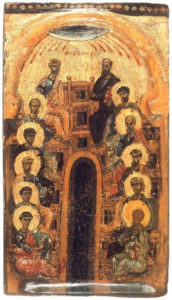
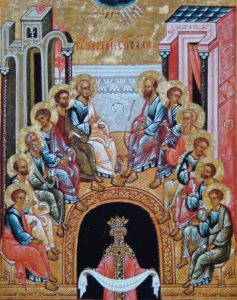
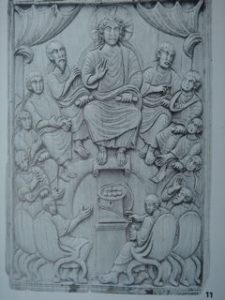
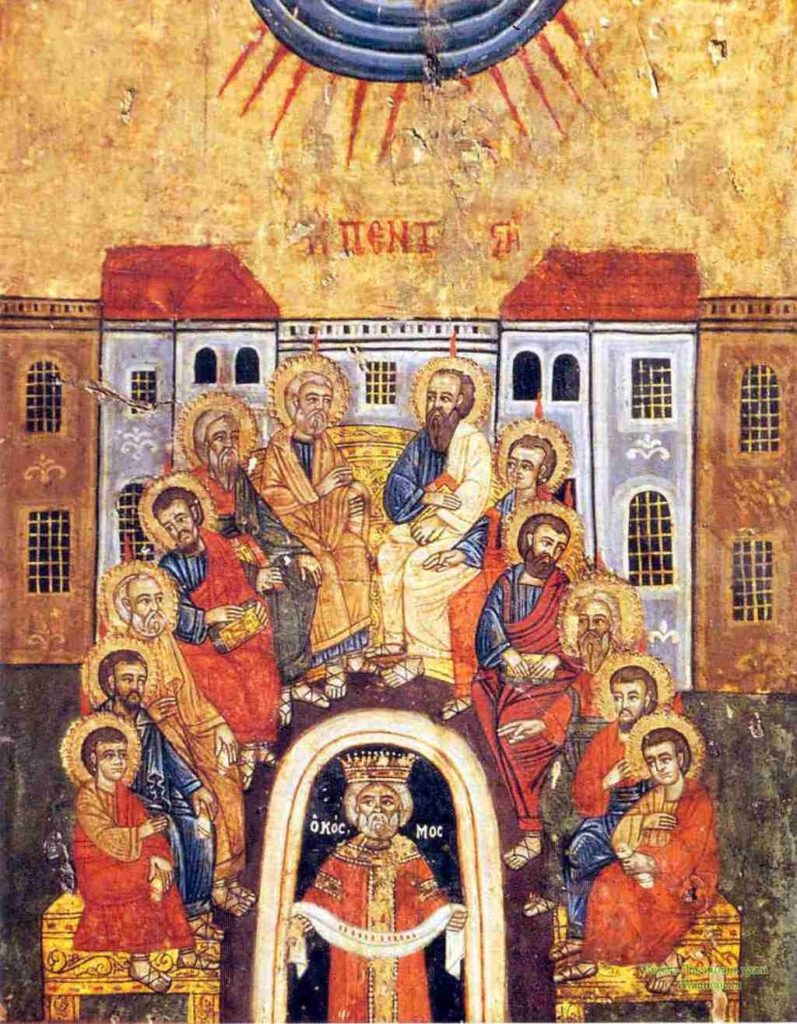
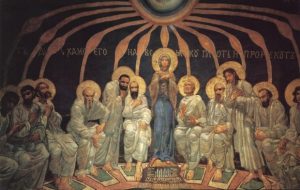
VROUBEL, ÉGLIE SAINT-CYRILLE À KIEV 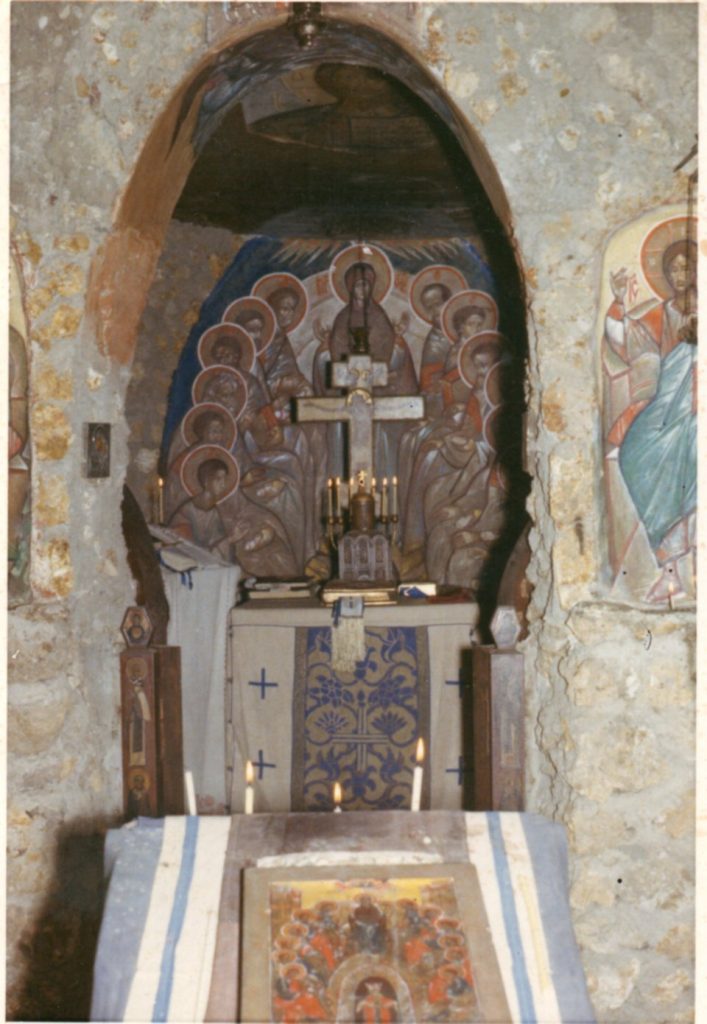
MOINE GRÉGOIRE KRUG, SKIT DU SAINT-ESPRIT AU MESNIL-SAINT- DENIS, PEINTURE MURALE 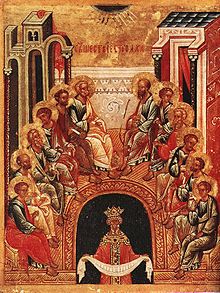
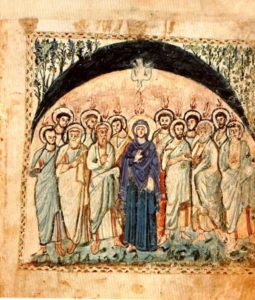

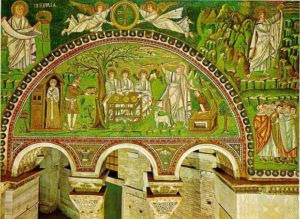

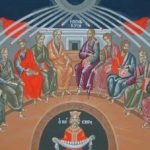
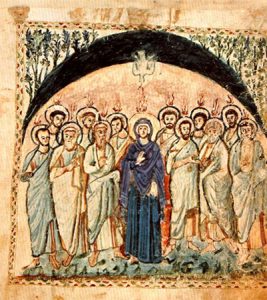
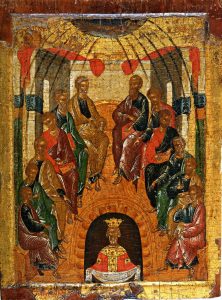
« Nous connaissons la Sainte Trinité à travers l’Église, et l’Église à travers la révélation de la Sainte Trinité. À la lumière du dogme de la Trinité, la sobornost’ se manifeste comme une identité de l’unité et de la pluralité, de l’unité qui se manifeste dans une pluralité diverse, et cette diversité continue d’être unie. Ainsi, il n’y pas en Dieu de nature hors de ses trois Personnes ; dans l’Église, l’universalité abstraite n’existe pas, mais il y a un accord parfait de la diversité plurielle ecclésiale. De même qu’en Dieu chaque personne – le Père, le Fils et le Saint-Esprit – ne sont pas des parties de la Trinité mais Dieu dans son entier, ainsi l’Église, elle aussi, n’est pas une certaine fédération de ses parties ; elle est ecclésiale dans chacune de ses parties puisque chaque partie est identique au tout, l’exprime et n’existe pas hors de ce tout. C’est pourquoi la sobornost’ se manifeste de diverses façons dans l’histoire de l’Église. »
Vladimir Lossky
-
ALEXANDRE KANTOROW À L’ABBAYE DE CAGNOTTE DANS LES LANDES
ALEXANDRE KANTOROW À L’ABBAYE DE CAGNOTTE DANS LES LANDES
VENDREDI 1O JUIN 2022
Triomphal récital de piano du jeune Français aux origines russes dans le lieu où était l’ancienne abbaye bénédictine de Cagnotte dans les Landes avec des exécutions magistrales et virtuoses de Liszt, de Schumann et surtout de Skriabine dont la sonate visionnaire « Vers la flamme » n’est pas souvent jouée à cause de sa complexité prémonitoire des futures avancées de la musique européenne, et cela peut se le permettre cet artiste à peine sorti de l’adolescence aux magnifiques longues et fines mains qui passent avec aisance des tonalités méditatives avec silences aux tourbillons volcaniques de la musique romantique lisztienne. Entre Horowitz et Rubinstein.

Il faut ajouter que le public landais lui a fait de telles standing ovations qu’il lui a offert 3 bis, dont le dernier était « La grande porte de Kiev »…
-
AVANT-PROPOS de ma monographie « Malévitch », parue chez Hazan en 2016
AVA NT-PROPOS
Ma monographie sur Malévitch parue en 1990 a été le premier livre qui embrassait toute l’évolution de la création du peintre, architecte, théoricien, pédagogue et penseur polono- ukraino-russe. La nouveauté de cette monographie tenait dans le fait que, pour la première fois, étaient mises dans leur ordre réel les différentes périodes stylistiques de l’œuvre malévitchienne, ce qui, jusque-là, n’était pas pris en compte ni dans les études ni dans les expositions qui lui étaient consacrées. Cette monographie a été publiée en français et traduite en japonais. Le livre a reçu le prix des beaux livres d’art en mai 1990. Il a été rapidement épuisé .
[Jean-Claude Marcadé, Malévitch, Paris, Casterman/Nouvelles Éditions françaises, 1990.
(Une variante augmentée a paru en langue ukrainienne à Kiev en 2013 aux éditions Rodovid.)]Plus de vingt ans se sont écoulés depuis cette parution et des événements importants ont eu lieu, surtout après la chute de l’URSS et l’accès libre aux archives, qui, jusqu’alors, étaient fermées aux chercheurs. Sont apparues de nouvelles études, des biographies, des monographies, des essais d’historiens de l’art (Charlotte Douglas, Alexandra Chatskikh, Andzej Turowski, Matthew Drutt, Irina Karassik, Tatiana Goriatchéva, Eléna Basner, Evguénia Pétrova, Dmitri Sarabianov, Dmytro Horbatchov, Rainer Crone, Serge Fauchereau, Andreï Nakov, Hans-Peter Riese, entre autres).
Selon moi, trois événements de première importance ont apporté de nouveaux matériaux pour l’étude de Malévitch :
1.Les Œuvres en cinq volumes [Sobraniyé sotchiniénii v piati tomakh] de Malévitch, Moscou, « Guiléya », 1995-2004 (sous la direction d’Alexandra Chatskikh).
2. Andréi Nakov, Kazimir Malewicz. Catalogue raisonné, Paris, Adam Biro, 2002.

3. Les deux volumes : Malévitch sur lui- même. Les contemporains sur Malévitch. Lettres. Documents. Souvenirs. Critique [Malévitch o sébié. Sovrémienniki o Malévitché. Pis’ma. Dokoumienty. Vospominaniya. Kritika], sous la direction d’Irina Vakar et de Tatiana Mikhiyenko, Moscou, RA, 2004.
Le catalogue raisonné de Nakov ne correspond guère aux règles scientifiques habituellement admises pour ce genre d’ouvrage : il mélange la trame chronologique et la trame interprétative des œuvres malévitchiennes, ce qui ne contribue pas à donner une vue claire de l’itinéraire créateur de l’artiste ; à cette exposition chaotique des faits s’ajoutent des appellations totalement arbitraires et subjectives de nombre d’œuvres particulières ou d’ensembles (sont inadéquates certaines dénominations de sections, comme, par exemple, « le suprématisme narratif », « le suprématisme éclectique », « les préoccupations cézannistes » ou « l’idylle champêtre » du Malévitch post-suprématiste, etc.). Malgré cela, ce catalogue raisonné représente un énorme travail de rassemblement de matériaux, c’est pourquoi il est un jalon important dans l’étude de la création malévitchienne ; il permettra, dans le futur, de créer une mise en ordre scientifique de toute la production du fondateur du suprématisme, après élimination de nombreuses œuvres qui y figurent indûment.
[Dans ce futur catalogue raisonné, il conviendra de réviser l’attribution à Malévitch de beaucoup d’œuvres ; on s’aidera pour cela du catalogue raisonné de l’ancienne collection d’Anna Léporskaya, assistante de Malévitch à la fin des années 1920 jusqu’à la mort de l’artiste en 1935, catalogue réalisé par un éminent pionnier des études malévitchiennes, Troels Andersen,K.S.Malevich. The Leporskaya Archive, Aarhus, Aarhus University Press, 2011 (voir en particulier le chapitre « Attributions », p. 210-214, où plus de deux cents œuvres de Malévitch introduites dans le catalogue raisonné de Nakov sont considérées par Andersen comme n’étant pas de la main du peintre ukrainien]
Il est un élément qui distingue mon travail de la majorité des autres études sur Malévitch, c’est la prise en considération des racines ukrainiennes de la poétique picturale du peintre, ce qui est passé sous silence ou est vaguement traité dans la plupart des travaux le concernant . Dans tous mes articles et livres traitant de ce qu’on a pris l’habitude d’appeler « l’avant-garde russe » et dont la dénomination ne s’est établie de façon durable qu’à partir des années 1960, je distingue dans ce puissant courant novateur trois tendances ou « écoles » : les écoles de Saint-Pétersbourg, de Moscou, et l’école ukrainienne, dont font partie Alexandra Exter, David et Vladimir Bourliouk, Archipenko, Malévitch, Baranov-Rossiné et, pour une grande partie, Larionov et Tatline
La veine ukrainienne – la nature, le mode de vie quotidien et la gamme colorée – a pénétré pour toujours dans toute la complexion humaine et artistique de Malévitch. Je me souviens que, lorsque, au tout début des années 1970, nous avons, ma femme Valentine et moi, rendu visite à Moscou au constructiviste Vladimir Stenberg, celui-ci nous a parlé de Malévitch comme d’un « patriote ukrainien » ; cela m’a étonné, car je n’avais pas alors pris conscience de ce que cela pouvait vraiment signifier ! Vladimir Stenberg a ajouté que Malévitch aimait porter des habits ukrainiens et chanter des chansons ukrainiennes. Et cela se passait avant la parution, à la fin des années 1970, de l’Autobiographie de Malévitch, de 1933, dans la rédaction de Nikolaï Khardjiev, où l’artiste se définit sans détours comme ukrainien .
Un autre trait, qui pourrait paraître annexe, unit Malévitch à l’Ukraine, et plus précisément à Gogol. Je ne parle pas ici seulement de l’hyperbolisme de la poétique artistique ni de l’humour dont on trouve les traces dans les œuvres picturales et dans les textes de Malévitch. Mais je suis très frappé par le fait que pour beaucoup de spécialistes, aussi bien russes qu’étrangers, la langue de Malévitch paraît barbare, extravagante, incohérente. Nombre de personnalités dignes de foi, comme, par exemple, les célèbres penseurs et historiens de la littérature Mikhaïl Guerchenzon et Mikhaïl Bakhtine, n’étaient pas de cet avis. En effet, le style malévitchien est très « complexifié », il a quelque chose de non normatif, et, dans le même temps, il est extraordinairement expressif et efficace
[L’exposition rétrospective « Malevich » à la Tate Modern londonienne (commissariat Achim Borchardt-Hume), en 2014, a éliminé totalement et de façon voyante l’élément ukrainien dans l’œuvre de Malévitch : la deuxième salle était intitulée « A Russian Artist », quant aux dernières salles 11 et 12, elles ignoraient la « réukrainisation » de Malévitch à la fin des années 1920 et au début des années 1930. Les mots « Ukraine » et « ukrainien » ont été systématiquement ignorés]
[Cf. Jean-Claude Marcadé, L’Avant-garde russe. 1907-1927, Paris, Flammarion, 1995, rééd. 2007, p. 20-22 (« École de Saint-Pétersbourg, école de Moscou, école ukrainienne »)]
[ Cf. K. Malévitch, « Enfance et adolescence. Chapitres de l’autobiographie de l’artiste » [1933], in Malévitch. Colloque international…, p. 162.]
Rappelons qu’au XIXe siècle il y eut des critiques littéraires russes qui osèrent conseiller à l’Ukrainien Gogol d’« apprendre la langue russe », voire qui qualifièrent de « galimatias bizarre 7 » la langue des Âmes mortes…
[Cf. Edyta M. Bojanowska, Nikolai Gogol. Between Ukrainian and Russian Nationalism, Cambridge (Mass.)/Londres, Harvard University Press, 2007, p. 70 sqq.]
La présente monographie a été considérablement élargie (presque doublée) et surtout actualisée par de nombreuses notes qui prennent en compte l’état des études malévitchiennes dans la première décennie du XXIe siècle. D’autre part, à la demande de Jean-François Barrielle, j’ai complété l’étude de l’itinéraire artistique, théorique et philosophique de Malévitch par des incursions dans sa biographie. Cela permet de faire ressortir l’extraordinaire présence humaine de l’auteur de Dieu n’est pas détrôné, son abnégation, sa conviction d’être porteur d’une haute mission, la capacité qu’il a d’entraîner et de fasciner ses disciples, le tout marqué tout au long de son existence du sceau d’un humour cathartique.
Jean-Claude Marcadé, décembre 2014
-
« La vision des choses à leur origine » dans l’art
Extrait de ma lettre de New York à Raphaël Léonovitch Khérumian du 9 mars 1977:
“En regardant le Carré blanc, après avoir lu l’article de Martineau sur le problème de la mimèsis chez Aristote, en réfléchissant à certains passages de la poétique de ce philosophe, il me semble que j’ai compris ce que Raphaël Léonovitch m’a écrit un jour et qui était resté pour moi une belle énigme : l’art du futur sera “préfiguratif”, disait à peu près Raphaël Léonovitch : je suis persuadé maintenant que le vrai art a toujours été et sera pré-figuratif mais cela n’implique aucunement une certaine manière de faire – figurative ou abstraite selon les classifications de l’histoire de l’art, mais une vision des choses à leur origine, avant les retombées dans le monde de la perception empirique. Cette pré-vision peut “se traduire” figurativement ou non, ce n’est pas cela, me semble-t-il, l’important, mais plutôt la qualité et l’épaisseur de cette pré-figuration. Dans la Poétique Aristote écrit : ”Les bons peintres, afin de délivrer la forme singulière (idia morphè), peignent les hommes plus beaux, bien qu’ils les fassent ressemblants” .”
-
« Torse féminin N° 1 » de Malévitch :
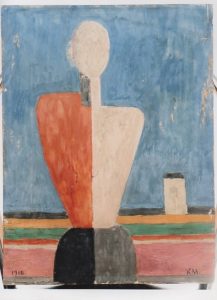
TORSE FÉMININ N° 1, FIN DES ANNÉES 1920 , COLLECTION PRIVÉE, KIEV 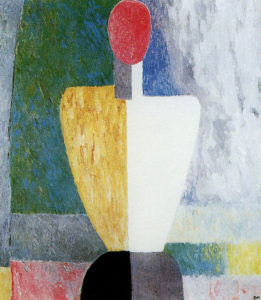
TORSE <FÉMININ, N° 2>, VERS 1930, MUSÉE NATIONAL RUSSE 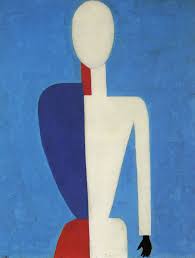
N° 3, FIN DES ANNÉES 1920, MUSÉE NATIONAL RUSSE -
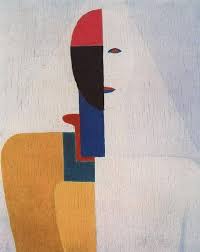
TORSE FÉMININ N0 4, FIN DES ANNÉES 1920, MUSÉE NATIONAL RUSSE
Torse féminin N° 1 de Malévitch :
un archétype d’une nouvelle iconicité suprématiste
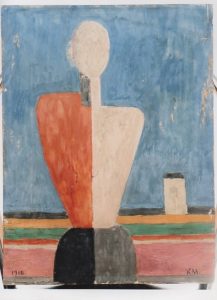
Le tableau Torse féminin N° 1 (huile sur bois, 41x31cm) qui vient d’apparaître dans une collection kiévienne, apporte un nouvel éclairage sur une série assez énigmatique de la fin des années 1920, telle qu’elle fut exposée à la rétrospective de la Galerie Trétiakov en 1929 et à la Galerie d’art de Kiev en 1930. La production de l’artiste ukrainien après 1927 reste encore difficile à classer de façon satisfaisante. Le Torse féminin N°1 nous permet de mettre un peu d’ordre dans cette production picturale.
Le contexte
Entre 1928 et 1934, le fondateur du suprématisme se remet intensément à la peinture et crée plus de deux cents oeuvres dont il est impossible d’établir aujourd’hui une chronologie exacte. On sait seulement que pour la rétrospective que lui consacrera la Galerie Trétiakov à Moscou en 1929, ainsi que pour la rétrospective à la Galerie d’art de Kiev en 1930, Malévitch peindra une série de tableaux impressionnistes qu’il date du début du siècle et reprendra le thème paysan de 1912-1913 qu’il antidatera également[1].
L’artiste a réinterprété également le cubofuturisme de ses débuts, en maintenant souvent des dates anciennes. Malévitch a daté des œuvres peintes à la fin des années 1920 selon la culture picturale qu’elles représentaient et non selon leur date d’exécution. C’est ainsi que Torse féminin N° 1 est daté de 1910, nous y reviendrons.
Toute une série d’œuvres (Le faucheur de la Galerie Trétiakov ; À la datcha[2], Garçonnet – Van’ka[3], du Musée national russe, etc.) reprend les motifs cubofuturistes anciens pour les insérer dans une structure qui tient compte des acquis du suprématisme. Ainsi, la structure est bâtie à partir de bandes colorées pour le fond et de surfaces simplifiées pour le corps des personnages [Jeunes filles dans un champ][4]. On note comme invariant la station verticale de ceux-ci qui occupent l’espace principal du tableau. Dans le post-suprématisme, l’homme se tient face à l’Univers dont les rythmes colorés le traversent. La ligne d’horizon est basse. Il n’y a pas de modelage réel de la couleur.
IMPORTANCE DE LA PEINTURE D’ICÔNES
Le retour de Malévitch à la figure d’après 1927 est en fait une synthèse où le sans-objet (bespredmetnost’) vient traverser des hommes représentés dans des postures d’éternité. Le visage du peintre Klioune avait fourni à Malévitch, entre 1909 et 1913, le sujet de différentes métamorphoses stylistiques (symbolistes, primitivistes géométriques, cubofuturistes, réalistes transmentales). Après 1927, il devient le visage paradigmatique du paysan, prenant comme structure de base des archétypes de la peinture d’icônes, en particulier du Pantocrator ou de la Sainte Face orthodoxe (« Christ Archeïropoiète »)[5]. Cet emprunt d’une structure de base empruntée à certaines icônes n’est pas, comme chez les boïtchoukistes, une « tricherie avec les siècles », selon l’expression d’Apollinaire à leur propos[6], mais l’utilisation moderne de « cette forme de la culture supérieure de l’art paysan »[7]:
« A travers l’art de l’icône, je compris le caractère émotionnel de l’art paysan, que j’aimais auparavant, mais dont je n’avais pas élucidé la portée et que j’avais découvert d’après l’étude des icônes. »[8]
Situation dans ce contexte du « Torse féminin N°1 »
Quatre éléments principaux interpellent dans cette oeuvre : son iconicité, son élément primitiviste populaire, son alogisme, l’énergie de la couleur.
ICONOCITÉ SUPRÉMATISTE
Le tableau est peint sur un panneau de bois de tilleul. Son fond est de l’huile mélangée à une colle animale et de la craie. Le choix du matériau utilisé n’est pas fait au hasard. Le bois de tilleul est un des matériaux nobles utilisés par les iconographes de la Rous’ et des Balkans ; la colle et la craie sont les ingrédients de ce que l’on appelle le levkas, par lequel les peintres d’icônes recouvrent la planche de bois avant d’inscrire le dessin du sujet à représenter. Ce dessin était appelé opis’ (contour), il traçait les contours du sujet avant la pose des couleurs.
On voit que dans le tableau Torse féminin N°1 Malévitch revient au principe du tableau-icône qu’il avait initié dès le début des années 1910, mais ici avec une nouvelle structure. Bien entendu, Malévitch n’est pas un peintre d’icônes, il est un peintre qui a voulu donner au tableau de chevalet le même statut structurel et métaphysique que celui de l’icône ecclésiale pour créer une nouvelle image du monde. Et cela est totalement différent de l’école byzantiniste boïtchoukiste qui avait l’ambition de revêtir le monde contemporain des formes de l’icône traditionnelle.
On peut considérer que Torse féminin N°1 est, du point de vue formel, comme une suprématisation de l’icône à son rythme minimaliste initial. Il est l’archétype de toute une série de tableaux et de dessins entre 1928 et 1932.
TORSE FÉMININ N°1 On connaît les oeuvres qui ont suivi immédiatement cet archétype : la toile Torse (Première formation d’une nouvelle image) du Musée national russe (fin des années 1920), qui porte au dos de la main de Malévitch : « N°3, Première formation d’une nouvelle image. Problème couleur et forme et contenu »[9].
TORSE FÉMININ N° 3 Or notre tableau Torse féminin N° 1, porte au dos, de la main de Malévitch : « N°1. Torse féminin couleur et forme »
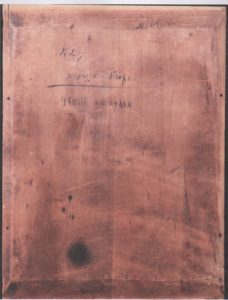
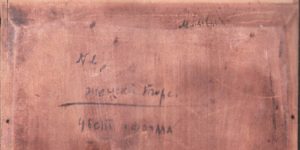
. On connaît encore un autre Torse féminin, également au Musée national russe, une huile sur contreplaqué de la fin des années 1920, qui porte au dos une inscription de la main de Malévitch : « N°4 Torse féminin ». Développement d’un motif de 1918″[10].
J’émets l’hypothèse qu’une autre toile de la même époque, également au Musée national russe, qui présente une structure identique à notre Torse féminin N° 1, à savoir Torse (Figure au visage rose)[11] est en fait le N° 2 qui suit immédiatement notre N°1 et précède le N° 3.
TORSE FÉMININ N° 2 C’est-à-dire que Malévitch s’est servi du N°1 comme un modèle archétypique, à partir duquel il a créé, tel un musicien des couleurs et de formes, des variations. Cette hypothèse me paraît confortée par la présence de deux trous de chaque côté de la planche, ce qui indique qu’elle a été clouée à un moment pour servir d’exemple pour le travail ultérieur.
Revenons sur le Torse féminin N° 4,
TORSE FÉMININ N° 4 car il s’agit visiblement d’une nouvelle étape dans l’élaboration de la « nouvelle image », puisque le personnage féminin est doté d’yeux et d’une bouche, mais là aussi, sans le moindre réalisme (il n’y a pas de représentation du nez), le caractère suprématiste iconique intemporel est total.
DATATION
On constate que, comme notre Torse féminin N°1, les oeuvres qui en découlent sont aussi datées 1910, le N° 4 note de façon plus juste « développement d’un motif de 1918 ». Pour comprendre à quoi le peintre ukrainien fait allusion, il faut se souvenir de sa lettre à Lissitzky, le 11 février 1925, à un moment où il est attaqué par les tenants du marxisme-léninisme et taxé d’idéaliste et de mystique. Non seulement il ne renie pas sa pensée, mais il la renforce avec son style hautement métaphorique-métonymique, à l’humour gogolien cinglant. Citant ses têtes de « paysans-orthodoxes » du début des années 1910, il déclare :
« J’ai, paraît-il, une tête ordinaire de paysan et il s’est trouvé qu’elle n’était pas ordinaire, car, en fait, si on la regarde du point de vue de l’Orient, elle est tout ce qui pour les Occidentalistes est ordinaire, alors que pour les gens de l’Orient, cela n’est pas devenu ordinaire, tout ce qui est ordinaire se transforme en Icône, car l’Orient est iconique, tandis que l’Occident, c’est la machine, l’objet, les chiottes, l’utilitarisme, la technique, alors qu’ici – l’Usine et les fabriques, c’est le nouvel enfer dont les hommes seront délivrés par la nouvelle image, c’est-à-dire par le nouveau Sauveur. C’est ce Sauveur que j’ai peint en 1909-1910 [antidatation habituelle chez Malévitch !], il est devenu sauveur à travers la Révolution, la révolution est seulement son drapeau, sa thèse par laquelle il est devenu synthèse, c’est-à-dire ‘Nouveau sauveur’ […] Je n’ai pas marché ‘À CÔTÉ de la révolution’, au contraire, j’ai prévu sa synthèse, dès 1909-1910, dans le Nouveau Sauveur. Et cela devient maintenant chez nous en tête des choses. La tour de Tatline, c’est une fiction de la technique occidentale, il va l’envoyer en ce moment à l’exposition parisienne et, bien entendu, il peut aussi construire une pissotière en béton armé pour que chacun s’y trouve un petit coin. Pour moi, tout cela est si clair que je peux sans lampe écrire à propos de l’Orient et de l’Occident. »[12]
Il est donc naturel que Malévitch, quand il revient à la peinture de chevalet et cherche à traduire en « couleur et forme » une nouvelle image-icône de l’homme et du monde, retrouve sa poétique du début des années 1910, où la figure du paysan (pas dans le sens sociologique du terme, mais dans celui de l’homme au sein de la nature) apparaît dans le filigrane de la représentation de l’Orthodoxe, du Pravoslave.
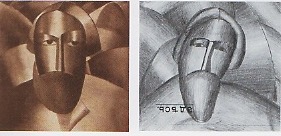
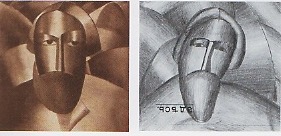
OTHODOXE, 1912 Dans ce prisme, on retrouve à la fin des années 1920 le Suprématisme dans les contours d’une paysanne (Femme au râteau) de la Galerie Trétiakov
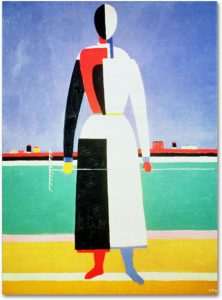
FEMME AU RÂTEAUN, vers 1930 ou encore Jeunes filles aux champs
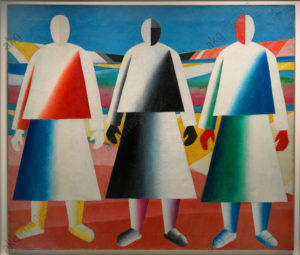
Kazimir Malevic, Ragazze in un campo, 1929, Museo di Stato Russo, San Pietroburgo ou les Sportifs du Musée national russe[13],
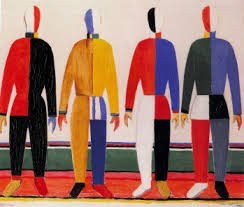
qui sont dans l’esprit de la notation « couleur et forme » dans notre Torse féminin N°1 où sont affirmées avant tout les intentions purement picturales de l’artiste.
Malévitch a pu dire qu’il ne faisait pas de visage parce qu’il ne voyait pas l’homme de l’avenir, ou plutôt que l’avenir de l’homme était une énigme insondable. Les références christiques ont une forte présence, souvent camouflée, dans le post-suprématisme.
Parmi les impulsions qui ont pu amener le peintre à ces « visages sans visage », peut-être y a-t-il eu celle qui provient de la pratique catholique romaine de la monstrance.

OSTENSOIR 
OSTENSOIR 
OSTENSOIR Bien que Malévitch, baptisé catholique romain à Kiev, n’ait pas été pratiquant, il a certainement fréquenté l’église dans l’enfance et l’adolescence, mais surtout on sait, par sa correspondance avec Mikhaïl Guerchenzon en 1920, depuis Vitebsk, qu’il est « retourné ou bien entré dans le Monde religieux » :
« Je ne sais pourquoi cela s’est fait, je fréquente les églises, regarde les saints et tout le monde spirituel en activité »[14]
Est-ce que parmi les impulsions du « monde religieux », le peintre aurait pu avoir celle qui est donnée dans l’église catholique romaine par l’adoration de l’hostie dans la lunule de l’ostensoir. Là aussi on a une « présence-absence ». Cette lunule était soit un cercle, soit un croissant de lune. Et l’on note justement que les visages « vides » de Malévitch ont cette forme lunaire. Cette lunule était traditionnellement entourée d’une pièce d’orfèvrerie représentant le soleil. Mais elle pouvait être sans cet ornement. Or précisément Malévitch veut sortir du Monde solaire et ne laisser que la contemplation de l’Acte pur. Notons que Malévitch fait référence à l’adoration du Saint-Sacrement dans la religion catholique dans son étonnant texte de 1924 sur Lénine « Extrait du livre sur le sans-objet » :
« On a enseveli Lénine dans un cercueil vitré pour la seule raison qu’il soit visible comme un Saint-Sacrement. Cette prévision que j’avais écrite s’est véritablement réalisée. Je l’avais écrite sans être au courant de l’idée d’une ouverture vitrée. J’avais pris en considération un cercueil vitré à partir de l’analyse selon laquelle un homme qui passe dans l’état de sainteté est un Saint-Sacrement et le degré de sa sainteté correspond au Saint-Sacrement dans le monde catholique où le Sacrement est mis sous verre »[15]
PRIMITIVISME
Malévitch en appelle à cette époque à un dénudement et non à l’accumulation sauvage. Ce retour aux rythmes premiers, au minimalisme de l’expression figurative a également à voir avec la poétique de l’art populaire qui cherche l’efficacité visuelle par des dessins laconiques, schématiques. Dmytro Horbatchov a montré combien les « visages sans visage » du Malévitch post-suprématiste font penser aux poupées-chiffons qui étaient fabriquées dans le monde paysan ukrainien. Il est intéressant de noter que dès juillet 1930, deux tableaux du cycle paysan sont exposés à Berlin dans le cadre de l’exposition « Sowjetmalerei » ; ils sont antidatés de 1913 et 1915. Le critique Adolf Donath, dans son article du Berliner Tageblatt du 9 juillet 1930, les décrit comme des peintures figuratives représentant des personnages semblables à des poupées rigides et sans visage devant des paysages plats, et d’ajouter :
« On perçoit dans ces œuvres la « machine qui asservit les hommes à la fois dans les arts et autour d’eux. »[16]
De la même façon, dans les bandes colorées sur laquelle se dresse la figure du Torse féminin N°1, bandes colorées que l’on retrouve dans plusieurs oeuvres, et même dans l’huile abstraite de 1932 du Musée national russe, Composition[17], il y a une impulsion donnée par les rayures sur les tabliers des paysannes ukrainiennes, ainsi que sur certains essuie-main ou tapis, en particulier en Polésie, une région d’où vient la lignée des Malewicz. Ces rayures polychromes abstraites se réfèrent à une vision aérienne des champs. C’est l’ultime affirmation malévitchienne de la présence cosmique qui émerge à travers tous les contours de l’homme et de la nature. Le suprématisme avait fait sauter toute circonscription réaliste. Le post-suprématisme restaure la configuration visible, tout en maintenant les exigences du « monde en tant que sans-objet ».
De même le thème de la maison sans fenêtres apparaît, avant l’emprisonnement et les interrogatoires de Malévitch par la Guépéou de la fin septembre au début décembre1930. Il semble alors qu’il s’agit d’une réduction primitiviste minimaliste, presqu’un graffiti, de la philosophie architecturale du peintres, de son « architectonie » aux formes si complexes. Comme le personnage du Torse féminin N° 1qu’il côtoie, cette maison est encore une énigme de que sera l’habitation de l’être humain dans l’avenir. Toutes les maisons, dessinées ou peintes à la fin des années 1920, avant 1930, sont de cette même couleur blanche qui est celle des khatas ukrainiennes. Après 1930, cette maison primitiviste deviendra l’emblème de la prison, symbolisée par la Maison rouge du Musée national russe[18], dans laquelle est désormais enfermé l’homme de la société totalitaire et où le rouge exprime la Passion subie par les emprisonnés.
De la même façon, après l’épreuve des interrogatoires par la police secrète et de la prison, les personnages sans visage deviennent de plus en plus des représentations de l’humanité souffrante, ligotés, mutilés. Pourtant, l’artiste continue à se donner pour tâche ce qu’il a énoncé dans Torse féminin N° 1, à savoir de s’attacher principalement à « la couleur et la forme ». C’est ainsi qu’il inscrit au dos de la toile du début des années 1930, Deux figures masculines, du Musée national russe[19] :
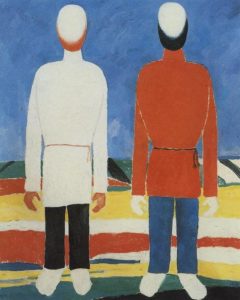
« L’ingénieur, pour exprimer ses desseins, utilise tel ou tel matériau ; l’artiste, pour l’expression des sensations de couleurs, prend telle ou telle forme de la nature. K. Malévitch 1913 Kountsévo. »
Bien entendu, le peintre donne à nouveau non pas la date de l’exécution de son tableau, mais la date initiale, quand cette tâche purement formelle a été conceptuellement pensée.
ALOGISME
Le caractère totalement inédit de cette nouvelle image, telle qu’elle se présente dans Torse féminin N° 1, provient de ce qu’elle montre la femme à la fois tournée vers nous et tournée vers l’Univers. Il semble, en effet, que la partie blanche de droite (le visage et le torse) nous font face, tandis que la partie gauche rouge, qui est surélevée, donne l’impression que le personnage nous tourne le dos et regarde le paysage.
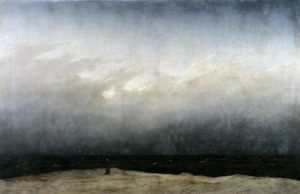
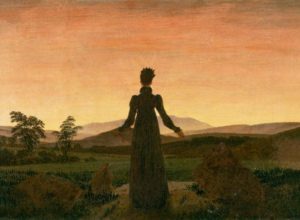
Un autre élément nous interpelle, qu’il ait été conscient ou non pour le peintre, c’est l’écho qu »il entretient avec le célèbre tableau de Caspar David Friedrich Mönch am Meer de Berlin
Deux autres tableaux de Friedrich, Frau vor untergehender Sonne de Essen
ou encore Femme à la fenêtre de Berlin
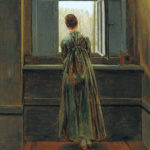
Une jeune femme se penche a la fenetre de l’atelier de Friedrich. C’est Caroline, l’epouse du peintre. Tournant le dos au spectateur, elle regarde couler l’Elbe. Les seuls signes de vie sont la femme, le vert delicat des peupliers, et le ciel de printemps. Dans ce travail, Friedrich a adopte un theme de predilection du romantisme, le cadre evoque un desir de l’inconnu. Le regard vers l’exterieur, contemplation de la nature, retour vers l’interieur de soi centre spirituel de l’individu. sont encore plus proches du Torse féminin N° 1; voir aussi Der Wanderer über dem Nebelmeer de Hambourg
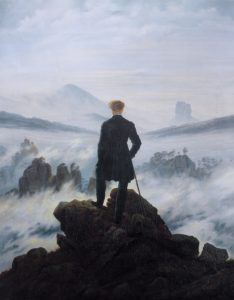
, ce qui voudrait dire qu’ici l’iconicité est combinée à une référence de la peinture universelle. Malévitch n’a pas pu ne pas voir les oeuvres de Friedrich lorsqu’il se trouvait à Berlin en avril-mai 1927.[21]
Cet alogisme de la présentation du personnage dans Torse féminin N° 1 se retrouve dans les trois autres tableaux de ce cycle : Torse (Figure au visage rose) <N° 2>, Torse (Première formation d’une nouvelle image N° 3, Torse féminin N° 4. On y relève la même surélévation de l’épaule gauche, qui nous tourne le dos. Le fait qu’il n’y ait pas de bras apparents dans ces torses, comme dans Torse féminin N° 1, a pu être interprété comme une sorte de mutilation, ce qui sera le cas après 1930. En réalité, on peut imaginer que les bras sont croisés derrière ou devant. D’ailleurs l le N° 3, Torse (Première formation d’une nouvelle image de la série, a bien un bras tourné vers nous et l’on peut supposer que du côté gauche, qui nous tourne le dos, le bras est rabattu. Et, de plus, il semble que Malévitch ait voulu dialoguer, dans la création d’une nouvelle forme, avec les torses de son compatriote Archipenko qui, à partir de 1914, a créé toute une série de formes féminines tronquées, sans bras.
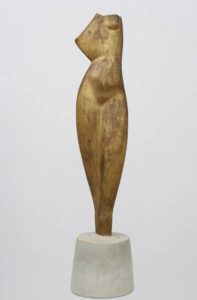
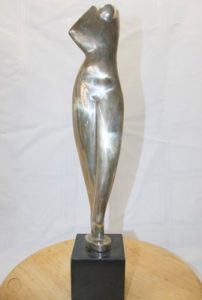
Dans le N° 4 on trouve un alogisme encore plus important :
TORSZ FÉMININ N°4 sur le côté gauche, il y a la superposition sur l’ »épaule » d’éléments qui pourraient indiquer un vêtement suprématiste avec un col. Le contraste est frappant avec la partie droite tournée vers nous avec la forte présence d’un carré blanc sur l’épaule, laquelle est indiquée par une légère courbure, un bras étant suggéré.
Le voile blanc qui recouvre la tête du personnage féminin lui donne le caractère d’une Fiancée. Souvenons-nous de l’article-poème du journal moscovite Anarchie du 12 juin 1918, intitulé « Les fiancés de l’anneau de l’horizon » qui décrit les artistes qui sont les « amants, les fiancés de la beauté » :
« Le long du visage de la Terre marchaient les chercheurs de la beauté. »
Et la Terre apparaît comme la riche fiancée que les artistes cherchent à débarrasser des « anneaux de l’horizon ».[22]
LA COULEUR
Un autre élément essentiel qui est donné par l’archétype du Torse féminin N° 1, c’est la question de la couleur. On est frappé, dans la production post-suprématiste de Malévitch de façon générale, par son éclatante polychromie. Aux » imaginaires dans la géométrie » des formes suprématistes correspond ici ce que l’on pourrait appeler les » imaginaires dans la couleur », dans la mesure où l’artiste réfute l’utilisation dans son oeuvre de la vision rétinienne. Déjà en 1913, la pensée que le soleil n’éclaire qu’un monde illusoire avait été affirmée dans l’opéra cubofuturiste de Matiouchine sur un livret de Kroutchonykh La victoire sur le soleil, où apparaît pour la première fois le « carré noir » dans le personnage du Fossoyeur. À partir de 1919-1920, à Vitebsk, il renforce cette idée que la couleur ne vient pas du prisme lumineux et il nomme la place de la couleur dans sa nouvelle figure de l’homme et du monde dans une lettre à Mikhaïl Guerchenzon du 11 avril 1920 :
« J’ai été occupé pendant plusieurs années à mon propre mouvement dans la couleur, en ayant laissé de côté la religion de l’esprit »[23]
Il poursuivra avec constance dans les années 1920 à étudier la question de « la lumière et la couleur »[24],confirmant que la couleur picturale n’a rien à voir avec les prismes que la science optique décortique et analyse. Mentionnons tout particulièrement ce qu’il a affirmé à ce propos lors de son enseignement à l’Institut d’art de Kiev en 1928-1930, c’est-à-dire à l’époque où il peint son Torse féminin N° 1. Réfutant l’idée d’avoir recours pour peindre aux études scientifiques de la couleur, celles, par exemple, d’Ostwald (on pourrait ajouter celles de Chevreul ou de Helmholtz), il écrit :
« Chez nous, on trouve jusqu’ici que les formes architecturales découlent des délibérations d’une assemblée générale de tous les représentants de diverses institutions, qui tous ensemble, dans l’enceinte de la maison érigée, assortissent la « color » qui va au bâtiment en question. Dans un autre cas, si les constructeurs veulent donner une base scientifique à leur peinture, ils s’adressent à Ostwald ou au cabinet de physique optique le plus proche qui s’occupe de l’étude de la couleur.
C’est comme si Picasso ou Braque, après avoir peint les formes d’un tableau, se tournaient vers ce même Ostwald pour qu’il colorie ces formes selon toutes les lois de la science, ou bien qu’une société d’artistes, d’ingénieurs, de boulangers, de représentants de toutes les unions, se réunit pour délibérer ensemble du coloriage de la forme dessinée sur un tableau. »[25]
Le peintre va continuer à réaffirmer le suprématisme après 1930, au coeur de sa production picturale désormais marquée au sceau de la tragédie, celle du génocide par la faim, le holodomor. Il écrit alors sur le « déploiement de la couleur et son dépérissement de par la dépendance des tensions dramatiques »[26] et prépare un livre intitulé La sociologie de l’art, qu’il ne peut réaliser avant sa mort. On peut aisément supposer que le mot « sociologie » n’aurait rien eu à voir avec la signification que Marx et ses continuateurs marxistes-léninistes lui ont donné…
Les bandes multicolores qui représentent le paysage suprématiste sont peintes dans notre tableau Torse féminin N° 1 de façon brutale, rude. Tout le fond de Torse féminin N° 1 est également colorié de façon primitiviste, sauvage, opaque, dans la manière du Matisse de La danse ou des tableaux de Larionov autour de 1910. On pourrait même dire à propos du Torse féminin N° 1 ce qui a été écrit sur la brutalité matissienne, qu’il s’agit d’ »une pulsation sauvage qui renvoie à l’archaïque, aux taches primitives« [27]
Cette même violence du coup de pinceau se trouve dans la tête de notre Torse féminin N° 1 où la touche blanche grumeleuse est pleine de palpitations énergielles. On retrouve la même texture dans la khata. La couleur blanche a une signification particulière dans la poétique malévitchienne, fondée sur la sensation du monde. Dans la lettre à Mikhaïl Guerchenzon mentionnée plus haut le peintre écrit :
« Je vois également le nouveau Temple, je le divise en trois actes – coloré, noir et blanc -, dans le blanc je vois l’Acte Pur du Monde, le premier acte coloré en tant que quelque chose de sans-objet, mais en tant qu’une sortie du Monde Solaire et de ses religions. »[28]
On voit précisément dans Torse féminin N° 1 les trois couleurs gris, noir, rouge se confronter au blanc de la partie droite de la figure et de la maison.
Comme dans beaucoup de portraits post-suprématistes, du visage de Torse féminin N°1 émane un élément qui lui donne une dimension « métaphysique » supplémentaire, métaphysique au sens étymologique du terme – au-delà du monde physique. L’artiste ukrainien a entouré à plusieurs reprises les faces des personnes représentées avec des sortes de « nimbes » (des éléments rouges de feu ou bien des chevelures mises en mouvement comme par une brise). On aperçoit sur le côté gauche de la face du personnage de Torse féminin N° 1, ce qui pourrait paraître comme une « bavure », voire une dégradation, une éraillure, dues aux aléas du vieillissement et des manipulations ; cela me paraît en fait être une ébauche d’un « rayonnement » qui sort de cette nouvelle figure du monde.
De la même façon, le Torse féminin N° 4 est auréolé d’un voile blanc transparent.
CONCLUSION
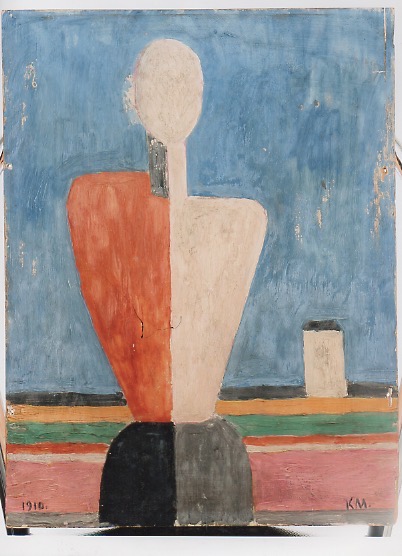
L’oeuvre Torse féminin N°1 que nous étudions ici est de toute évidence le prototype de tout un groupe d’oeuvres des années 1928-1929 où le peintre ukrainien continue à explorer, à travers la sensation du monde sans-objet, la possibilité de représenter une nouvelle figure de l’homme au sein de la nature. Il s’agit d’une incarnation renouvelée du suprématisme dans des contours iconiques.
Torse féminin N°1 permet de réordonner la production post-suprématiste qui jusqu’ici est présentée de façon générale de façon chaotique et approximative. Il est nécessaire, en premier lieu, de nettement distinguer les oeuvres réalisées avant 1930, dont fait partie Torse féminin N°1. Toutes celles qui ont cette structure iconique, que ce soit avec un visage ou sans visage, forment un tout cohérent. Dans cette période entre 1928 et 1930 où Malévitch est plongé dans l’univers multiforme ukrainien, la création de l’artiste oscille entre une vision reflétant le monde à venir comme plutôt optimiste, bien qu’énigmatique, en tout cas comme une promesse d’un bonheur possible. C’est une série de cet ordre qu’inaugure Torse féminin N°1. Certes un tableau comme Charpentier[29], montré à la rétrospective de la Galerie d’art de Kiev en 1930, contient des éléments inquiétants camouflés : c’est l’Artiste-Christ qui est représenté, comme muselé, tenant dans ses mains les instruments de la crucifixion. Mais il n’y a pas encore la vision tragique qui se manifeste avec force dans des tableaux comme Paysanne <au visage noir>[30], visage noir qui est celui d’un cercueil, cette oeuvre est visiblement du début des années 1930, elle ne saurait être mise dans la période précédente, elle inaugure le cycle qui témoigne de la tragédie que vit le peuple et la société, ce qui se traduira en Ukraine et au Kouban en 1932-1933 par le génocide par la faim (holodomor). De même la toile <Trois> Paysans me paraît à l’évidence avoir été peinte après 1930.[31]
Après l’épreuve de la prison, les personnages sans visage paraissent ligotés, quand ils ont des bras, ou mutilés quand ils n’en ont pas. Les thèmes de la crucifixion, des tombes, de la croix, se font insistants. La maison blanche d’avant 1930 devient la présence menaçante rouge de la prison (pas le rouge de la Beauté du « Carré rouge (Réalisme pictural d’une paysanne en deux dimensions » de 1915[32], mais un rouge de sang).
Ainsi Torse féminin N° 1 donne la possibilité de réviser la présentation de la création post-suprématiste malévitchienne, elle donne aussi la possibilité de comprendre la synthèse qu’a voulu réaliser le peintre ukrainien entre suprématisme, primitivisme, icône, alogisme, énergie colorée. Cette synthèse est unique, d’une totale originalité dans les arts européens de la fin des années 1920 et le début des années 1930.
Jean-Claude Marcadé
Juin-juillet 2018
N.B. de Juillet 2020
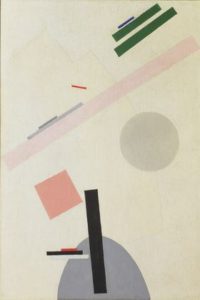
Olivier Camy, organisateur du Colloque international consacré à « La Politique de Malévitch » à l’Université de Dijon en décembre 2018 a attiré mon attention sur le rapport qu’il pouvait y avoir entre un tableau suprématiste de Malévitch de 1916-1917 au MoMA et les torses féminins 1 et 2 de la fin des années 1920. En effet on peut voir dans l’œuvre de 1916-1917 un embryon, une sorte de matrice sans-objet de ces torses.
-
-
« FEMALE TORSO No. 1 » BY MALEVICH IS THE IMAGE OF THE NEW SUPREMATIVE ICONICITY

TORSO 1 TORSO 2 TORSO 3 TORSO 4 Jean-Claude Marcadé
« FEMALE TORSO No. 1 » BY MALEVICH IS THE IMAGE OF THE NEW SUPREMATIVE ICONICITY
The painting “Female Torso No. 1” (oil on wood, 41 x 31 cm), which appeared in a private collection in Kyiv, brings new light to one rather mysterious series of the late 1920s, which was shown in a retrospective exhibition of Malevich in Tretyakov Gallery (Moscow) in 1929 and in the Art Gallery (Kyiv) in 1930. It is still difficult to classify the artist’s paintings after 1927. « Female Torso No. 1 » allows us to bring in some order to this important part of the paintings of the Ukrainian artist.
BACKGROUND
Between 1928 and 1934, the founder of Suprematism intensively returns to painting and creates more than two hundred works, the exact chronology of which cannot be established today. We only know that for a retrospective exhibition at the Tretyakov Gallery in 1929 and at the Art Gallery in 1930 in Kyiv, Malevich draws a series of impressionist paintings which he dates by the beginning of the 20th century and depicts the peasant themes of 1912-1913 in a new way, which he also antidates.
The artist then reinterprets his early cubofuturism, leaving the old dating. He dates works made in the late 1920s by the pictorial culture that they represent, and not by the date of their drawing. Thus, “Female Torso No. 1” is dated as of 1910, and we will return again to this problem. The entire series of the works (“The Mower” at the Tretyakov Gallery, “At the Cottage”, “Van’ka Boy” at the State Russian Museum, etc.) employs again the early cubofuturistic elements in order to bring them into a structure that takes into account the achievement of Suprematism.
So, this structure is built of colorful stripes for the background and simplified planes for the body of the characters (see “Girls in the field » at the State Russian Museum[1]). The invariant verticality of those characters who, like in the church icon, occupy the central space of the picture is noted. In post-suprematism, a person stands in front of a universe whose color rhythms pass through him/her. The horizon line is low. There is no real color simulation.
THE MEANING OF ICON PAINTING
Malevich’s return to the image after 1927 is actually a synthesis in which objectivity pierces people depicted in the position of eternity. Between 1909 and 1913, the face of the painter Ivan Klyun served as the plot of various stylistic metamorphoses, symbolist, primitivist, geometric, cubofuturistic, realistically abstruse. After 1927, it became the paradigmatic face of the peasant, adopting the basic structure of the prototypes of icon painting, in particular the Pantocrator or the Miraculous Savior[2].
This borrowing of the basic system of some icons is not, as in Boychukism, a “juggling of centuries” [“tricherie avec les siècles”] as Apollinaire[3] puts it, but a modern application of icon painting as a “form of the highest culture of peasant art”[4]:
« Through icon painting, I understood the emotional art of the peasants, which I loved before, but did not understand the whole meaning that was discovered after studying the icons. »[5]
POSITION IN THIS CONTEXT OF THE PICTURE « WOMEN’S TORSO No. 1 »
The four main elements are of great interest in this work: its iconicity, its popular primitivism, its alogism, and its energy of color.
SUPREMATIC ICONICITY
The painting « Female Torso No. 1 » is painted on a linden board. Its background consists of oil paint, to which animal glue and chalk are mixed. Linden wood is one of the noble materials used by icon painters in Russia and in the Balkans; glue and chalk are an integral part of gesso, with which artists cover the board before they integrate the drawing into the plot. This drawing is called the sketch, it draws the outline of the plot before applying paints.
In the painting « Female Torso No. 1 », it is clear that Malevich returns to the principle of the icon-picture, which he initiated in the early 1910s, but here he applies a new structure. Of course, Malevich is not an icon painter, he is a painter who wanted to give the easel picture the same structural and metaphysical setting as the church icon in order to develop a new image of the universe. In this, we repeat, it differs from the Byzantine Boychukist school, which strove to garment modern reality in the forms of traditional icon painting.
On the formal side, you can consider « Female Torso No. 1 » as a suprematization of the icon. He is the prototype of a series of paintings and drawings between 1928 and 1932.
The works that immediately followed this prototype are known: the canvas “Torso. The First Formation of a New Image 1928-1929” in the Tretyakov Gallery, on the back of which is written by Malevich’s hand: “No. 3 The First Formation of a New Image. The Problem is Color and Form and Content,”[6]
TORSO 3 and on the back of our painting « Female Torso No. 1 », Malevich wrote: « No. 1 Female Torso color and shape«
; another « Female Torso 1928-1929 » is also known, which is also in the State Russian Museum, oil on plywood, on the back of which the artist writes with his own hand: « No. 4 female torso – Development of the 1918 motive.”
TORSO 4 My hypothesis is that another canvas of the same late 1920s, located in the State Russian Museum, which has an identical structure as our « Female Torso No. 1 », namely, « Torso (figure with a pink face) 1928-1929 »[8]
TORSO 2 is actually number 2 which immediately follows number 1 (our « Female Torso ») and precedes number 3.
That is, Malevich used « Female Torso No. 1 » as a prototype from which he created variations in the likeness of a composite of paints and shapes. This hypothesis seems to me confirmed by the presence of two holes on both sides of the board, indicating that it was nailed to serve as a model for further work.
Let us go back to the “Female Torso No. 4”
TORSO 4 , since here we are talking about a new step in developing the “new image”: the female face has an eye and a mouth, but also without the slightest realism (for example, there is no direct image of the nose); the suprematic iconic timeless character of the image is fully marked.
DATING
We find, as in our painting « Female Torso No. 1 », dating of 1910 in the works which, most likely, follow from this prototype. To understand what the Ukrainian artist is implying, one should recall his letter to L. M. Lisitzky dated February 11, 1925, at the time when he was attacked by the adherents of Marxism-Leninism and he was accused of idealism and mysticism. He not only does not give up his thoughts, but also reinforces them with his highly metaphorical-metonymic style, Gogol’s biting humor. Speaking about his heads of the « Orthodox peasants » of the early 1910s, he announces:
“It turned out, I painted the ordinary head of a peasant that it is unusual, and really if you look from the point of view of the East, then it’s everything that is ordinary for Westerners, then for people of the East it becomes unusual, everything ordinary turns to the Icon, for the East is iconic and it is, and the West is a machine, an object, a toilet, utilitarianism, technology, and here is a plant and factories, this is a new hell from which People will be freed through a new image, that is, through a new Savior. I painted this Savior in 1909-1910, he became a savior through the Revolution, the Revolution is only a banner, the thesis through which he became a synthesis, that is, the « New Savior » […]
I did not go « past the Revolution » – on the contrary, I foresaw its synthesis back in 1909-1910 in the New Savior. And this is now becoming the main thing. The Tatlin Tower is a fiction of Western technology, he will now send it to the Paris exhibition, and of course he can also build a reinforced concrete urinal so that everyone can find a corner. It’s so clear to me that without a lamp I can write (paint) about the West and the East. « [9]
So it is natural that Malevich, when he returns to easel painting and seeks to convey “in color and form”, as it is written in our “Female Torso No. 1”, a new image-icon of a man and the world, continues his poetics of the beginning of 1910 when the image of the peasant (not in the sociological sense of the word, but in the sense of a man in the lap of nature) is revealed in the prism of the image of the Orthodox.
THE ORTHODOX, 1912 In this section, we find the same iconic features in the late 1920s in the painting « Suprematism in the contour of a peasant woman » [« Woman with a rake« ] from the Tretyakov Gallery
or in « Girls in the field”
Kazimir Malevic, Ragazze in un campo, 1929, Museo di Stato Russo, San Pietroburgo and “Suprematism in the contour of athletes » from the State Russian Museum[10],
which are in the spirit of our « Female Torso No. 1 », which affirms the purely pictorial framework of the artist.
Malevich could say that he does not portray the faces of many of his characters because he does not see the person of the future, or most likely because the future is an unknown mystery.
Christological references are present in many images of post-Suprematist creativity, often they are camouflaged.
Among the impulses that could lead the artist to these “faceless faces”, there is the Roman Catholic practice of worship (adoratio) before the wafer (guest) in a monstranza (ostensorium).
Despite the fact that Kazimir Severinovich, being baptized according to the Roman Catholic rite, was not a churchman, he in all probability visited churches in childhood and in his youth. In addition, we know from correspondence with M.O. Gershenzon in 1920 from Vitebsk that he « returned or entered the religious world »:
“I don’t know why this happened, I go to churches, look at the saints and the whole spiritual world”[11]
Could the artist, among the impulses from the “Religious World”, receive an impulse from worship in front of a guest who is in the hole of the Catholic Ostensarium. And there is « presence-absence. »
The ostensarium well is round or sickle-shaped. Just « faceless faces » have a lunar contour. The monstrance’s hole was traditionally surrounded by bronze, silver or gold artwork, often depicting the sun. But she could have been without this ornament. Namely Malevich wants to leave the Solar World, leaving only a contemplation of the Pure action.
It should be noted that Malevich refers to the adoration of the Blessed Sacrament in the Catholic Church in his astonishing text on Lenin « Extract from the book on the Objectlessness » (1924):
« Lenin was buried in a glass coffin for no other reason except that he should be seen as a Blessed Sacrament.This forecast that I wrote has really come true. When I wrote it I did not know about the idea of the glass slit. I had considered the idea of the glass coffin supposing that a man who has been sanctified is a Blessed Sacrament, and the degree of his holiness corresponds to the holy sacrament in the Catholic world in which the Sacrament is put under glass.”( Malevich III, The world as Non-Objectivity. Unpublished writings, 1922-25. (ed. Troels Andersen),Borgen, 1976, p. 315-36)
PRIMITIVISM
Malevich calls in this era for exposure, not for wild accumulation. This return to primary rhythms, to the minimalism of figurative expression, also deals with the poetics of folk art, which seeks visual efficiency with the help of sketchy drawings. Dmytro Gorbachov showed how these Malevich’s « faceless faces » resemble rag dolls created in the peasant Ukrainian world. It is interesting to note that since July 1930, two paintings of the peasant cycle were among the exhibits of the exhibition « Sowjetmalerei » (Soviet painting) in Berlin. They were dated 1913 and 1915! The critic Adolf Donat describes them as figurative paintings depicting characters resembling tight and faceless dolls in front of flat landscapes. He adds:
« That ‘colossus’ is visible, in which a person is displaced simultaneously in the arts and around them. »[12]
In the same way, the colored stripes that have the figure of the “Female Torso No. 1” next to them, are a kind of picturesque echo of those polychrome stripes on the aprons of the Ukrainian peasant women, like many handmade towels and carpets, especially in Polesie, where the Malevich’s family comes from. The artist even used these stripes in a lot of post-suprematic paintings and even they make up objectless (pointless) canvas painting of 1932 from the State Russian Museum[13]. These polychrome abstract stripes refer to aerial vision of the fields. This is the last statement of outer space, which protrudes through the contours of man and nature. Suprematism blew up any visible realistic outline, while post-Suprematism restores the visible outline of things, while preserving the demands of « peace as pointlessness. »
The theme of the windowless house also appears before Malevich’s prison and interrogations at the GPU from late September to early December 1930. Here, it seems, the matter is about a simplified minimalist primitivistic arrangement, almost graffiti, of the painter’s architectural thought, his “architectons” with its so complex form; like the character of « Female Torso No. 1 », with whom he adjoins, this house is another mystery of what will be the dwelling of a human being in the future. All houses depicted or painted in 1928-1930 have the same white color of Ukrainian huts. After 1930, this primitive house will become the emblem of a prison symbolized by the Red House from the State Russian Museum[14], in which a man of a totalitarian society is already imprisoned and where red expresses the suffering to which the prisoner is subjected.
In the same way, after being subjected to the interrogations by the KGB and spending time in prison, Malevich’s faceless characters become more and more representatives of suffering humanity; they seem to be connected, ugly. Nevertheless, the artist continues to adhere in parallel to the task that he expressed in « Women’s Torso No. 1, » namely, the further development of the purely pictorial problem of « color and form. » In this regard, he wrote on the back of the canvas of the 1930s « Two male figures » from the State Russian Museum:
« An engineer uses one or another material to express his purpose, the artist painter takes one form or another of nature to express color sensations. K. Malevich 1913 Kuntsevo. »[15]
It’s funny that Malevich tried to write his text using pre-revolutionary spelling, supplying the endings in the consonants with a solid sign! Of course, he gives, as usual in these cases, not the date the drawing was painted, but the initial date when this purely formal task was conceptually conceived.
ALOGISM
The character of the “new image” in the form in which it is found in “Female Torso No. 1” is very peculiar: in it, at the same time, the woman is represented facing us and facing the universe. It seems that the right white part (face and torso) appears to us full-face, while the left red-black side, which is raised, gives the impression that the character turned to us backwards and looks at the world.
Another element, whether conscious or not for the artist, which may attract our curiosity, is an echo of the famous painting by Caspar David Friedrich, “The Monk by the Sea”, (1808-1810) from the Berlin National Gallery
This would mean that here the iconicity of Malevich’s work is coupled with the reference to the world art. Others paintings by Friedrich are even closer to « Female Torso No. 1 » : « A Woman Before the Sunset » from the Folkwang Museum in Essen

or “Woman at a Window”
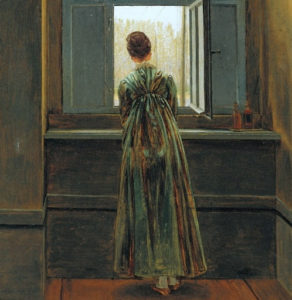
Une jeune femme se penche a la fenetre de l’atelier de Friedrich. C’est Caroline, l’epouse du peintre. Tournant le dos au spectateur, elle regarde couler l’Elbe. Les seuls signes de vie sont la femme, le vert delicat des peupliers, et le ciel de printemps. Dans ce travail, Friedrich a adopte un theme de predilection du romantisme, le cadre evoque un desir de l’inconnu. Le regard vers l’exterieur, contemplation de la nature, retour vers l’interieur de soi centre spirituel de l’individu. See also “Traveler in Front of a Sea of Fog” from Kunsthalle in Hamburg.
The artist saw without a doubt the art of Friedrich when he was in Berlin in April-May 1927[16].
The alogism of the character’s representation in “Female Torso No. 1” can be found too in all three other paintings of this cycle: “Torso (Figure with a pink face) <No. 2>”, “Torso (Primary formation of a new image) No. 3” and “Female torso No. 4 » We observe in all these paintings the same raised left shoulder, which turns its back on us. There is no depiction of hands that could be interpreted as a kind of disfigurement, as it will happen in the paintinge after 1930. In fact, one can imagine that the arms are crossed with a cross or tucked in the back or in the front. Moreover « Torso N° 3,(Primary formation of a new image), has one arm turned towards us and we can assume that on the left side which turned its back on us, the arm is folded down. And, moreover, it seems that Malevich wanted to dialogue, creating a new form, with the torsos of his compatriot Archipenko who, from 1914, created a whole series of truncated, armless female forms.
In No. 4 we note an even stronger alogism: on the left side we see the overlapping on the “shoulder” of elements that can indicate suprematist clothing with a collar. The contrast with the right-hand side turned towards us is very strong due to the bright presence of a white square on it on the shoulder, which is marked by a slight bend, while the beginning of the arm is represented.
The white veil surrounding the woman gives her the character of a Bride. Recall an article-poem in the Moscow newspaper Anarchy on June 12, 1918, “Engaged in a Horizon Ring,” which describes artists of all arts as lovers of the earth who seek its “hidden beauty”:[17]
« Beauty seekers walked across the face of the earth, among the rings of the horizon. »[18]
The earth appears as a « rich bride, »[19] to which « lovers engaged in a horizon ring aspire”[20].
COLOUR
Another significant element identified in the prototype of « Female Torso No. 1 » is a matter of color. Striking in post-suprematist paintings is its generally bright polychrome. The « imaginary geometry » of suprematic forms corresponds to what might be called the « imaginary colors », to the extent that the artist refutes the use in his painting of all scientific optical studies of the color prism. Already in 1913, the idea that the sun illuminates only the illusory world was approved in the cubic futuristic opera by M. Matyushina based on A.E. libretto Kruchenykh “Victory over the Sun”, in which the “black square” appears for the first time in Malevich’s sketch for “The Grave Digger”. From the 1919-1920s in Vitebsk, the artist reinforces the idea that color does not come from a light prism and that he determines the place of color in his letter to M.O. Gershenzon of April 11, 1920:
« For many years I was busy with my movement in colors, leaving aside the religion of the spirit. »[21]
He further, in the texts of the 1920s devoted to the question of “light and color,” invariably confirms that the pictorial color has nothing to do with prisms that optical science disassembles and analyzes.[22]
Note what Malevich declares about this during his teaching at the Kyiv Art Institute in 1928-1929, i.e. at the time when « Female Torso No. 1 » was written; refuting the idea that a painter must resort to scientific research on color, such as, for example, Ostwald (you can add Chevreul and Helmholtz there), he writes:
“We still think that the architectural forms follow from one “-ism”, and the color and texture follow from the discussion of the general meeting of all representatives of different institutions, who collectively select the color for this building on the walls of the built house. In another case if the builders want to bring the scientific base to color, turn to Ostwald or the nearest optical physical study room for studying color.
It’s all the same if Picasso, Braque, having drawn the forms of the painting, would have turned to Ostwald to have them painted according to all the rules of science, or if a society of artists, engineers, bakers, representatives from all unions would gather together to discuss the coloring of the painted form of a picture. »[23]
The painter affirms Suprematism even after 1930 in his work, already marked by the tragedy of the Holodomor (Great Hunger in Ukraine). He then wrote about “the development of color and its extinction from the dependence of dynamic stresses”[24]. He then intends to write a treatise on the “Sociology of Color,” which he cannot realize until death. It can be assumed that the word « sociology » did not have for the painter the meaning that Marx and his Marxist-Leninist followers gave to it …
Multicolor stripes depicting a Suprematist landscape are painted in our painting “Female Torso No. 1” in a rough, rigid manner, which is typical of many other Malevich’s last paintings.
The whole background of « Female Torso No. 1 » is also colored with a primitive brutal opaque way like the Matisse palette, for example, in the famous « Dance », or in M.F. Larionov around 1910… One could say about the “Female Torso No. 1” what was written about the “rude” application of paint by Matisse as a “wild pulsation ascending to the archaic, to primitive stains.”[25]
The same brush stroke power is found in the image of the head, where a white rough brushstroke is full of energy flutter. We find the same texture in a white hut. White paint is of particular importance in the poetics of Malevich, based on his attitude towards the world. In his above-mentioned letter to M.O. Gershenzon, he writes:
« I also see the New Temple, I divide black, white, and other colors into three actions – in the white I see the Pure action of the World, the colors are something pointless, but the conclusion of the Solar world and its religions. »[26]
Just in the “Female Torso No. 1” we see that three colors – gray, black, red – are opposed to the white figures and the house on its right side.
In the same way, as in many post-Suprematist portraits, from the face of the “Female Torso No. 1” comes an element that gives an additional metaphysical dimension, metaphysical in the etymological sense of the term, that is, behind the physical world. The Ukrainian artist several times surrounded with a kind of « halo » the faces of the depicted characters; then it’s a fiery red radiance, then the hair of some characters seems to be moved by the breeze, then it’s a white cover in “Female Torso No. 4… What we see on the left side of the face of “Female Torso No. 1 could be considered as » leaking « or damage to the picture, « a scratch ». It seems to me, in fact, that the matter is about the outline of the radiation emanating from this new image.
CONCLUSION
The painting « Female Torso No. 1 », which we consider in this article, is obviously the prototype of a whole group of works from 1928-1929, when the Ukrainian painter continues to research, through a sense of a objectless (pointless) world, the possibility of introducing a new image of a person in the bosom of the « Earth Bride ». It is a question of a new embodiment of Suprematism in icon contours.
« Female Torso No. 1 » allows us to reorganize suprematist creativity, which is still described in a chaotic approximate order, often just on a thematic basis.
First of all, it is necessary to distinguish works created before 1930, the category of which includes « Female Torso No. 1 ».
All those things that have this icon structure, either with or without a face, form a coherent unity. In this period, between 1928 and 1930, when Malevich was immersed in the Ukrainian world, his work was marked by a vision reflecting the coming world to be rather optimistic, although mysterious, in any case, as a promise of possible happiness. « Female Torso No. 1 » just opens a series of this type.
Although such a picture as “The Carpenter”, shown at the Kyiv exhibition in 1930, contains camouflaged disturbing elements (the Christ Artist holds a Passion’s tool in his hands)[27].
It is obvious, however, that the famous « Peasant Woman » with a black face[28], in which a black coffin is in place of the face, cannot be attributed to the period before 1930. It marks the beginning of the tragic vision of the suffering people and society. The painting « Peasants »[29] from the State Russian Museum is also, apparently, painted after 1930. After spending time in the prison and experiencing interrogations, Malevich starts drawing faceless and mutilated people. The themes of the crucifix, coffin, and cross become insistent. The white hut becomes the menacing red emblem of the prison. Red is no longer the color of the « Beautiful » as in « Red Square. The Peasant Woman » of 1915, but the color of blood.
So, “Female Torso No. 1” makes it possible to reinterpret Malevich post-Suprematist creativity; it also allows us to understand at its source the synthesis that the Ukrainian painter wanted to realize between Suprematism, primitivism, icon, alogism, and colorful energy. This synthesis is unique and completely original among the European art of the late 1920s-early 1930s.
June-July 2018
[traduit du russe par Andriy Khraban]
[1] Казимир Малевич в Русском музее, Санкт-Петербург, Palace Editions, 2000 (под ред. Е.Н. Петровой et alii), № 42, с. 337 / Kazimir Malevich in the Russian Museum, St. Petersburg, Palace Editions, 2000 (edited by E.N. Petrova et al), No. 42, p. 337
[2] См. Валентина Маркаде, “Селянська тематика в творчості Казимира Севериновича Малевича” (“Сучасність”, лют. 1979, с. 65-76) / See Valentine Marcadé, “Te Peasant Themes in the Work of Kazimir Severinovich Malevich” ( Malewitsch, Cologne, Galerie Gmurzynska, 1978, p. 94-119° )
[3] Guillaume Apollinaire, « Les Russes » [Русские], L’intransigeant, 22 avril 1911
[4] К. Малевич, Главы из автобиографии художника [1933], в кн. « Малевич о себе. Современники о Малевиче. Письма. Документы. Воспоминания. Критик (сост. И.А. Вакар, Т.Н. Михиенко), Москва, РА, 2004, т. 1, с. 28 / K. Malevich, Chapters from the autobiography of the artist [1933] in the book. « Malevich about himself. Contemporaries about Malevich. Letters. Documents. Memoirs. Critic (compiled by I.A. Vakar, T.N. Mikhienko), Moscow, RA, 2004, v. 1, p. 28
[5] Ibidem
[6] Казимир Малевич в Русском музее, цит. произв., № 36, с. 334. / Kazimir Malevich in the Russian Museum, cit. production., No. 36, p. 334.
[7] Там же, № 38, с. 335. Начальная дата была « 1910 », она была изменена на « 1918 », что требовало бы комментария, не входящего в рамки нашегонастоящего эссе. / The first date was “1910”, it later was changed to “1918”, which would require a comment that is not part of our present essay.
[8] Там же / Ibidem, № 37, с. 335
[9] К.С. Малевич, Письмо к Л.М. Лисицкому от 11 февраля 1925, в кн. Малевич о себе. Современники о Малевиче. Письма. Документы. Воспоминания. Критика, цит. произв., т. 1, с. 171 / K.S. Malevich, Letter to L.M. Lissitzky February 11, 1925, in the book. Malevich about himself. Contemporaries about Malevich. Letters. Documents. Memories. Criticism, cit. production., t. 1, p. 171
[10] [10] Казимир Малевич в Русском музее, цит. произв., № 42, с. 337 и № 68, с. 352 / Kazimir Malevich in the Russian Museum, cit. production., No. 42, p. 337 and No. 68, p. 352
[11] К.С. Малевич, Письмо к М.О. Гершензону от 11 апреля 1920 года, в кн. Малевич о себе. Современники о Малевиче. Письма. Документы. Воспоминания. Критика, цит. произв., т. 1, с. 127 / K.S. Malevich, Letter to M.O. Gershenzon of April 11, 1920, in the book. Malevich about himself. Contemporaries about Malevich. Letters. Documents. Memories. Criticism, cit. production., t. 1, p. 127.
[12] Цитирую по Joop M. Joosten’у в каталоге Malevich . 1875 [sic]-1935, Los Angeles, The Armand Hammer Museum of Art, 1990, c. 19 / I quote from Joop M. Joosten in the Malevich catalog. 1875 [sic] -1935, Los Angeles, The Armand Hammer Museum of Art, 1990, p. 19.
[13] Казимир Малевич в Русском музее, цит. произв., № 70, с. 353 / Kazimir Malevich in the Russian Museum, cit. production., No. 70, p. 353
[14] Там же / Ibidem, № 85, с. 358
[15] Там же / Ibidem, № 74, с. 354
[16] Thank the Berlin sociologists Anabella Weismann and Gerd Otto, who led me to such an interpretation of « Female Torso No. 1 ».
[17] Казимир Малевич, Собрание сочинений в пяти томах, Москва, « Гилея », т. 1, 1995, с. 115 / Kazimir Malevich, Collected Works in Five Volumes, Moscow, Gilea, vol. 1, 1995, p. 115
[18] Там же / Ibidem.
[19] Там же / Ibidem, с. 116
[20] Там же / Ibidem, с. 115
[21] К.С. Малевич, Письмо к М.О. Гершензону от 11 апреля 1920 года, цит. произв., с. 127 / K.S. Malevich, Letter to M.O. Gershenzon of April 11, 1920, cit. production., p. 127
[22] К.С. Малевич, Письмо к М.О. Гершензону от 11 апреля 1920 года, цит. произв., с. 127 / K.S. Malevich, Letter to M.O. Gershenzon of April 11, 1920, cit. production., p. 127
[23] К.С. Малевич, « Архитектура, станковая живопись, скульптура » [1929], в кн. Казимир Малевич. Київський період 1928-1930 (сост. Тетьяна Филевська), Київ, Родовід, 2016, с. 127 / K.S. Malevich, « Architecture, easel painting, sculpture » [1929], in the book. Kazimir Malevich. Kiev period 1928-1930 (comp. Tetyana Filevska), Kyiv, Rodovid, 2016, p. 127
[24] К.С. Малевич, Письмо к Л.М. Антокольскому от 15 июня 1931 года, в кн., Малевич о себе. Современники о Малевиче. Письма. Документы. Воспоминания. Критика, цит. произв., т. 1, с. 227 / K.S. Malevich, Letter to L.M. Antokolsky from June 15, 1931, in the book. Malevich about himself. Contemporaries about Malevich. Letters. Documents. Memories. Criticism, cit. production., t. 1, p. 227
[25] Isabelle Monod-Fontaine, « Grandeur Obtained by the Simplest means« , в каталоге Keys to a Passion (сост. Suzanne Pagé, Béatrice Parent). Paris, Fondation Louis Vuitton, 2015, p. 162
[26] К.С. Малевич, Письмо к М.О. Гершензону от 11 апреля 1920 года, цит. произв., с. 128 / K.S. Malevich, Letter to M.O. Gershenzon of April 11, 1920, cit. production., p. 128
[27] Казимир Малевич в Русском музее, цит. произв., № 34, с. 334 / Kazimir Malevich in the Russian Museum, cit. production., No. 34, p. 334
[28] Там же / Ibidem., № 72, с. 353
[29] Там же / Ibidem., № 21, с. 326