Auteur/autrice : Jean-Claude

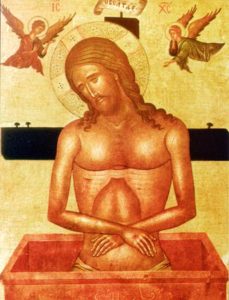
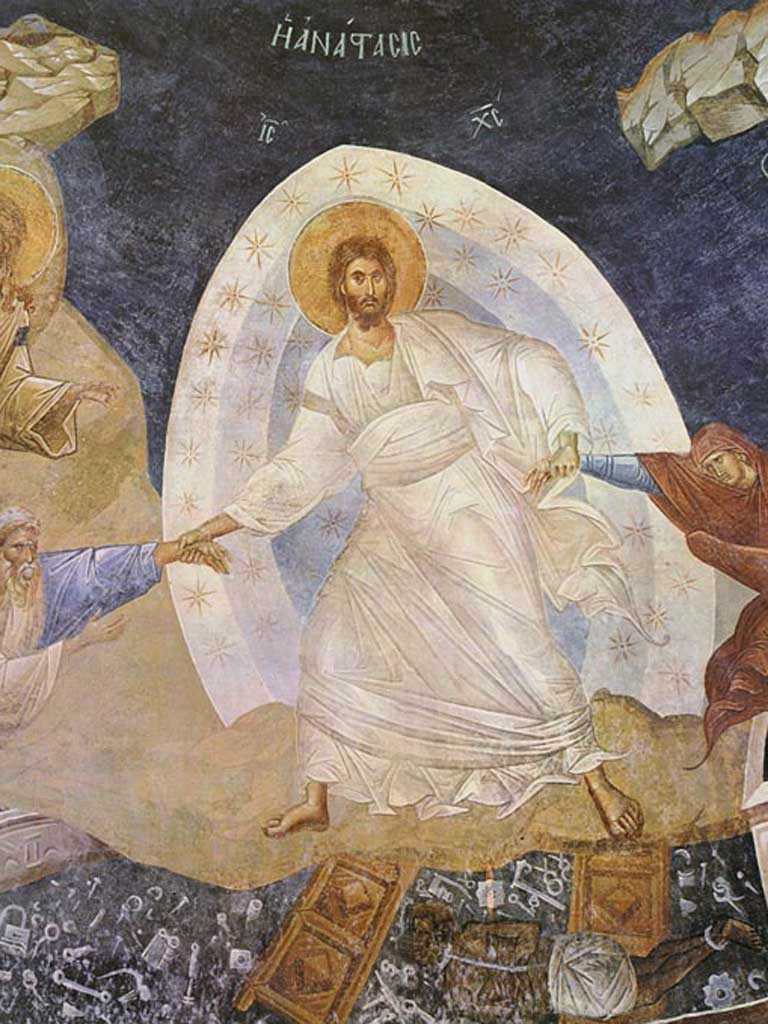
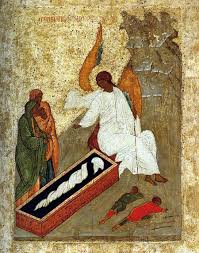
  • SAMEDI SAINT ORTHODOXE/Μεγάλο Σάββατο


    Μεγάλο Σάββατο

    SAMEDI SAINT ORTHODOXE

     Première épître du saint apôtre Paul aux Corinthiens (5, 6-8 ; Gal 3, 13-14)

    Frères, un peu de levain fait lever toute la pâte. Purifiez- vous donc du vieux levain pour être une pâte nouvelle, puisque vous êtes des azymes. Car le Christ, notre Pâque, a été immolé. Célébrons donc cette fête non avec du vieux levain ni avec un levain de malice et de perversité ; mais avec les azymes de la pureté et de la vérité. Car le Christ nous a rachetés de la malédiction de la Loi, en devenant lui-même malédiction pour nous (il est écrit en effet : Maudit soit quiconque pend au gibet), afin que dans le Christ Jésus la bénédiction d’Abraham s’étende aux nations païennes et que nous recevions par la foi l’Esprit de la promesse.

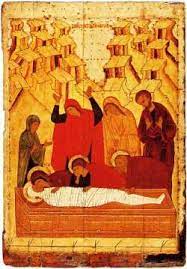
  • VENDREDI SAINT ORTHODOXE/Μεγάλη Παρασκευή

    VENDREDI SAINT ORTHODOXE

    Μεγάλη Παρασκευή 

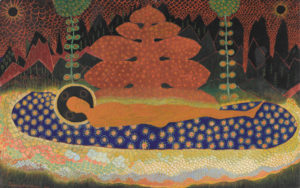
    Malévitch « Epitaphios », 1908

    Lecture de la première épître du saint apôtre Paul aux Corinthiens (1, 18 – 2, 2)

    Frères, le langage de la Croix est folie pour ceux qui se perdent, mais pour nous qui sommes sauvés, il est puissance de Dieu. Car il est écrit : « Je détruirai la sagesse des sages, j’anéantirai l’intelligence des intelligents. » Où est-il, le sage, où est-il, l’homme cultivé, où est-il, le raisonneur d’ici-bas ? Dieu n’a-t-il pas frappé de folie la sagesse de ce monde ? Car le monde, avec sa sagesse, n’ayant pas reconnu Dieu dans la sagesse de Dieu, c’est par la folie de son message qu’il a plu à Dieu de sauver les croyants. Oui, tandis que les Juifs demandent des signes et que les Grecs sont en quête de sagesse, nous prêchons, nous, un Christ crucifié, scandale pour les Juifs et folie pour les Grecs, mais pour les élus, qu’ils soient Juifs ou Grecs, c’est le Christ, puissance de Dieu et sagesse de Dieu. Car ce qui est folie de Dieu est plus sage que la sagesse des hommes, et ce qui est faiblesse de Dieu est plus fort que la force des hommes. Aussi bien, frères, considérez votre vocation. Il n’y a pas beaucoup de sages selon la chair, ni beaucoup de puissants, ni beaucoup de gens bien nés. Mais ce que le monde tient pour insensé, voilà ce que Dieu a choisi pour confondre les sages. Ce qu’il y a de faible dans le monde, voilà ce que Dieu a choisi pour confondre la force. Ce qui, dans le monde, est sans naissance et sans importance, voilà ce que Dieu a choisi : ce qui n’est pas, pour réduire à rien ce qui est, afin que nulle chair ne se glorifie devant Dieu. Car c’est grâce à lui que vous êtes dans le Christ Jésus, qui de par Dieu est devenu pour nous sagesse, justice, sanctification et rédemption, afin que, selon le mot de l’Écriture, celui qui se glorifie se glorifie dans le Seigneur.

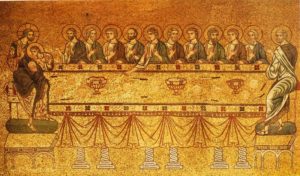
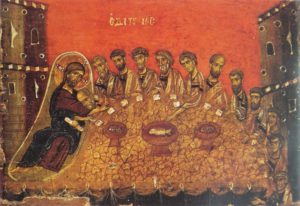
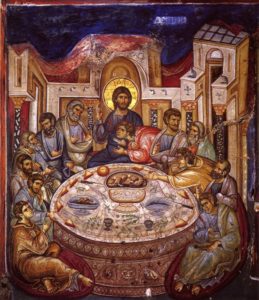
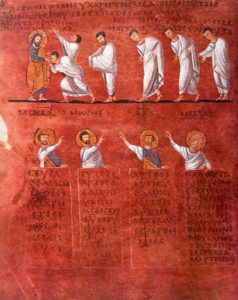
  • JEUDI SAINT ORTHODOXE

    JEUDI SAINT ORTHODOXE

    EXTRAIT DU LIVRE DE JOB  (38 ; 42)

    Le Seigneur dit à Job, du sein de la tempête et de la nuée : Quel est celui qui obscurcit mes conseils par des propos dénués de sens ? Mets ta ceinture, comme un homme : je vais t’interroger, tu me répondras. Où étais-tu quand j’ai fondé la terre. Parle, si tu es informé. Qui en a pris les mesures : le saurais-tu ? Qui a tendu sur elle le cordeau ? Sur quoi reposent ses bases ? Qui en a posé la pierre d’angle, parmi le concert joyeux des astres du matin, aux acclamations de tous les Anges de Dieu ? Qui a fermé la mer avec des portes, quand elle jaillit du sein maternel, quand je lui donnai les nuées pour habit et, pour langes, des brouillards ténébreux, quand je lui traçai des limites et lui mis portes et verrous en disant : « Tu n’iras pas plus loin, ici se brisera l’orgueil de tes flots » ? As-tu, une fois dans ta vie, commandé au matin, assigné l’aurore à son poste, pour qu’elle saisisse les ailes de la terre et en secoue les méchants ? Ou bien est-ce toi qui, prenant du limon de la terre, façonnas un vivant et le mis sur terre avec la parole ? Arraches-tu aux impies la lumière ? As-tu brisé le bras de l’orgueilleux ? As-tu pénétré jusqu’aux sources de la mer, t’es-tu promené au fond de l’océan ? Les portes de la mort se sont-elles ouvertes devant toi ? Les gardiens de l’Enfer, en te voyant, ont-ils été dans l’épouvante ? As-tu quelque idée des étendues terrestres ? Parle, si tu sais tout cela ! De quel côté habite la lumière ; et les ténèbres, où résident- elles ? Pourrais-tu me conduire à leurs frontières et reconnaître les sentiers de leur demeure ? Tu dois le savoir, puisque tu étais déjà né : le nombre de tes jours est si grand ! Job répondit au Seigneur en ces termes : Je sais que tu peux tout, que rien n’est impossible à Dieu. J’étais « celui qui obscurcit tes conseils par des propos dénués de sens ». Aussi ai-je parlé, sans les comprendre, de merveilles qui me dépassent et que j’ignore. Je ne te connaissais que par ouï-dire, mais maintenant mes yeux t’ont vu !

    EXTRAIT DE L’ÉVANGILE SELON SAINT LUC  (22)

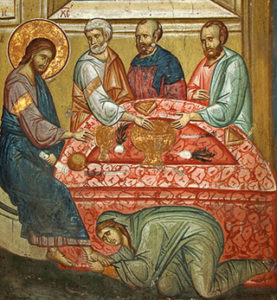
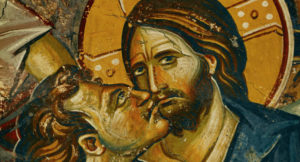
    En ce temps-là, la fête des Azymes, appelée la Pâque, approchait. Les grands prêtres et les scribes cherchaient le moyen de faire disparaître Jésus ; car ils craignaient le peuple. Or Satan entra dans Judas, surnommé Iscariote, qui était du nombre des Douze. Il s’en alla conférer avec les grands prêtres et les chefs des gardes sur la manière de le leur livrer. Ceux-ci s’en réjouirent et lui promirent de l’argent. Il donna son accord et se mit à chercher une occasion favorable pour le leur livrer à l’écart de la foule. Vint le jour des Azymes, où l’on devait immoler la Pâque. Jésus envoya Pierre et Jean et leur dit : Allez nous préparer de quoi manger la Pâque. Ils lui demandèrent : Où veux-tu que nous la préparions ? Il répondit : Quand vous entrerez dans la ville, vous trouverez un homme portant une cruche d’eau ; suivez-le dans la maison où il entrera, et vous direz au propriétaire de la maison : Le Maître te fait dire : Où est la salle où je pourrai manger la Pâque avec mes disciples ? Et il vous montrera, à l’étage, une grande pièce garnie de coussins ; faites-y les préparatifs.

    Ils s’en allèrent donc, trouvèrent tout comme Jésus le leur avait indiqué, et ils préparèrent la Pâque. L’heure venue, Jésus se mit à table avec les douze apôtres et leur dit : J’ai désiré d’un grand désir manger cette Pâque avec vous avant de souffrir ; car, je vous le dis, désormais je ne la mangerai plus qu’elle soit accomplie dans le royaume de Dieu. Prenant alors une coupe, il rendit grâces et dit : Prenez cette coupe et partagez entre vous ; car, je vous le dis, désormais je ne boirai plus de ce fruit de la vigne jusqu’à ce que le royaume de Dieu soit venu. Puis il prit du pain et rendit grâces, il le rompit et le leur donna en disant : Ceci est mon corps qui est donné pour vous ; faites ceci en mémoire de moi. De même, après le repas, il prit la coupe en disant : Cette coupe est la nouvelle alliance en mon sang qui est versé pour vous. Cependant, voici que la main du traître est à cette table avec moi. Le Fils de l’homme va à son sort selon ce qui a été décrété ; mais malheur à l’homme par qui il est trahi !

  • Mercredi Saint/Страстная среда

    Страстная среда

    Μεγάλη Τετάρτη


    DE L’ÉVANGILE SELON SAINT JEAN (chapitre 12)

    Beaucoup toutefois, même parmi les notables, crurent en lui ; mais, par crainte des Pharisiens, ils n’osaient se déclarer, de peur d’être exclus de la synagogue, préférant ainsi la gloire des hommes à la gloire de Dieu.

    Cependant Jésus dit d’une voix forte : Qui croit en moi, croit non pas en moi, mais en celui qui m’a envoyé ; et qui me voit, voit celui qui m’a envoyé. Moi, la lumière, je suis venu dans le monde afin que quiconque croit en moi ne demeure pas dans les ténèbres. Si quelqu’un entend mes paroles et ne les garde pas, ce n’est pas moi qui le condamnerai, car je ne suis pas venu pour condamner le monde, mais pour le sauver. Celui qui me rejette et ne reçoit pas mes paroles a déjà son juge : la parole que j’ai fait entendre, c’est elle qui le jugera au dernier jour ; car je n’ai pas parlé de moi-même, mais le Père qui m’a envoyé m’a lui-même prescrit ce que je devais dire et faire entendre ; et son commandement, je le sais bien, c’est la vie éternelle. Aussi les paroles que je dis, je les dis comme le Père me les a enseignées.

  • Mardi Saint

    Η Μεγάλη Τρίτη

    Lecture de la prophétie d’Ézéchiel (1, 21-28)

    Lorsque les animaux avançaient, les roues avançaient près d’eux, et lorsqu’ils s’élevaient de terre, les roues s’élevaient. Là où l’esprit les poussait, ils allaient, et les roues s’élevaient avec eux, car un souffle de vie animait aussi les roues. Dominant la tête de ces êtres, il y avait quelque chose qui ressemblait à une voûte limpide comme le cristal, tendue au-dessus de leur tête, et sous la voûte leurs ailes étaient déployées jusqu’à se toucher, et elles couvraient leur corps. Et j’entendis le bruit de leurs ailes, comme un bruit de grandes eaux, comme la voix du Tout-puissant, un tumulte semblable à celui d’un camp. Lorsqu’ils s’arrêtaient, ils repliaient leurs ailes. Et il se produisit un bruit au-dessus de la voûte qui dominait leur tête. Au-dessus de cette voûte, il y avait quelque chose comme une pierre de saphir, en forme de trône, et sur cette forme de trône, dessus, tout en haut, un être ayant apparence humaine. Et je vis qu’il avait l’éclat du vermeil, et près de lui il y avait quelque chose comme du feu, tout autour, depuis ce qui paraissait être ses reins, et au-dessus ; et depuis ce qui paraissait être ses reins, et au- dessous, je vis quelque chose comme du feu, et une lueur tout autour. Tel l’arc qui apparaît dans les nuages les jours de pluie, telle était la splendeur qui l’environnait. Cette vision, c’était l’image de la gloire du Seigneur.

    Prokimenon, t. 6 (Ps. 130) : Mets ton espoir, Israël, dans le Seigneur, dès maintenant et à jamais. Verset: Seigneur, je n’ai point le cœur fier, ni le regard hautain.

  • ВЕЛИКИЙ ПОНЕДЕЛЬНИК

    ВЕЛИКИЙ ПОНЕДЕЛЬНИК

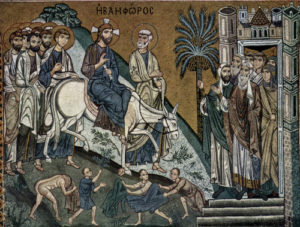
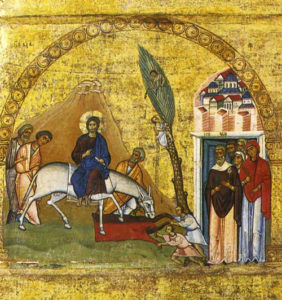
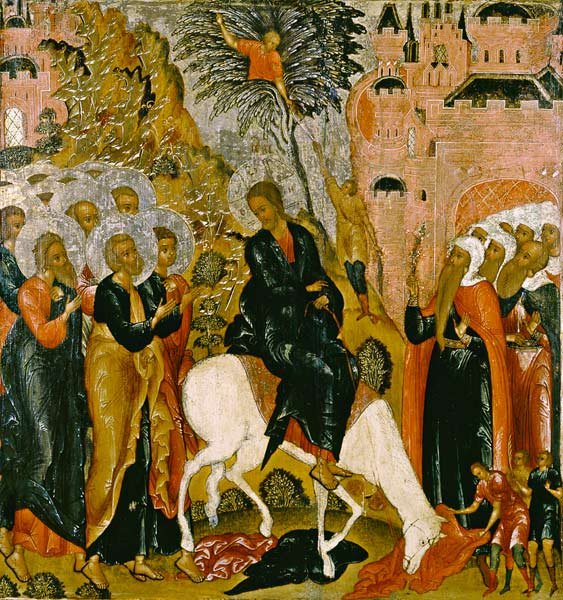
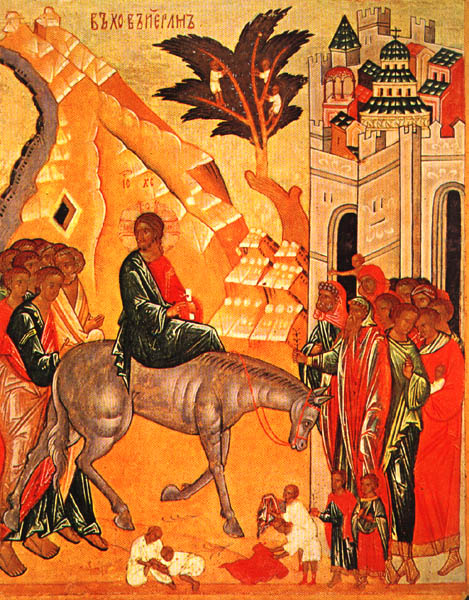
  • Bonne fête des Rameaux

    С Вербным воскресеньем!


    Outre le magnifique texte de Saint Jean  sur la visite de Jésus chez Lazare ressuscité, Marthe et Marie, la lecture, en ce jour de fête orthodoxe des Rameaux, d’un extrait de l’Épître aux Philippiens est aussi un passage des plus inspirés de l’Apôtre :

    Réjouissez-vous sans cesse dans le Seigneur, je le dis encore, réjouissez-vous.

    Радуйтесь всегда в Господе; и еще говорю: радуйтесь.

    5.

    Que votre modération soit connue de tous les hommes. Le Seigneur est proche.

    Кротость ваша да будет известна всем человекам. Господь близко.

    6.

    N’entretenez aucun souci ; mais en tout besoin recourez à l’oraison et à la prière, pénétrées d’action de grâces, pour présenter vos requêtes à Dieu.

    Не заботьтесь ни о чем, но всегда в молитве и прошении с благодарением открывайте свои желания пред Богом,

    7.

    Alors la paix de Dieu, qui surpasse toute intelligence, prendra sous sa garde vos cœurs et vos pensées, dans le Christ Jésus.

    и мир Божий, который превыше всякого ума, соблюдет сердца ваши и помышления ваши во Христе Иисусе.

    8.ux

    Enfin, frères, tout ce qu’il y a de vrai, de noble, de juste, de pur, d’aimable, d’honorable, tout ce qu’il peut y avoir de bon dans la vertu et la louange humaines, voilà ce qui doit vous préoccuper.

    Наконец, братия мои, что только истинно, что честно, что справедливо, что чисто, что любезно, что достославно, что только добродетель и похвала, о том помышляйте.

    9.

    Ce que vous avez appris, reçu, entendu de moi et constaté en moi, voilà ce que vous devez pratiquer. Alors le Dieu de la paix sera avec vous.

    Чему вы научились, что приняли и слышали и видели во мне, то исполняйте, – и Бог мира будет с вами.

  • UNOVIS in the History of the Russian Avant-Garde

    UNOVIS in the History of the Russian Avant-Garde

    Jean-Claude Marcadé

    A New Approach to Art

    Like the Bauhaus, formed a few months earlier in 1919, and the INKhUK (Institute of Artistic Culture), formed in Moscow in May 1920, Kazimir Malevich’s UNOVIS (late 1919–22) overthrew the age-old methods of artistic education in favor of what would henceforth be based on the study of five pictorial cultures, which, according to Malevich, formed the basis for the new art: Impressionism (Monet), Post-Impressionism (Cézanne, Gauguin, van Gogh, Pointillism), Cubism, Futurism, and Suprematism.

                Art was to be studied on an objective basis: with the phenomenon of art considered as a whole, as an ensemble—as a body—without distinguishing major arts from minor arts, artist from artisan, technique from creation, etc. Art was to be inserted into a multi- and interdisciplinary complex. Pictorial culture was to be understood as a particular case of artistic culture in this definition. At the very moment that the first “museums of modern art” in the world—the Museums of Pictorial Culture—were being established in Russia, Malevich showed himself to be the most radical of all regarding the relations between innovation and nostalgia for the past.

                One of the virtues of this “leftist art” in Russia, Belarus, and Ukraine has been to disentangle the study of art from the magma of impressions, emotions, aesthetic subjectivism, psychologism, and the anecdotal. “The influence of economic, political, religious, and utilitarian phenomena on art is the disease of art,” Malevich declared.[1]

                « Modern art begins with Cézanne: this was the cornerstone of Malevich’s teaching that he dispensed at the UNOVIS collective in Vitebsk, then at the INKhUK of Petrograd / Leningrad (1922–26), and at the Art Institute of Kiev (1928–30),[2] which consisted of studying the five main “pictorial cultures” of the “new art” and underscoring their essential elements. Impressionism, Cézannism (a general term covering Post-Impressionism), Futurism, Cubism, and Suprematism were analyzed according to the “sensation of contrasting interactions, tonalities, colorful elements in each painting,”[3] but also according to “the dynamic, the static, the mystical, and other sensations.”[4] The word sensation (oshchushchenie; Empfindung; aesthesis) occurs repeatedly in Malevich’s writing: “the union of Universe and man is not in form but in the process of sensation.”[5]

                The fact that his reflections start from the analysis of Cézanne’s paintings in the first place attests to the convergence between his thinking and the thoughts of the master of Aix, who considered that painting defined itself as the “means of expression of sensation.”[6] Along the same lines, Cézanne wrote to Émile Bernard that he wanted to bring together nature and art, adding: “Art is a personal apperception, which I embody in sensations and which I ask the understanding to organize into a painting.”[7]

                In affirming that color is “the place where our brain and the universe meet,”[8] Cézanne can be seen as a precursor of Malevich. Indeed, in his pedagogy of the 1920s, the founder of Suprematism would analyze a work in terms of both form and color, without neglecting an analysis of sensation. A photomontage created under his leadership contained six columns in alignment and labeled Naturalism, Impressionism, Cézannism, Cubism, Futurism, and Suprematism—in other words, according to Malevich, the basic stages of the art of the left since its break with naturalism. Each column contained reproductions of paintings in contrast to photographs of real environments. Malevich titled this graphic presentation Photomontage Showing the Pictorial Sensations and Environment of Naturalism, Impressionism, Cézannism, Cubism, Futurism, and Suprematism.[9]

                The paintings in the Naturalism column are barely distinguishable from the photographs they are identified with, which are of landscapes, rivers, skiffs, peasant houses, scenes from daily life. In the Impressionism column, Auguste Renoir’s La Grenouillère (formerly part of the Morozov collection, now in The Pushkin Museum of Fine Arts, Moscow) is shown with a photograph of an open-air dance hall. The Cézannism column shows an image of Gardanne (Barnes Foundation, Philadelphia) and Mont Sainte-Victoire seen from Les Lauves (formerly in the Shchukin collection, now in The Pushkin Museum of Fine Arts, Moscow), on one side, with photographs of villages in Provence on the other. Cubism displays works by Picasso and Braque with a montage of collages made from geometrical fragments, newspapers, views of industrial exhibitions, a violin, and pieces of material—all of them placed so as not to conform to the representational logic of the visible. Futurism shows a painting by Gino Severini titled The Pan Pan Dance at the Monico (Centre Pompidou, Paris) and a drawing by Umberto Boccioni after The States of Mind: The Farewells (first version: Museo del Novecento, Milan; second version: The Museum of Modern Art, New York), with photographs of crowds in a limited space, along with machines, obstacle courses, trains, and factories. As to the column devoted to Suprematism, it contains two lithographs by Malevich placed opposite aerial views of fields and clusters of buildings.

                In the example of Suprematism, one can see clearly that the environment that parallels the works of art does not condition them, contrary to the way this question is addressed in Hippolyte Taine, for example, or in Karl Marx. Malevich’s considerations are antipositivist and anti-Marxian. Suprematism does not “paint space.” It is space itself, a “liberated nothingness” that paints itself on the surface of the painting, and this is made possible precisely through sensation. One can say that a Suprematist painting is equal to the universe, that it is nature, and that the cosmic excitation that passes through it also passes “inside man, without goal, without meaning, without logic.”[10]

    Pure Form, Freed of Content and Function

    Malevich always insisted that art was independent of any utilitarianism. Starting with his writings from 1915–16, he contrasted utilitarian reason and intuitive reason, with the first in the service of the latter. In 1919, he engaged in polemics with his former followers, who were preparing to found Constructivism (especially with Aleksandr Rodchenko and Liubov Popova) and wrote that “All colorations with utilitarian intent are insignificant.”[11]

                Selim Khan-Magomedov has clearly described the process that led to Malevich’s objectless poetics.

    “The deep space of white background (of unlimited depth, almost cosmic)—this is Malevich’s innovation (or discovery). All the early Suprematist work consists of colored geometric ornamentation, without reference, on a white background. From his earliest years, Malevich had observed the white of the walls and woodburning stoves of the Ukrainian khatas on which the peasant women made their colored drawings.”[12] Describing “the assortment of geometric figures freely dispersed on the white background,” the Soviet art historian adds, “It was as if he were sending the flat kites of children aloft.”[13]

                In his books from Vitebsk, the Ukrainian-Russian artist rejected any utilitarianism that resorts to figurative forms and colors. He proclaimed a new Suprematist utilitarianism that did not copy but that would instead create other constructions of objects, based on an economic principle that aimed at the complete rejection of the outward forms of the past, that would bring forth a new formal dynamic and a true spiritual energy.

                The example of Ukrainian peasant women from Verbivka [Verbovka], who transposed Suprematist and abstract themes into embroidery in 1915, constituted a first step.[14] UNOVIS would further radicalize these first attempts through new forms, with objectless elements inscribed on them. There is no question that El Lissitzky played a crucial role in the broad participation of the Affirmers of the New Art in every domain known as the “applied arts.” But as early as January 1919, Malevich claimed that “every art exhibition must be an exhibition of projects to transform the picture of the world.”[15]

                It was no coincidence that Malevich declared in 1920, before the future Moscow Constructivists, that “painting has long since outlived its time.”[16] But the pictorial (zhivopisnoe), as a way of organizing a space, continued its centuries-old existence.

                Khan-Magomedov has noted that the “supergraphic [supergrafica] created in Vitebsk in 1919–20 by Malevich and Lissitzky (with their students) was an astonishing phenomenon at the scale of the Russian artistic avant-garde . . . Involvement in the supergraphic enabled Suprematism to feel out its points of contact with social practice.”[17]

                Thus a number of domains were explored by Malevich, Lissitzky, Vera Ermolaeva, Nina Kogan, and their students (Ilya Chashnik, Nikolai Suetin, Lazar Khidekel, Ivan Chervinka, and Boris Tseitlin, among others). Their experiments concentrated at the outset on the facades of several buildings in the Belarusian town, on the interiors of public space (theaters, cafeterias), tribunes for orators, vehicles of urban transport, posters, or even on the staging of revolutionary festivals. In the fields of book design and scenography, UNOVIS members followed the prime Suprematist principle according to which the visual elements were to be autonomous in relation to the content.

                Work in ceramics was one of the high points of avant-garde design in Russia, comparable mutatis mutandis to the publication of Futurist books in the 1910s. One can claim, as does Khan-Magomedov, that the projects for tableware, as well as for fabrics, are part of the general evolution of Suprematist painting.[18] The Suprematist pictorial existed outside easel painting, which Malevich downplayed in Vitebsk, preferring to concentrate on the publication of his texts and on pedagogy.

                Another step forward was taken by UNOVIS: the conquest of the cosmos, or at the very least, the will to pursue the Suprematist adventure into architecture. This was thanks to Lissitzky, himself an architect by profession, who conducted architecture studios in Vitebsk that were attended by Malevich’s students. The extraordinary group of Prouns (Projects for the Affirmation of the New), the first of which were created in Vitebsk, showed that Lissitzky was the first to have extended in his canvases and drawings, architectural volumes with Suprematist plans, creating “stations on the way to constructing a new form.” Quoting Khan-Magomedov once more, “One can even say that in the general evolution of Suprematism, from painting to volume, the Prouns were the clearest manifestation . . . It is true that the Prouns were not architecture . . . but paintings pregnant with architecture.”[19] In that sense, Lissitzky anticipated not only Chashnik’s pictorial reliefs, but also Malevich’s Arkhitektons, which would take form after 1922, in Petrograd / Leningrad, within the framework of what would become the INKhUK.

                Nor can we pass over the work of David Yakerson, who directed a sculpture studio in Marc Chagall’s People’s Art School and joined UNOVIS. Aleksandra Shatskikh has written numerous articles about this Belarusian sculptor. In Yakerson’s monuments erected in Vitebsk in 1920 to the memory of Karl Marx and Karl Liebknecht (cat. pp. 58–59), she recognizes the seeds of the Arkhitektons that Malevich would begin to produce in Petrograd in 1923.[20] Nonetheless, like the stone sculptures of Georges Vantongerloo titled Constructions of Volume Relations (1919), each a sort of pile of solid blocks (that Yakerson was perhaps acquainted with), these were all far from the complexity of Malevich’s own assemblages of Suprematist plans. It would no doubt be more judicious to consider as precursors the extraordinary Dynamic Cities (fig. 1) by the Latvian-Russian Gustav Klucis [Klutsis], a student of Malevich and subsequently of Natan Pevzner (alias Antoine Pevsner) at the Moscow SVOMAS (Free State Art Studios) between 1919 and 1920.

    Malevich and the Other Avant-Gardists

    An artist who had been close to the Constructivists, Elizaveta Galperina-Zeldovich, would say in a later interview:

    “The objectless. The objectless painting, that is to say the painting which is made up purely from composition, color, and craftsmanship, but without content. . . . Strictly speaking, in Malevich there is a content—a geometrical one. His work contained a regulated square, combinations of squares and triangles—and that was all. There were no, shall we say, finishing touches—none of these gradations such as we see in Kandinsky. There was nothing like that. There was an exact geometric construction of the surface of the painting, a solid relationship from one piece to another, such that nothing would break down.”[21]

                The path that Malevich chose was completely different, not only from Vasili Kandinsky’s, but also from those of Mikhail Larionov, Vladimir Tatlin, Pavel Filonov, Mikhail Matiushin, and Aleksandr Rodchenko, to mention only a few of the luminaries of the Russian and Ukrainian avant-garde who founded schools of painting. The founder of Suprematist objectlessness kept his distance from artists who recklessly claimed to be proponents of nonfigurative bespredmetnost’.

                This is why, in the June 20, 1918, edition of the Moscow journal Anarkhiia (Anarchy), for which he had prepared a comparative analysis of the first exhibition of artists of the Left Federation after the Revolution, he expressed his ferocious criticism of certain artists who referred to objectlessness:

    “At this point, after I had set out the basis of the Suprematist movement, whose influence has formed a whole number of individual artists, I wanted to separate out those who would adhere to the principles of Suprematism from the flood of those who claim objectlessness, to clarify the muddle that characterizes criticism, which considers objectlessness as Suprematist. / But here we encounter a difficulty, because the features of the flat surface emerge from objectlessness, which can introduce some confusion in the mind of the spectator, as was the case in the exhibition of the Union of Artist-Painters: Left Federation, where the treatment of various planar surfaces and the very facet of the planar surface coincide with what is Suprematist. But in their essence, they have nothing in common.”

                After listing what he considered to be the principles of Suprematism (freedom in the interactions between form and color; surface tranquility; balance in the planes; energetic craftsmanship; immateriality), he concluded that “the entire structure of Suprematism represents a flat surface in tension . . . where on each planar surface we see a semantic ambulation [smyslovoi khod], a great ease and conservation of the sign. And what is displayed in the exhibition under the name of objectlessness, which is noted in the reviews as Suprematist, does not correspond to the truth [pravda], except [for the works of] Rozanova.”[22]

                He then launched into a critique of abstract works that were labeled “objectless,” but which could not be called Suprematist in the strict sense of the word. These included the work of Aleksandr Vesnin, of Liubov Popova (as lacking in unity between the different planes, and between form and color), and of Nadezhda Udaltsova (for piling on combinations without sufficient concern for equilibrium). This makes it clear why the Tenth State Exhibition in 1919 in Moscow was titled Objectless Creation and Suprematism. It appears that Malevich sought to distinguish his work from the group forming around Rodchenko (Stepanova, Vesnin, Popova) and which was breaking off from him, and would subsequently be joined by Ivan Kliun, who was moving away from Suprematism. Malevich would find new disciples through the Vitebsk UNOVIS and its different branches in the Soviet Federation. One can also understand why he was opposed to the artists who constituted the first Constructivist nucleus within the INKhUK in 1921.

                The distinguishing feature of the Constructivist experiment is that it identifies with the sociopolitical demands of revolutionary Russia, at first under the banner of anarchy and proletarian culture, and subsequently under the banner of Bolshevik Marxism-Leninism. The objective was to shape life in the new society through an ensemble of artistic experiments.

                In Suprematism, the experience is first of all the conceptual experience of living in an objectless world. Experimentation consists in deciphering, within the existing (the artist, the artwork, social organization), the truth of being of the objectless, which traverses this existing. The entire aim of Malevich’s Suprematism is to reorient the workings of the world toward “eternal rest.” He saw Suprematism as a new religion that would replace the old ones—the religion of the “pure white act”—and wanted to found a new figure of God, an objectless god. This began in the Vitebsk UNOVIS, where Malevich’s philosophical treatise God Is Not Cast Down: Art, Church, Factory was published in 1922.

    Translated from French by Christian Hubert

    [1] Kazimir Malevich, “Zhivopis i problema arkhitektury” (Painting and the Problem of Architecture), Nova Generatsiia 3, no. 2 (1928).

    [2] On Malevich’s activity in his native Ukraine, at the Kiev Art Institute, see the new documents published in Tetyana Filevska, ed., Kazimir Malevich: Kyiv Period, 1928–1930 (Kiev: RODOVID, 2017).

    [3] Kazimir Malevich, “Esteticheskii test dlia opredeleniia khudozhestvennoi i neartistskoi storony rabot” (Aesthetic Test to Determine the Artistic and Nonartistic Side of Works) (1928), in Kazimir Malévitch, Écrits, trans. Jean-Claude Marcadé (Paris: Allia, 2015), vol. 1, p. 548.

    [4] Ibid.

    [5] Ibid., p. 585.

    [6] Letter from Paul Cézanne to Émile Zola, dated November 20, 1878, in Paul Cézanne, Correspondance, ed. John Rewald (Paris: Grasset, 1978), p. 177.

    [7] Letter from Paul Cézanne to Émile Bernard, quoted in Maurice Merleau-Ponty, “Cézanne’s Doubt,” Sense and Non-Sense (Evanston, Ill.: Northwestern University Press, 1992), p. 13.

    [8] Quoted in Maurice Merleau-Ponty, “Eye and Mind,” in The Merleau-Ponty Aesthetics Reader, ed. Galen A. Johnson (Evanston, Ill.: Northwestern University Press, 1993), p. 141.

    [9] See Troels Andersen, Malevich, Stedelijk Museum Amsterdam, 1970, p. 116-132; in french : Jean-Claude Marcadé, Malévitch (Paris: Casterman, 1990), pp. 202–11.

    [10] Kazimir Malevich, Bog ne skinut: Iskusstvo, tserkov’, fabrika (God Is Not Cast Down: Art, Church, Factory) (Vitebsk: UNOVIS, 1922), in Écrits, vol. 1, p. 312.

    [11] Kazimir Malevich, in Écrits, vol. 2, p. 193.

    [12] Selim O. Khan-Magomedov, Suprematizm i arkhitektura: Problemy formoobrazovaniia (Suprematism and Architecture: The Problem of the Constitution of Forms) (Moscow: Arkhitektura-S, 2007), p. 113.

    [13] Ibid., pp. 113–14.

    [14] See Charlotte Douglas, “Suprematist Embroidered Ornament,” Art Journal 54, no. 1 (1995), pp. 42–45.

    [15] Kazimir Malevich, “Novatoram vsego mira” (To Innovators Around the World), January 1919, in Kazimir Malevich, Sobranie sochinenii v piati tomakh (Collected Works in Five Volumes), ed. Aleksandra Shatskikh (Moscow: Gileia, 2004), vol. 4, p. 141.

    [16] Kazimir Malevich, Écrits, vol. 1, p. 263.

    [17] Khan-Magomedov, Suprematizm i arkhitektura (Suprematism and Architecture), p. 218.

    [18] Ibid., p. 245.

    [19] Ibid., p. 294.

    [20] See especially Aleksandra Shatskikh, Vitebsk: The Life of Art, 1917–1922 (New Haven: Yale University Press, 2007), pp. 169–75.

    [21] Elizaveta Galperina-Zeldovich, interview with Viktor Duvakin, in Kazimir Malevich: Letters, Documents, Memoirs, Criticism, ed. Irina A. Vakar and Tatiana N. Mikhienko (London: Tate Publishing, 2015), vol. 2, p. 213.

    [22] Kazimir Malevich, “Vystavka professional’nogo soiuza khudozhnikov-zhivopistsev: Levaia Federatsiia–Molodaia Fraktsiia” (The Exhibition of the Union of Artist-Painters: Left Federation–Youth Faction), Anarchie, no. 89 (June 20, 1918), in Écrits, vol. 1, pp. 156–57.