Auteur/autrice : Jean-Claude
-
Antoine Pevsner dans le nouvel accrochage du MNAM
L’Association « Les Amis d’Antoine Pevsner » (c/o Pierre Brullé, 25 rue de Tournon, 75006 Paris) a publié trois ouvrages :
Pevsner Colloque, en 1993
Catalogue raisonné de l’oeuvre sculpté de Pevsner (d’Élisabeth Lebon et Pierre Brullé), en 2002
Pevsner Cahier 1, en 2014
Ces ouvrages peuvent être commandés à l’adresse de l’Association « Les Amis d’Antoine Pevsner »
Dans le nouvel accrochage très stimulant des collections du MNAM Pevsner est bien représenté. Je regrette seulement que Malévitch soit, à nouveau, mis dans une nébuleuse, appelée « Constructivismes », alors que l’on sait que le fondateur du Suprématisme (mot dont le nom n’est même pas prononcé!) fut dans les années 1920 radicalement opposé au constructivisme soviétique (voir, en français, le livre de Sélim Khan-Magomédov –
Sélim Khan Magomédov, L’Inkhouk. Naissance du constructivisme, CH-Gollion, Infolio, 2013 (traduit du russe par Françoise Pocachard-Apikian) (381 p.)


-
Nicéphore le Patriarche de Constantinople (758-828)
Les travaux de Marie-José Mondzain sur le saint patriarche Nicéphore sont à lire et à relire :
Nicéphore (758 – 828) : Discours contre les iconoclastes, Collection d’esthétique, Klincksieck, 1989 (ISBN 978-2-252-02669-4) (Traduction, présentation et notes par Marie-José Mondzain)
L’Image naturelle, Le Nouveau commerce, 1995
Image, icône, économie. Les Sources byzantines de l’imaginaire contemporain, Seuil, 1996 (ISBN 978-2-02-020867-3)


-
Alexandre SOKOUROV
Alexandre SOKOUROV


Alexandre Sokourov n’est peut-être pas l’homme le plus drôle de Russie (difficile autrement lorsqu’on réalise une « tétralogie sur le mal ») mais il est un grand cinéaste et audacieux.
Avant Faust, Sokourov avait dressé les portraits d’Hitler, Lénine puis Hirohito. Ce dernier opus s’inspire librement de l’œuvre de Goethe. Telle est d’ailleurs la seule planche de salut lorsque le cinéma adapte un monument littéraire : l’appropriation totale, la largesse d’adaptation.Cyril Béghin a déjà beaucoup dit sur ce film dans Les cahiers du cinéma (n° 679 de juin 2012). Apporter de l’inédit sur une œuvre aussi difficile d’accès réclame de la prise de tête, fusion de connexions synaptiques à venir.
Côté forme, le film ose tout : le vieux format 1.33 (image quasi carrée), les filtres de couleurs, les distorsions d’images, une musique dissonante. La forme est généreuse en angoisse et en enfermement. A noter que la direction photo est assurée par le français Bruno Delbonel (Amélie Poulain, Dark Shadows, Inside Llewyn Davis, …). Que ceux qui se froissent aisément à la vue du maniérisme cinématographique passent leur chemin.Le film débute classiquement avec un gros plan de la verge d’un cadavre, d’autant plus percutant avec ce format d’image plus étroit. Le ton est donné, on va s’entendre parler de la vie mais surtout de la mort et les blagues fuseront … avec parcimonie. En fait, nous assistons à l’autopsie menée par le professeur Faust, il cherche où réside l’âme. Faust est alors bien loin de la passion charnelle, il est tout à sa Science. Au commencement était la mort. Chez Sokourov (ou peut-être chez Sokourov lisant Goethe), la mort est la pierre d’achoppement originelle ; celle après quoi s’installe le déséquilibre existentiel, elle est un point de départ. Faust ne trouvant aucune trace corporelle de l’âme humaine, traine son désarroi existentiel jusqu’au cabinet de son père qui pour toute réponse lui propose une vie ascétique et vertueuse. Nouvel échec. Faust, affamé et sans le sou, est obligé de mettre au clou ses biens. Il se rend chez l’usurier Mauricius (adapté de Méphistophélès). Le diable est un usurier, un préteur sur gage « ce que j’ai ne m’appartient pas » et il ajoute plus loin « la Mort existe encore. Mais bientôt elle aura disparu. Certains sont déjà sur le chemin ».
Chez Sokourov, Faust vient à Mauricius et non l’inverse comme chez Goethe. In fine, le seul moteur de la narration est la quête de sens de Faust. On entrevoie la thèse de Sokourov que seule la fin du film dévoile. Faust et Mauricius sont contraints de fuir la ville (les morts s’accumulant) dans les montagnes. Ici, devant le spectacle d’un geyser, Faust jubile enfin. Il s’émerveille du phénomène et exulte d’en comprendre le mécanisme, il assure même pouvoir reproduire un geyser dans son laboratoire. Bien qu’apparemment anodine cette scène est un déclic. Faust prend un virage radical en s’élevant au niveau de la Nature et même du Créateur. Faust en vient à assassiner Mauricius et ainsi à dompter la Mort. Faust qui manifeste au fil du film un intérêt décroissant pour la mort de ses congénères, cherche seulement − tout orgueil devant − à dépasser sa condition biologique. Il y a à cet endroit beaucoup de ponts à jeter avec le Caligula de Camus. La tyrannie nait de l’existence combinée de l’Absurde et de l’orgueil.
Sokourov s’est donné une tâche audacieuse : portraitiser et expliquer le mal, plus précisément celui des dictatures du XXème siècle. Que vient alors faire Faust et son XIXème siècle par ici ? Dans cette tétralogie que Sokourov souhaite circulaire (que chaque film dialogue avec les autres), Faust apparait comme le dénominateur commun des trois premiers films. Sa thèse serait finalement que les monstres et monstruosités du XXème siècle sont nés de la crise existentielle du XIXème. Les tyrans sont des êtres refusant leur finitude, leur propre mort. En quelque sorte, Vladimir Ilitch Oulianov trouve le prolongement de son être en Lénine, pourfendeur de sa condition mortelle.
Le Faust de Sokourov est un conte philosophique, genre suffisamment rare au cinéma pour justifier un visionnage. Le film est verbeux, plombant et Sokurov nous laisse pour alternative une vie ascétique faite d’abnégation et quelque peu sinistre. Pour les lecteurs de Cioran (plusieurs fois la naissance est décrite comme une tragédie, une damnation) et de Wittgenstein, pour ceux qui aiment une réalisation appuyée, foncez. Le film ne peut pas laisser indifférent, un monument de cinéma sur bien des points.
Lorsque Darren Aronofsky remet le Lion d’Or à la Mostra de Venise en 2011, il explique son choix : « Certains films vous font pleurer, certains films vous font rire et certains films vous changent pour toujours après les avoir vus et celui-là en fait partie ».Maxime du Blog du Cinéma.
GALERIE
PUBLIÉ LE 28/10/2012 PAR AURÉLIEN POIRS -
Maurice Denis autour de 1890
À la galerie Malingue de Paris, une très belle petite exposition de tableaux de Maurice Denis – un peintre aux sources de l’art du XXe siècle


-
Paul Celan


TODESFUGE
Schwarze Milch der Frühe wir trinken sie abends
wir trinken sie mittags und morgens wir trinken sie nachts
wir trinken und trinken
wir schaufeln ein Grab in den Lüften da liegt man nicht eng
Ein Mann wohnt im Haus der spielt mit den Schlangen der schreibt
der schreibt wenn es dunkelt nach Deutschland dein goldenes Haar Margarete
er schreibt es und tritt vor das Haus und es blitzen die Sterne er pfeift seine Rüden herbei
er pfeift seine Juden hervor läßt schaufeln ein Grab in der Erde
er befiehlt uns spielt auf nun zum TanzSchwarze Milch der Frühe wir trinken dich nachts
wir trinken dich morgens und mittags wir trinken dich abends
wir trinken und trinken
Ein Mann wohnt im Haus der spielt mit den Schlangen der schreibt
der schreibt wenn es dunkelt nach Deutschland dein goldenes Haar Margarete
Dein aschenes Haar Sulamith wir schaufeln ein Grab in den Lüften da liegt man nicht engEr ruft stecht tiefer ins Erdreich ihr einen ihr andern singet und spielt
er greift nach dem Eisen im Gurt er schwingts seine Augen sind blau
stecht tiefer die Spaten ihr einen ihr andern spielt weiter zum Tanz aufSchwarze Milch der Frühe wir trinken dich nachts
wir trinken dich mittags und morgens wir trinken dich abends
wir trinken und trinken
ein Mann wohnt im Haus dein goldenes Haar Margarete
dein aschenes Haar Sulamith er spielt mit den Schlangen
Er ruft spielt süßer den Tod der Tod ist ein Meister aus Deutschland
er ruft streicht dunkler die Geigen dann steigt ihr als Rauch in die Luft
dann habt ihr ein Grab in den Wolken da liegt man nicht engSchwarze Milch der Frühe wir trinken dich nachts
wir trinken dich mittags der Tod ist ein Meister aus Deutschland
wir trinken dich abends und morgens wir trinken und trinken
der Tod ist ein Meister aus Deutschland sein Auge ist blau
er trifft dich mit bleierner Kugel er trifft dich genau
ein Mann wohnt im Haus dein goldenes Haar Margarete
er hetzt seine Rüden auf uns er schenkt uns ein Grab in der Luft
er spielt mit den Schlangen und träumet der Tod ist ein Meister aus Deutschlanddein goldenes Haar Margarete
dein aschenes Haar SulamithBucarest, 1945.
-
L’éternel entarté
L’entarté qui ne sera pas publié dans la langue de Chestov, le philosophe qui a inauguré l’opposition d’Athènes et de Jérusalem avant, et bien mieux, l’activiste hystérique et irresponsable.
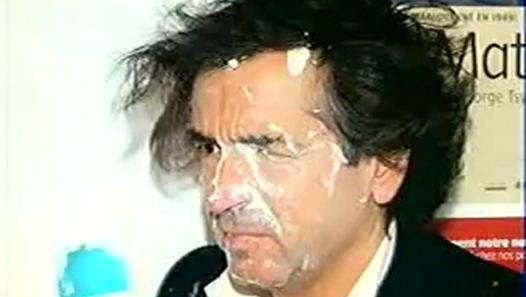
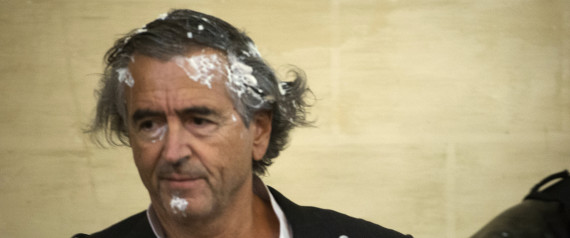
French philosopher and writer Bernard-Henri Levy looks on after being hit by a cream pie thrown by Belgian notorious pie thrower Noel Godin ahead of a discussion between Belgian artist Jan Fabre and Bernard-Henri Levy on the exhibition « Facing time. Rops/ Fabre » in Namur, on May 30 2015. AFP PHOTO / BELGA PHOTO / ANTHONY DEHEZ **BELGIUM OUT** -
Gorbatchev sur la situation mondiale
PRESIDENT GORBACHEV’S STATEMENT
At the International Climate Change Symposium
Tempio di Adriano, Piazza di Pietra, Rome
27 – 29 May 2015Dear participants,
We live in urgent times. The sum of the concurrent crises that have been engulfing everything from climate to energy, to politics and economy is creating a spiral of need for change. But climate change sticks out of this list as being an explicitly clear and present danger of existential proportions. Therefore I welcome your effort to review the linkages between climate change and world development and to examine broad lines of action to improve human wellbeing and security in the new conditions of the 21st Century. Unfortunately my health prevents me from joining you, which I regret, as the situation in the world makes this Symposium extremely timely and important.
xxxxxIn December 2015, world leaders will gather in Paris to negotiate a binding agreement to reduce global carbon emissions. It will be the twenty-first UN climate summit since 1992. Two decades of climate negotiations unfortunately have been accompanied by mounting emissions and rising temperatures. The World Meteorological Organization has pronounced 2014 as the warmest year on record for the planet. And the latest Intergovernmental Panel on Climate Change report warns that short of a “substantial and sustained” reduction in greenhouse gas emissions we will experience more frequent heat waves, droughts, storm surges, shocks to the world food supply and other extreme weather-related events.
Climate scientists say the window of opportunity for strong action on climate is rapidly closing, but that we can yet stabilize global atmospheric temperatures and put the world on a path to sustainable development. In fact Paris is the last chance to stay below 2 degrees Celsius beyond the pre-industrial temperature.
The world remains trapped on an agonizingly unsustainable development path. Economic growth, without concern for the capacities of the planet, continues to be top goal and priority. Because of that we are facing unprecedented and relentless environmental degradation, deterioration and over-exploitation of natural resources, with water, food and energy crises looming, while over a billion people are still living in extreme poverty and global inequality is clearly growing. Oxfam recently warned that the combined wealth of the richest one per cent would overtake that of the other 99 per cent of people next year, unless the current trend of rising inequality is checked.
Politics is lagging behind the transformation process. This is the main reason for the multiplying crises we face – climate, food, water, energy, and poverty. In fact we face the crisis of our developmental model.
However the international situation is becoming more complex and more worrisome. Increasing tensions on the world scene, escalating terrorism, ethnic and religious violence, reincarnation of nationalism, and the systematic violation of human rights have downgraded the sustainability agenda into almost an abstract discussion putting to a hard test not just the post-cold war order, but the future of international politics in general and pushing the world to the edge of a disaster.
There is too much at stake and the risks and threats are too great. If we fail to reverse the politics, which are driving us towards a new confrontation, all the agenda of sustainability may fall victim to this downward spiral in current politics.
The Ukrainian crisis is a symptom of the growing dysfunctionality of the existing world order. This was triggered by a failure to adjust it to new realities after the end of the Cold War. The world has been pregnant with the new order (we have discussed this with President Bush and other leaders of the West very seriously). However, these plans have been put aside by the West, which was carried away by the “victory euphoria” after the end of the Cold War. Pope John Paul II warned in 1992 that “the Western countries run the risk of seeing this collapse of Communism as a one-sided victory of their own economic system, and thereby failing to make necessary corrections in that system.”
Unfortunately after 25 wasted years, his prediction did come true as the global crisis of 2008-2009 triggered the transition to a different historical period. In essence, it clearly revealed that the gap between the world’s growing interconnectedness and its inadequate coordination capacity has created a vacuum, leaving different actors to see how far they could try and push.
The Ukrainian crisis, rooted in this asymmetry, has provoked a serious and dangerous breakdown of relations between Russia and the West.
However dramatic is the current political situation, the relations between Russia and the West should not be reduced to the Ukrainian crisis. We should take a long-term perspective; while seeking solutions to the conflict in Ukraine and ways to overcome the international fallout from the crisis triggered by the events there.
There is only one option to pursue – dialogue, search for consensus and urgent upgrading of the international governance system.Globally the “rules of the game” must be changed to stop the dangerous drift towards confrontation and to make further escalation impossible. It’s important to reformulate the international agenda and political frameworks to encourage transformative leadership. Current governance and international institutions should be upgraded fast enough to harness and channel change, instead of being overwhelmed by it.
Within Europe, the crisis can be contained by working out a common goal of long-term co-development. It must be acknowledged that Europe today is no longer the centre of the world. Its problems are part of a complex global system, where all are affected by all. Perhaps, as once the United States and Canada were made part of the European process, it’s time to think about turning the European process into a Eurasian one.
Actions of external players throughout the Ukrainian crisis invite serious criticism. Ukraine is a tragic example of a short-sighted policy of “geopolitical engineering”.
But now it badly needs our help. EU member states, and above all Germany and France, seem to have learned some lessons and are now trying, alongside Russia and Ukraine, to find ways to de-escalate the conflict. This is a positive development. Still I reiterate that the revival of dialogue between Russia and the United States is essential to peace in Ukraine, in Europe, and the entire world. The two countries have a special role to play and a special responsibility.
They are permanent and most powerful members of the U.N. Security Council and they should realize their responsibilities and cast aside expediency-driven agendas, restoring the required level of understanding and trust. The recent meeting of President Putin and State Secretary Kerry in Sochi – the first direct Russia – US political level contact in the last two years – was a step in the right direction.
And most urgently, joint and concerted efforts are needed to take Ukraine away from the brink of social and state breakdown, and to turn it into a hub of cooperation rather than a prize drawn from Russia – West competition.
The new governance architecture should provide an integrated agenda for progress on security (including the coordinated efforts to address frozen conflicts), energy, economic cooperation as well as sustainability.
It is very important to take a sober and balanced look at the situation, to be conscious of the existence of global challenges and universal human values, as well as the numerous issues that cannot be resolved without cooperation between the world’s leading powers.
This means that we have to return to the basic tenets of the new thinking, which we proposed to the world when relations between the East and the West were severely strained.
The main challenge then was to avert a global nuclear conflict. We succeeded in warding off that threat; however, the threat of a new arms race has not disappeared.
Other threats are also looming large, above all the danger of climate change. In addition, there are other global issues such as the growing shortage of fresh water, food shortages, international terrorism, cyber security, pandemics, and so on.
What is needed today is a dialogue based on the awareness of our common destiny and common exposure to new threats rather than on grievances, mutual recriminations and frustrations. We must put aside prejudices inherited from the Cold War and work together to create a new global system of responsibility, vision and solidarity.
If we are to succeed the world will require true political leadership, prophetic vision and courage, rather than an adaptive strategy of small steps, as well as revitalized multilateral governance architecture adequate to meet the interconnected challenges of the 21st century.


