Jean-Claude Marcadé
The Russian Avant-Garde Today
The term « Russian avant-garde » made its first appearance in European Marxist or Marxist-influenced circles in the 1960s. In the 1910s and 1920s the creative innovators of the Russian Empire, and then of the Soviet Union, spoke out for a « art of the left » – not in the political sense before the revolutions of 1917, but in the sense of a struggle against the conservatism of the art schools and academies. The « inventors » of the « Russian avant-garde » appellation then adopted it as a product of the October Revolution and used it to fabricate the myth of the « Twenties », an era when every success was supposedly due to the Bolshevik revolutionary impetus. During the years of the Stalinist Terror, however, this form of art was consigned to oblivion in the storerooms of the USSR’s museums, when it was not actually destroyed in the autos-da-fé of the late 1920s.[1]
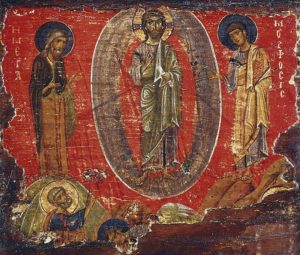
Russia’s visual arts were long the poor cousins of international art history, victims of the deep-rooted notion that while the country undeniably possessed a splendid literature, as well as music and ballet of great originality, it was not a land of painters. Some critics even went as far as damning Russian painting as no more than an imitation of Byzantine art.[2]Louis Réau’s classic book L’art russe des origines à Pierre le Grand (« Russian Art from the Beginnings until Peter the Great », 1921) was a pioneering work in many respects, but some of its overall aesthetic judgements ring false today: the author speaks, for example of the « relative inferiority of Russian art » as compared to the Western – and the Japanese and Islamic – varieties, attributing this to its « lack of outreach »;[3]judgements like these are accompanied by generalisations about the influence of soil and climate, very much in the tradition of Hippolyte Taine’s philosophy of art. Ultimately it took Paul Valéry to break with these mandatory correlations between art and things other than itself, and consider it in terms of its being, presence and specific aura. From this changed point of view the Russian art of the left of the 1910s and 1920s represented a crucial advance in the perception of the painting of icons as one of the essential loci of universal art.
Moreover, the Russian artists who were working in Paris helped maintain this notion of the absence of original painting in their homeland. As late as 1956 we could find André Salmon writing, « It has to be said that Russia has never had any visual artists apart from the craftsmen who painted icons strictly in the Byzantine tradition, and the delicious painters of signs: of the baker with his golden loaves, of the caterer with his plates of kasha, his bottle of vodka and his serviette worn like an archimandrite’s hat – when in fact there was no serviette at all; together with the popular image makers inspired by national folklore, turning out instinctive little masterpieces from which the only person who has succeeded in drawing some benefit for real art was the simultaneously, or by turns, innocent and crafty Chagal [sic], who is Jewish.
« At the age of twenty in Saint Petersburg, when early exile had left me ignorant of almost everything in French painting since Courbet, I needed no great skill to recognise this total absence of painterly genius among the Russians. »[4].
It was not until the 1960s that art historians in the West called attention to the sheer breadth of painting in Russia in the first quarter of the twentieth century, and to an art scene as original and universal as the one that had seen the flowering of the Russian schools of icon painting from the fifteenth to the seventeenth centuries. English art historian Camilla Gray’s book The Great Experiment: Russian Art 1863–1922came as a revelation in 1962.As the wife of Oleg Prokofiev, son of the composer, Gray had access to the reserves of the museums in the two Russiancapitals, as well as to private collections. Magnificently illustrated, the book made public a hitherto unknown body of innovative works by Russian artists; and at the same time it enabled its author to highlight the work of émigré Russians living in the West – mostly in France and mostly unknown – and give them a place in a common history: that of the pre-Revolutionary era and the splendid upsurge that followed. This discovery was fêted in a host of exhibitions in Germany, the United States and Japan; and the artists of the Russian Empire who were working in Paris, and whose Russo-Soviet past had been somewhat played down, now saw their « avant-garde » period brought into the spotlight. Among them were Larionov and his companion Natalia Goncharova, Kandinsky,[5]Chagall, Pougny, Pevsner etc.. It became clear that the experiments of Russia’s innovators had coincided with the bold work that had been going on in the West in the early twentieth century, actually pre-empting it in some cases and in others providing a decisive stimulus. It now became vital to tell the full truth about an avant-garde threatened by oblivion, and at the same time to get to know the circumstances that had forged it; only thus would the issues be made clear. Thus it became fashionable to display, in one way or another, a fondness for the golden age of the 1910s and 1920s in Russia and the Soviet Union.
Gray’s book caused a furore in official Soviet circles, and for more than a decade all access to the reserves at the Tretyakov and the State Russian Museum was denied. Even so, Western specialists had the chance to become better acquainted with the avant-garde through the extraordinary collection of Georgy Costakis, whose Moscow apartment, a veritable museum, remained open to visitors throughout the 1960s and up until Costakis left for the homeland of his Greek ancestors in 1977. His departure entailed leaving behind at least half his collection, now the jewel in the Tretyakov crown. The remaining 1275 pieces followed him Westwards; they were acquired by the Greek state in 1997 and are now the basis of the collection of the Museum of Contemporary Art in Salonika.[6]
Probably the first events throwing some (still very partial) light on avant-garde Russian art were the 1968 exhibition L’art d’avant-garde russe. 1910–1920, organised in Montreuil by Pierre Gaudibert, and an issue of the bilingual magazine Cimaisedevoted to the subject.[7]Limited to works available in the West, the Montreuil exhibition used photographs to round out its survey.
The 1970s were marked by a number of dazzling events instigated by Pontus Hulten, the Swedish director of the new Centre Pompidou. The Malevichretrospective, curated in 1978 by Jean-Hubert Martin, was followed by the first international colloquium devoted to the founder of Suprematism and, most notably, the monumental Paris-Moscowexhibition of 1979. He had already attracted attention with a Vladimir Tatlin show in Sweden in 1968, curated by Troels Andersen.[8]It was Hulten, too, who initiated the reconstruction of the model of Tatlin’s Monument to the Third International, based on the plans and photographs of the three earlier models built by Tatlin in his Petrograd studio with the aid of his « creative collective » (which included Sophia Dymshits-Tolstaya) between 1920 and 1925. Tatlin’s Tower, as it is also known, was famed for the violent debates it had triggered among architects, painters and politicians. A spiral ultimately meant to be higher than the Eiffel Tower, it combined some of the latter’s features with elements of traditional representations of the Tower of Babel, Geometrical Cubism and Futurist dynamism. Hanging from steel cables inside the spiral and revolving at different speeds were a cylinder, a pyramid and a cube, intended as a meeting room, exhibition space and concert hall.[9]
WithParis-MoscowHulten had succeeded where André Malraux, General de Gaulle’s minister for culture, had failed: with the help of Soviet museums he put on show a selection of the art created in the USSR during the first three decades of the twentieth century.
DespiteParis-Moscow‘s « art bazaar », holdall character, which did little to facilitate viewer reception of the Russian avant-garde,[10]it had an impact that earned the twentieth-century Russian School a place on the world art scene, especially as it was part of the series of enormous exhibitions that also included Paris-New York, Paris-Berlinand Paris 1937–Paris 1957.
Significantly, it was at the Malevich retrospective and Paris-Moscowthat Hulten revealed his discovery of all Malevich’s post-Suprematist paintings in the reserves of the State Russian Museum. He had only been able to include some of them in the Malevich exhibition, but he emphasised their importance. One of the dominant – and dogmatic – critical approaches of the time was that of American art critic Clement Greenberg, who saw this return to the figurative as « reactionary ». Rejecting this judgement, Hulten spoke of « an inspired, visionary art » indicative of « total independence and freedom » and « the fundamental importance of artistic creation and its autonomous power over supposedly logical and teleological theory. »[11]
There had not been an exhibition on this scale in the West or the USSR since 1922 and the famous Soviet exhibition at the Van Diemen gallery in Berlin.[12]The Russian avant-garde was still present, albeit to a lesser extent, in the USSR pavilion at the 1924 Venice Biennale, which featured the three fundamental Suprematist images – Black Square, Black Crossand Black Circle– accompanied by five of Malevich’s spatial architecture drawings: the planitsor space houses. The same exhibition included the first European appearance of the Organicist School, with works by Matyushin and his disciples Maria, Xenia and Boris Ender. Similarly in Paris in 1925, the International Exhibition of Modern Industrial and Decorative Arts created a significant but unfortunately short-lived stir with its highlighting of Constructivist architecture: the Soviet pavilion was built by the Constructivist master Konstantin Melnikov, and Rodchenko presented his celebrated « Workers’ Club ». The theatre sets and costumes triumphed – with Yakoulov and Meller receiving first prizes – as did all the applied arts: textiles, clothing, ceramics, display stands, kiosks, posters and books.[13]
But to come back to Paris-Moscow: it needs to be pointed out that for this exhibition and other, similar ones up until the collapse of the USSR in 1991, contributions by Soviet museums involved negotiation and ideological compromise, with French curators who wanted to show masterpieces by the « Russian avant-garde » finding themselves forced to submit to the bargaining demands of Soviet officials: you want Malevich, Kandinsky, Chagall, Lyubov Popova? – okay, but you also have to take the Socialist Realists BorisIoganson, Grekov, Plastov, Laktionov, the Kukrinskys and so on. Even so, the 1980s saw a series of exhibitions highlighting the unique contribution of avant-garde art from Russia and the Soviet Union, in London,[14]New York,[15]Los Angeles,[16]Budapest and Vienna.[17]
At the beginning of the 1990s the Centre Pompidou organised the world’s first retrospective of the great artist Pavel Filonov, whose concept of painting went directly counter to that of the Russian avant-garde: contrary to the tendency towards minimalism and extreme reduction of figurative elements – which were totally eliminated in Malevich’s Suprematism – the « Analytic Art » of Filonov and his school aimed at an uncompromising, atom by atom, saturation of the picture surface. Probably the most Russian of all the practitioners of his country’s art of the left, Filonov was greeted with bafflement by French critics and the French public. Doubtless there should have been greater contextualisation and explanation of the total, multivocal specificity of Filonov’s theoretical approach, imagery and polysemy. His magnificent Formula of Spring, included in this exhibition, is an absolute masterpiece that sums up all its creator’s splendid implexity. The « atomistic » technique of its finish, and of the relentless work on each tiny section of the canvas, shows the work’s gradual construction in wave after wave of microcosms drawn-painted with incredible meticulousness until a new, macrocosmic organism takes shape. The « painterly rain » of Formula of Springis that of light-hatching, of universal colour-hatching, to borrow from some of Filonov’s titles. Matyushin was the first to decipher his ever-enigmatic creativeness, and the following brief passage provides a key to seeing and understanding Filonov’s pictures:
« Filonov’s style-texture is astonishing both in its variety and its method of combining areas of thick impasto with others laid in so subtly that they almost vanish into the air, strangely, while at the same time form is condensed or deployed with incredible vigour and boldness. The old masters could only have dreamed, maybe, of such colossal technique, but their tasks and their means were different . . .
« Filonov understands movement not as included in the visible periphery of things, but rather as going from the centre outwards, and vice versa . . .
« This is not cerebral analysis, but the intuitive deduction of a clairvoyant able, thanks to his stunning mastery, to disentangle the Threads of Fate of the Norns. »[18]
The collapse of the USSR in 1991 cleared the way for numerous exhibitions which, by drawing extensively on the collections of the Tretyakov Gallery and the State Russian Museum, clarified and broadened our knowledge of the historical sequence of artistic innovations. In 1992, for example, Frankfurt welcomed a huge ensemble of paintings, sculptures and examples of the applied arts: theatre sets, industrial design, posters and photographs. This was a kind of variation on Pontus Hulten’s Paris-Moscow, but this time freed of all the politico-ideological constraints and thus well structured and more comprehensible. The exhibition in question was The Great Utopia: The Russian Avant-Garde, 1915–1932, which later travelled to Amsterdam and New York.[19]
« The Great Utopia » was a direct reference to « O Velikoi Utopii », a brief article written by Kandinsky in 1920, in which the author of Concerning the Spiritual in Artputs forward the « utopian idea » of an international art congress for which « one would have to mobilise, apart from the three arts already mentioned [painting, sculpture, architecture], all the others: music, dance, literature in the broad sense, and poetry in particular, as well as theatrical artists from all branches of the theatre, including the intimate stage, variety, etc., right up to the circus. » The result of this « Congress of Representatives of All the Arts of All Countries », Kandinsky hoped, would be « the building of an international house of art » which « would have to accommodate all branches of art . . . but also those which have existed and which exist only in dreams – without any hope of these dreams ever being realised. »[20]
The Die große Utopieexhibition helped shore up the myth, widespread among Western critics, that in a way the Russian avant-garde, in what had become the Soviet Union, had failed to fulfil its aspirations, and that this utopianism was conditioned by the Marxist-Leninist political utopia and its monstrous outcomes. I have already pointed out elsewhere the inexactness and skewed perspective of this myth of a utopia.[21]The « utopian » project of this art of the left was in fact directed towards the world to come, which means, in these early years of the twenty-first century, that the huge formal, intentional and conceptual reservoir created by the avant-gardists has not been drained and remains a fertilising influence for art forms including choreography,[22]architecture[23]and even fashion.[24]
The other historiographical myth regarding the Russian avant-garde of the early twentieth century is that of the « Twenties », mentioned at the beginning of this article. In a way the Great Utopiaexhibition in Frankfurt set out to reinforce this view of things. The choice of dates is far from innocent, tending as it does to make the history of Russia’s art of the left begin in 1915 – a year which did, it must be said, see the appearance on a massive scale of a new art form: Tatlin’s pictorial reliefsand counter-reliefs(at the Tramway Vexhibition) and Malevich’s Suprematism (at the 0. 10 exhibition). And before 1915? Can one really not know that L’Année 1913(« The Year 1913 »), the three-volume work edited by Liliane Brion-Guerry in the early 1970s, demonstrates that when the War of 1914–1918 broke out, virtually all of the radical innovations had already taken place – completely or embryonically – and that the developments to come only added to the formal notions of the first half of the 1910s?[25]
I should point out here that I was one of the first, if not the first, to demonstrate the flimsiness – not to say the outright erroneousness – of the « Twenties » myth.[26]Let us not forget that in less than a decade – that of the « Nineteen-Tens » – all the recent artistic codes (Impressionism, Post-Impressionism, Cézannism, Fauvism, Primitivism, Cubism, Italian Futurism) had been assimilated in Russia; and that the totally new pictorial cultures that emerged remain even now, as I have already emphasised, a continuing source of ways of apprehending reality: the Neo-Primitivism of 1907–1909; Cubo-Futurism (1912–1914); Larionov’s Rayonism (1912–1913); Suprematism (1913), including the scenery forMatyushin’s sets for theopera Victory Over the Sun, in which Malevich’sblack squareappears in the gravedigger’s costume; Tatlin’s « pictorial reliefs » (1914); Filonov’s Analytic Art, outlined in his « Made Art » manifesto of 1914; and the Organicism of Matyushin and his wife Elena Guro, who died in mid-1913. The first rooms of the Grimaldi Forum exhibition cover these trajectories and the movements associated with artists who are among the greats of the century: Larionov, Malevich, Tatlin, Filonov, Yakoulov, and the astonishing, unique series of women painters that included Natalia Goncharova, Alexandra Exter, Olga Rozanova, Lyubov Popova and Nadezhda Udaltsova.
What emerges from all this is that it was not the sociopolitical revolution that sired the avant-garde in Russia and Ukraine, but rather, as Malevich asserted, the artistic revolution which, while it did not sire the social revolution, prefigured it.
This is not to say that the « Twenties » do not represent a glorious moment in the history of the arts. One of the great « merits » of this era of radical sociopolitical revolution is that it gave unexpected resonance to the avant-garde revolution of the pre-Revolutionary years; all the more so in that progressive movements all over the world were dutifully looking to the October Revolution as a driving force for every kind of avant-garde audacity. In reality, though, relationships between the authorities and avant-garde artists were never harmonious, even under People’s Commissar for Education Anatoly Lunacharsky, a writer and Marxist-influenced thinker. Lenin himself preferred Gorky’s poetics to Mayakovsky’s and, in the visual arts, the committed realists of the nineteenth century to the « Futurists » – the blanket term for the miscellaneous avant-garde movements. After five years of tolerance and relative freedom, in 1922 the Communist Party took up arms against the « art of the left » whose aesthetic was declared « bourgeois » because it had taken shape during the « imperialist era ». This latter term was used to designate the avant-garde works on show in the State Russian Museum in Leningrad, directed by art historian Nikolai Punin; a self-declared « Communist-Futurist » alongside Mayakovsky in 1919, Punin would have to capitulate to the prevailing Stalinist diktats by 1925–1926. In March 1922 this shift by the Communist Party found expression in the formation of the Association of Artists of Revolutionary Russia (AKhRR, 1922-1932), the most virulently anti-avant-garde of all the artistic-political organisations. The association and the eleven exhibitions it organised were the source of the dogma of « socialist realism », whose basic concept would be laid down by Gorky at the First Congress of Soviet Writers in 1934.
And yet the « Twenties » saw the birth, in 1921–1922, of the last historic European avant-garde movement: Soviet Constructivism. Rodchenko shattered the age-old precepts of sculpture with his constructed objects – his rectangular, spherical and vertical Spatial Constructionson stands, and hisHanging Spatial Constructionssuspended on wires from the ceiling – which comprised triangles within triangles, hexagons within hexagons, quadrilaterals within quadrilaterals, circumferences within circumferences and ellipses within ellipses. In these two types of sculpture, shown at the Society of Young Artists (OBMOKhU, 1921–1923) in Moscow in May 1921, we can see precursors of Calder’s stabiles and mobiles, first shown in Paris ten years later. In January 1922 three OBMOKhU artists, Konstantin Medunetsky and the brothers Georgy and Vladimir Stenberg, presented their Constructivistsexhibition in Moscow – the first public use of the term. It had been preceded in September 1921 by 5 x 5 = 25, a manifesto exhibition by recognised avant-garde painters Varvara Stepanova and her husband Rodchenko, Alexandra Exter, Lyubov Popova and Alexander Vesnin. The pieces on show owed nothing to easel painting, being in fact the preliminaries to spatial constructions and productivist art. The « death of the picture »[27]– the end of all « contemplative » art, and the concomitant proclamation of the advent of « active » art – led to artists turning en masse to the designing of constructed theatre sets. Art was now intended to serve technology and industry. Strictly speaking, it could even be said that there was no such thing as « Constructivist painting », Constructivism having emerged in opposition to easel painting. « Composition » was replaced by « construction », the picture by « spatial forms » and the artist by the « engineer » or « constructor », the aim being a radical transformation and modelling of the human environment. Such was the self-set task of Constructivism’s practitioners in the 1920s.
At the same period two major schools of the Russian-Soviet art of the left were developing: Matyushin’s Organicist School (1918–1934) and the Masters of Analytic Art, revolving around Filonov (1925–1933). Opponents of the Futurist cult of the machine, Matyushin and his circle stressed the organic and indissoluble nature of the reciprocity between man and nature. This led them to set up the Zor-Ved (Seeing and Knowing) research centre, where Matyushin’s ideas on expansion were implemented and tested out through everyday visual functioning. This « new perception of space » – this « expanded vision » – was a « deliberate act aimed at unifying not only the eye’s central vision, but also the vision of the peripheral areas. » The goal of these experiments was to activatevision, to cause it to develop its existing receptive capacities and discover a new organic substance and rhythm in the apprehension of space. A striking feature of Xenia Ender’s work is the unmistakable analogy between the divisions within her images and the cellular poetics of the work of Serge Poliakoff thirty years later. When Georgy Costakis showed visitors Ender’s pictures in his Moscow apartment, he never failed to point out this similarity.[28]
The collapse of the USSR in 1991 brought a worldwide avalanche of exhibitions, an impactful early example being curator Henry-Claude Cousseau’s The Russian Avant-Garde 1905–1925: Masterpieces from Russia’s Museums, at the Musée des Beaux-Arts in Nantes in 1993. Cousseau’s tour de force consisted in bringing together unknown masterpieces from the reserves of museums in the Russian Federation’s provinces: from Astrakhan, Yaroslavl, Ivanovo, Nizhny Novgorod, Nizhny Taghil, Ufa, Samara, Simbirsk, Slobodskoy and Tula. In doing so Cousseau offered the French public access to hitherto unseen works by artists like Kandinsky, Malevich, Larionov, Natalia Goncharova, Alexandra Exter, Olga Rozanova, Lyubov Popova, Varvara Stepanova and Ivan Kliun. Thus the exhibition represented a significant addition to our knowledge of this innovative current, and all the more so in that it included artists – among them Sofia Dymshits-Tolstaya, Mikhail Le Dentu, Alexei Morgunov and Polish painter Władysław Strzemiński – who had not yet found their place in art history.
France, though, would have to wait another ten years for a comparably impressive exhibition of the art of the left in Russia and the Soviet Union: Jean-Louis Prat’s Russia and the Avant-Gardesat the Maeght Foundation in 2003. Rather than a summary of what was already known about artistic events in Moscow and Saint Petersburg/Petrograd/Leningrad, this was a totally original overview of the historic avant-garde of the 1910s and 1920s, now an integral part of the global art landscape. It included works never shown in France before, among them Filonov’s extraordinary Formula of Spring, an unqualified masterpiece and a splendid summary of its creator’s « analytic art ». The Grimaldi Forum has had the good fortune to be able to show this work, which almost never leaves the State Russian Museum in Saint Petersburg because of its size and the transport problems it poses.
The Maeght Foundation exhibition also presented, for the first time in France, Black Square, Black Crossand Black Circle. I wrote of them at the time that Jean-Louis Prat had displayed these fundamental forms of Malevich’s Suprematism « like an introductory and closing chord. » This minimalist trilogy revealed the supremacy of Nothingness, of the objectless, and of colour emanating not from the sun, but from the depths of this objectlessness. The coloured surface « kills the subject », leaving manifest only the movement of its coloured forms. While black and white are « the energies that unveil form », the painter would also use polychromy to point up the quadrilaterals which, like planets, are suspended at the heart of the white ground of infinite space.
Beginning in 1920, as flat Suprematism evolved towards architectonic Suprematism, the « Suprematist straight line » came to the fore. In Berlin in 1927, in the film Malevich was working on with Hans Richter, this « volumetric straight line »[29] »is compressed into a square » and forms « two colonies »: « a cruciferous colony » which, « through spinning, forms a circle. » The Black Squareis systematically the base of the development – via the stage of « Suprematist volumo-construction objects »[30]– towards what Malevich calls architectony. Out of the extension of the square through a horizontal and a vertical plane intersecting perpendicularly, comes the Black Cross, whose spinning gives rise to the Black Circle. The Black Circlethen becomes the culmination of the movement of the Universe – of « cosmic thought ».
Jean-Louis Prat’s exhibition also revealed, for the first time in France, the painting of Matyushin and the Enders. As I see it, this presentation of the avant-garde definitively cut the ground from under the one-sided sociopolitical interpretation of Kandinsky’s spiritual concept of the Great Utopia. It did so simply by foregrounding one of the apogees of human creativity, a miraculous moment in the history of art: the combination of a vigorous primitivism, a radical abstraction (objectlessness) founded on the energy of colour, robustness of formal composition, and an unrivalled rightness of conception.
Among the many major exhibitions in Europe between 2003 and 2015, I shall briefly mention three: Kazimir Malevich: Suprematismus (Berlin/New York/Houston, 2003–2004), curated by Matthew Drutt; La Russie à l’avant-garde, 1900-1935(Brussels, 2005–2006), curated by Evgenia Petrova and Jean-Claude Marcadé; and Kazimir Malevich and the Russian Avant-Garde: Featuring Selections from the Khardziev and Costakis Collections(Amsterdam, 2013–2014), curated by Bart Rutten et al. Matthew Drutt’s exhibition offered for the first time the most exhaustive possible coverage of Suprematism as radical abstraction.[31]For the Brussels exhibition Evgenia Petrova opted in both Russian and English for the title The Avant-Garde: Before and After: this enormous grouping of 400 works was intended not only to retrace the trajectory of the art of the left in Russia and the Soviet Union, but also to interconnect the avant-garde’s forms of radicalism with what had preceded them (in particular Symbolism and Art Nouveau) and what had followed (Post-Suprematism, the late works of Filonov, the romanticism of Alexander Samokhvalov). The third – magnificent – exhibition, in Amsterdam, included the Stedelijk Museum’s extensive Malevich holdings, together with many previously unshown works from the collection of the great historian of Soviet art, Nikolai Khardzhiev, who had died in exile in Amsterdam.[32]
Now, at the Grimaldi Forum, we find Jean-Louis Prat taking up the same challenge as just over ten years ago at the Maeght Foundation. And doing so not only with a host of absolute, « must see » masterpieces, but also with new or rarely shown works. Among the latter are the imposing sculptures by Baranov-Rossiné, which round out our knowledge of the reliefs this Russian-Ukrainian artist produced around 1913–1915 (Symphony No. 1from MoMA, Counter-relief(conventionally named « Disabled Artist »)from the Wilhelm Lehmbruck Museum in Duisburg, and Toreadorfrom a private collection in Paris). There is, too, Tatlin’s Blue Counter-Relief, one of the very rare constructions from the period to have survived the vicissitudes inflicted on the avant-garde by the Communist authorities. Of Blue Counter-Reliefthe great Russo-Soviet specialist Anatoly Strigalev has written, « This relief is an especially clear example of the ‘choice of materials’ method, at a time when the immediate constructional tasks were still completely ancillary to the plastic ones. This work exactly matches Tatlin’s ideas during the period, limited to 1914, of his ‘pictorial reliefs’. »[33]Still with regard to the rarities, I should like to mention a Rayonist picture by Alexander Shevchenko, mainly known for his geometrical primitivist Cézannism. This painting comes from the Museum of Fine Art in Perm, in the Urals, where Serge Diaghilev spent the first twenty years of his life. Rayonism, as we know, was one of the very first non-figurative approaches to appear between late 1912 and 1914. It consisted in interpreting reality through a cluster of coloured rays which illuminate the figurative elements from within and thus transfigure them. Rayonism was invented and theorised by Larionov and his companion Natalia Goncharova, who remain its best-known exponents, but it had other practitioners whose work is little known, and the « discovery » of Shevchenko’s Rayonist painting is a valuable addition to the canon. We also find here Rodchenko’s Abstraction (Rupture), from the Costakis Museum, rarely shown because it was painted in late 1920 and does not jibe with its creator’s advance towards constructed art. For while he was developing the « linearism » that was the basis of Soviet Constructivism, Rodchenko was also working on a series of non-constructed works, some of them « cosmic » and others verging on an abstract, lyrical-Expressionist poetics. This approach offers a fit with one of Jean-Louis Prat’s curatorial characteristics: an imperious challenging of the viewer with contrasts driven not by any urge to astonish, but by the certainty that seemingly contradictory poetics can fuse in their quest for essential rhythms. Prat’s intentions are less didactic (in the historical sense) than aesthetic. Thus for him the Russian and Soviet avant-garde is a model of energy profusion which, without discounting the topical backdrop, allows him to play on the visual faculties by stressing the dynamics of form and colour emanating from the objects portrayed. There is, of course, a degree of subjectivity in this kind of approach. But as the Romans used to say, quod licet Iovi non licet bovi. This grounding, depth and solidity of experience and culture ensure a carefully honed sensibility.
From this point of view the choice of the title From Chagall to Malevich may surprise, given that these two great artists seem to be at opposite poles in their concept of painting and their Kunstwollen. Chagall and Malevich have even fewer points in common than Matisse and Picasso, who exist, as a previous exhibition convincingly demonstrated – as if it were necessary – in the absolute irreducibility of their respective poetic-picturological drives. A Picasso reclining nude is subjected to a surgical operation that transforms it from a « tableau vivant » into an example of pure painterly expression. A Matisse reclining nude is subjected to a calligraphy of its contours, which, even when they are deformed or simplified, retain the mellow roundedness of the living model. Chagall and Malevich both addressed subjects taken from provincial life. The latter’s powerful primitivism of 1911–1912 transfers people and things from the sociopolitical context of their time into the zone of the timelessly paradigmatic exemplified here by MowerorReaper. Chagall, in his portrayals of the exotic world of the shtetlsof Belarus, emphasises illuminations, in both the everyday and the Rimbaud-inflected sense.
Chagall’s and Malevich’s primitivist alogicality – one might call it their « pre-Surrealism » – also expresses this polarity. Chagall’s picturology brings out the subject’s expressiveness by accentuating and even exaggerating the figurative elements; making them « grimace », the better to capture their singularities. Malevich, on the other hand, offers a juxtaposed jumble of figurative elements, frequently incongruous and arranged in a totally unorthodox, hieratic fashion that stands reality on its head.
Nonetheless the Chagall-Malevich pairing can seem justified, if for no other reason than their joint presence in 1919–1920 at the Vitebsk Fine Arts School, famously founded by Chagall himself in his home town. In a letter of 2 April 1920 to the Russian-Polish art critic and collector Paweł Ettinger, Chagall mentions the existence of two groups: « 1) the youngsters linked to Malevich and 2) the youngsters linked to me. Both of us are identically making our way towards the art of the left circle [i.e. the « avant-garde »], while having different opinions of the aims and methods of this art form. » The crucial decision was ultimately taken by Chagall’s own pupils, for the most part Jewish teenagers: on his return from a trip to Moscow in May 1920 they informed him that they were leaving him and joining Malevich’s Suprematist UNOVIS (« The Champions of the New Art »).
The Chagall-Malevich comparison, like the one already mentioned between Picasso and Matisse, raises the issue of the « interplay of influences » in the creative process of each. We see Picasso endlessly incorporating, engulfing and recasting figurative elements from painterly practices other than his own, including Matisse’s. Matisse, meanwhile, imperturbably followed his own creative line, never letting himself be led astray and never borrowing anything at all except the exhilaration of painting. Great creative figures – I am thinking here of Wagner in music and Kandinsky in painting – have drawn on the work of their contemporaries without diminishing their own originality. Chagall had no qualms about using figurative elements from other pictorial cultures of his time and bending them to his own purposes. Malevich, though, even if decisively prompted sometimes by Natalia Goncharova, Larionov, icons and Russian popular art as a whole, never directly included elements from elsewhere; he always recreatedthese influences in images for which it would be difficult to find exact models.
One of the real highlights of the exhibition is the complete set of murals Chagall painted for the lobby of Alexei Granovsky’s[34]Jewish Art Theatre in Moscow immediately after leaving Vitebsk in 1920. Many of these works bear the aesthetic stamp of Malevich’s Suprematist innovations. Initially sprung from the pen of the great Russian-Ukrainian Yiddish writer Sholem Aleichem, the figures – fairground entertainers, acrobats, violinists, exotic creatures and animals – move through settings made up of geometrical strips and Suprematist circles. The most extraordinary example of this Suprematist pervasiveness is the panel Love on Stage, from the Tretyakov Gallery in Moscow, which pushes pictorial dematerialisation to its outer limits.[35]Never again would Chagall resort to the Cubo-Futurist or Cubo-Suprematist systems. The Chagall-Malevich skirmish in Vitebsk was brief (1919-1920) but electrifying.
This exhibition at the Grimaldi Forum Monaco is proof that Chagall was not, as André Salmon would have it, the only artist to draw successfully on the enormous arsenal of vigorous, expressive forms offered by the popular arts of the Russian Empire. Its title –From Chagall to Malevich: The Revolution of the Avant-Garde – says exactly that.
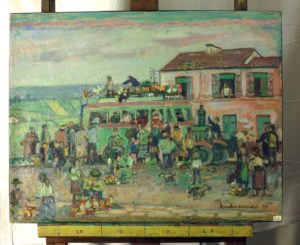
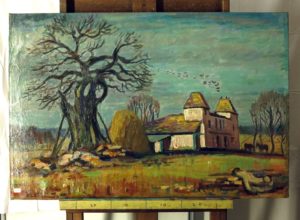
[1]Decisions to destroy works of art on the grounds that they were valueless were taken by special committees. There was one such committee at the Tretyakov Gallery, but liquidations took place in several other USSR museums. To my knowledge no study of this subject has yet been made. We do know, however that Malevich’s Guitaristdisappeared from the museum in Samara and that some ten of the fifteen Cubist paintings by Andreenko in the museum in Lviv were destroyed.
[2]I recall a lecture at a seminar organised by Pierre Francastel at EHESS in Paris, in which the eminent Soviet art historian Mikhail Alpatov raised the issue of Byzantine and Russian art with regard to the painting of icons. Alpatov said that anyone who could not see in these two forms identical but dissimilar modes of expression made him think of someone who could not tell Bach from Mozart.
[3]Louis Réau, L’art russe, des origines à Pierre le Grand(Paris, Laurens, 1921), p. 14.
[4]André Salmon, Souvenirs sans fin. Deuxième époque (1908-1920)(Paris: Gallimard, 1956), p. 228
[5]Even in the 1960s Nina Kandinsky preferred to refer to her husband as « European » rather than « Russian ». And at the Hermitage the imposing Composition VIwas exhibited as part of the « German School ».
[6]The most comprehensive account of the Costakis Collection as a whole is Angelica Zander Rudenstein’s The George Costakis Collection: Russian Avant-Garde Art(New York, HarryN. Abrams, 1981).
[7]Cimaiseno. 85-86, February-March-April-May 1968, included « The Situation of the Avant-Garde in Russia » by Michel Hoog; « Malévitch the Misunderstood » by Miroslav Lamač; articles on Pevsner, Pougny, « From Russian Futurism to the Morrow of October by the Voice of Maïakovsky », and « The Architectural Revolution in the USSR from 1921 to 1932 » by Michel Ragon, together with an introduction to the « unknowns » Mansouroff, Yakoulov and Baranoff-Rossiné.
[8]See Troels Andersen (ed.), Vladimir Tatlin, exhibition catalogue (Stockholm: Moderna Museet, 1968).
[9] Cf. Jean-Claude Marcadé, « La Tour à la IIIème Internationale », in L’Avant-garde russe. 1907–1927(Paris, Flammarion, 2007), pp. 252–260.
[10]I refer the reader to my review « The International Exhibition ‘Paris-Moscow’: The Problem of Reception and Museography of Russian Art in the West », in Hans-Jürgen Drengenberg (ed.), Art in Eastern Europe in the 20th Century(Berlin: Arno Spitz, 1991), p. 389.
[11]Pontus Hulten, « L’idée d’avant-garde et Malévitch, homme de ce siècle », in Malévitch(Paris: MNAM, 1978), p. 8. At the International Malevich Colloquium I emphasised the power and enduring character of these works and a return to the figurative that was totally unexpected given the European climate of the famous « return to order » of the late 1920s and early 1930s. The post-Suprematist paintings, I said, heralded a new figuration. See Jean-Claude Marcadé, « Allocution d’ouverture », in Malévitch. Actes du Colloque international tenu au Centre Pompidou (Lausanne; L’Âge d’Homme, 1979), p. 10.
[12] See Moskau-Berlin. Erste russische Kunstausstellung: Berlin 1922: Galerie van Diemen & C°(Cologne: W. König, 1988); and Helen Adkins, « Erste russische Kunstausstellung », in Eberhard Roters et al. (eds.), Stationen der Moderne(Berlin: Berlinische Galerie, 1988), pp. 185–215.
[13]For a sound overview of the International Exhibition of Modern Industrial and Decorative Arts, see the special issue of Waldemar George’s magazine L’Amour de l’Art, no. 10, October 1925.
[14]Abstraction: Towards a New Art, The Tate Gallery, 1980
[15]An exhibition of the Costakis Collection at the Solomon R. Guggenheim Museum, 1981-1982.
[16]The Avant-Garde in Russia 1910–1930: New Perspectives, County Museum of Art, 1986. Stephanie Barron, co-organiser of the exhibition with Maurice Tuchman, visited my wife Valentine and myself in Paris to ask us to contribute to the catalogue. When she named Ermilov as one of the exhibitors, we remarked in surprise, « But that’s not the Russian avant-garde, that’s the Ukrainian avant-garde! » To which she replied, « Is there such a thing as a Ukrainian avant-garde? » The upshot was the article Valentine Marcadé, »Vasilii Ermilov and Certain Aspects of Ukrainian Art of the Early Twentieth Century » on pages 46–50 of the catalogue.
[17]The coming of perestroika brought to light hitherto unknown masterpieces. See the exhibition catalogueKunst und Revolution. Russische und Sowjetische Kunst 1910–1932(Vienna: Vertrieb, Gesellschaft fur Österreichische Kunst,1988).
[18]Mikhail Matiouchine, « La création de Pavel Filonov » [1916], in Continent, no. 1 (Paris: Albin Michel, 1989), pp. 168–169.
[19]See the catalogue, The Great Utopia: The Russian and Soviet Avant-Garde, 1915–1932(New York: The Solomon Guggenheim Museum, 1992).
[20] Kenneth C. Lindsay and Peter Vergo (eds.), Kandinsky: Complete Writings on Art, (New York: Da Capo, 1994), pp. 444-448, 464.
[21] Jean-Claude Marcadé, « Utopisme ou prophétisme? », in Jean-Louis Prat(ed.),La Russie et les avant-gardes(Saint-Paul de Vence: Fondation Maeght, 2003), pp. 237–245.
[22]I am thinking, among other examples, of Decouflé’s choreography for the Winter Olympics in Albertville in 1992, and of the specific references to the Russian avant-garde at the splendid Sochi Winter Olympics in 2014.
[23]There seems to me to be a strong Suprematist influence in contemporary Japanese architecture; likewise, in many buildings by Frank Gehry– in particular the Bilbao Guggenheim – we find decisive stimuli traceable back to Tatlin (especially the Monument to the Third International) and the Constructivism of Pevsner and Gabo.
[24] The mathematician Etienne Ghys, in an extremely knowledgeable talk on « geometry and fashion » given in Lyon on 14 November 2014 (see dailymotion.com, « La géométrie et la mode avec Étienne Ghys »), cited among other examples Issey Miyake’s « developable dresses » and, from the art world, Antoine Pevsner’s sculpture Developable Surface, now in the Peggy Guggenheim Collection in Venice.
[25] Liliane Brion-Guerry(ed.), L’année 1913. Les formes esthétiques de l’œuvre d’art à la veille de la première guerre mondiale, 3 vols. (Paris: Klincksieck, 1973). See also Duccio Colombo and Caterina Graziadei (eds.), L’Anno 1910 in Russia(Salerno: Europa Orientalis, 2012).
[26]See, for example, Jean-Claude Marcadé, Le Futurisme russe 1907–1917: aux sources de l’art du XXème siècle(Paris: Dessain & Tolra, 1989).
[27] Emblematic of this « putting to death » of traditional painting were the three Rodchenko paintings shown at the 5 x 5 = 25 exhibition, each a primary-coloured monochrome: Pure Red Colour, Pure Yellow Colourand Pure Blue Colour. Red, yellow and blue would seem to represent the degree zero of painting as the colours that are the simplest, the least variable, the purest, and also the only ones that the retina can perceive quintessentially. At the same time they are the most neutral and thus open to repetition. This entails, as Varvara Stepanova wrote, the destruction of « the sacred value of the artwork considered as something unique ». Rodchenko’s three monochromes can also be seen as a Duchamp-style act, but his annulling of easel painting does not signify an annulling of the painterly, of which the picture is only one, historically outdated incarnation. Duchamp’s act, by contrast, was intended to replace painting with products resulting from a conceptually inflected decision. [28] It is not impossible that the young Poliakoff, who was twenty-four when the work of Matyushin and the Enders was first shown in the West – at the Venice Biennale of 1924 – actually saw these pictures, and that the event remained buried in the depths of his visual memory. The ways of creativity are inscrutable…
[29]Kazimir Malevich, « Lettre de Malévitch à la rédaction d’Architecture contemporaine » [1928], in Écrits(Paris: Allia, vol. 1, to be published in October 2015), p. 407.
[30]Ibid. This term is clarified and expanded on in Patrick Vérité, « Malevič et l’architecture. À propos des ‘objets-volumo-constructions suprématistes’ », Les Cahiers du Mnam, no. 65, autumn 1998, pp. 39–53
[31]This is the only chance the West has had to see the famous black Quadrangleof 1915 (and then only at the Guggenheim in New York), which had vanished into the reserves of the Tretyakov Gallery in 1920, resurfaced there in 1991 and stayed there, having been judged untransportable. See Matthew Drutt, Kazimir Malevitch : Suprematism(New York: Guggenheim Museum, 2003).
[32]See Geurt Imanse and Frank van Lamoen, Russian Avant-Garde: The Khardzhiev Collection(Amsterdam: Stedelijk Museum, 2013).
[33]Anatoli Strigalev, « Les Reliefs picturaux de Vladimir Tatline: Le Contre-relief bleu« ,Connaissance des Arts, no. 498, September 1993, p. 83.
[34]See Béatrice Picon-Vallin, Le théâtre juif soviétique pendant les années vingt(Lausanne: L’Âge d’Homme, 1973).
[35]See Benjamin Harshav, « Note sur l’ Introduction au Théâtre juif « , in Marc Chagall. Les années russes. 1907–1922, catalogue of the exhibition curated by Suzanne Pagé et al., (Paris: Musée d’Art Moderne de la Ville de Paris 1995), pp. 200–217.